
4 Ways Monetize AI Agents in 2026
Creators Economy Behind AI Agent

One week. $5,000 in annualized revenue. That’s what creator Tom Kuegler got after launching a small AI bot that gives feedback in seconds. So, creators are no longer just selling knowledge.
Let’s say it right away — there’s a big difference between using AI and selling something AI-powered people actually want.
And, really, most creators are still on the first step. They use AI to write faster, research faster, edit faster, repurpose faster. Are you happy with that? Maybe. But not for long. The real opportunity in 2026 sits one layer above that. It’s about packaging your expertise into something that can do useful work on demand.
That is what agents change.
The new era. How creator monetization is changing nowadays
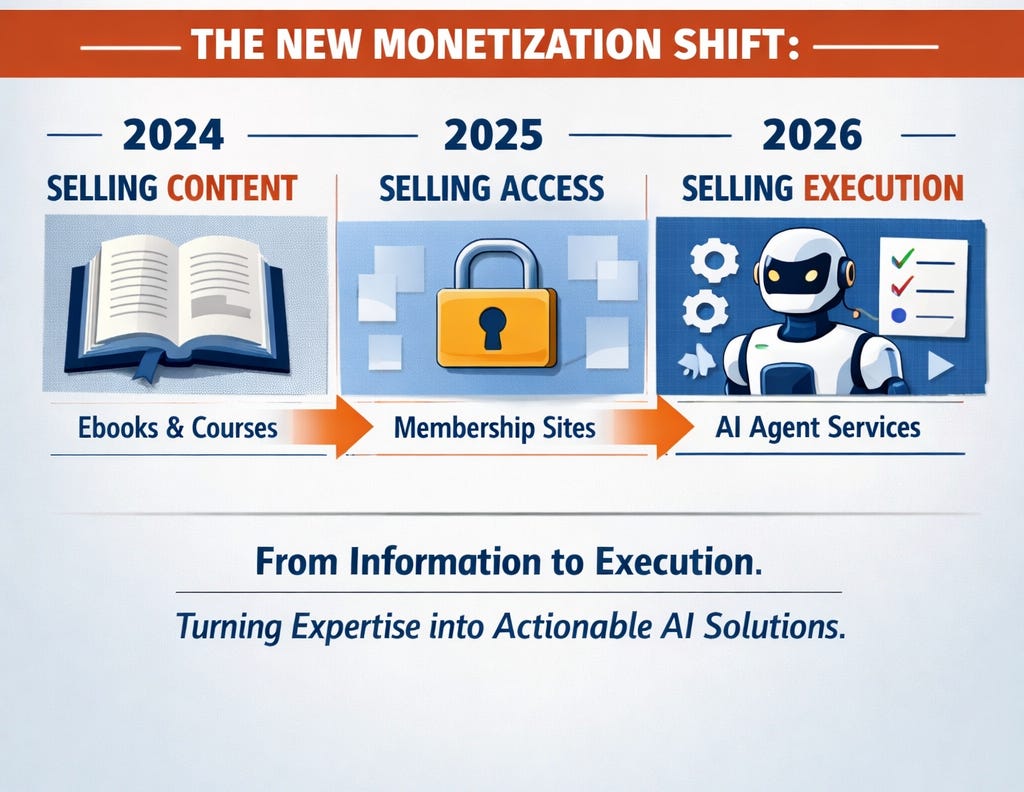
In 2024, creators sold content.
In 2025, creators sold access.
In 2026, the strongest ones are starting to sell executions.
That is the leap.
- An ebook gives information.
- A course gives structure.
- A community gives accountability.
- An agent gives labor.
That one difference changes the economics.
The old content funnel was built around teaching. The new one is increasingly built around utility. The most interesting creator businesses now are similar to tiny software companies built around trust. Or a very specific job to be done.

Subscribe for more creator’s breakdowns!
Four monetization models that actually fit creators
Let’s continue. So the real question now is different than it was recently: what part of my expertise can become a repeatable paid action?
Once you ask that, the whole business model gets clearer!
So here’s all four most important models for the creator in 2026.
Model 1. Paid access to a niche agent
This is the cleanest model. The point is that the creator takes one repeated audience pain point and wraps it in a simple promise. So, “give me the input, get the result”.
That can look the same as a newsletter growth agent that suggests good headlines. Or:
- A dating advice bot trained on a creator’s framework.
- A brand brief agent for small businesses.
- A research assistant for B2B writers.
- A sponsor-fit agent for media operators.
This model works best when buyers already trust the creator’s taste. Or maybe a specific method. The monetization is straightforward too!
One of the clearest proof points came from creator Tom Kuegler, who built “The NoteSmith,” a bot that gives feedback on Substack Notes in seconds. In his own write-up, he says 200 people tried it, multiple users bought his paid tier to keep access, and the product reached $5.000 in annualized revenue in its first week.
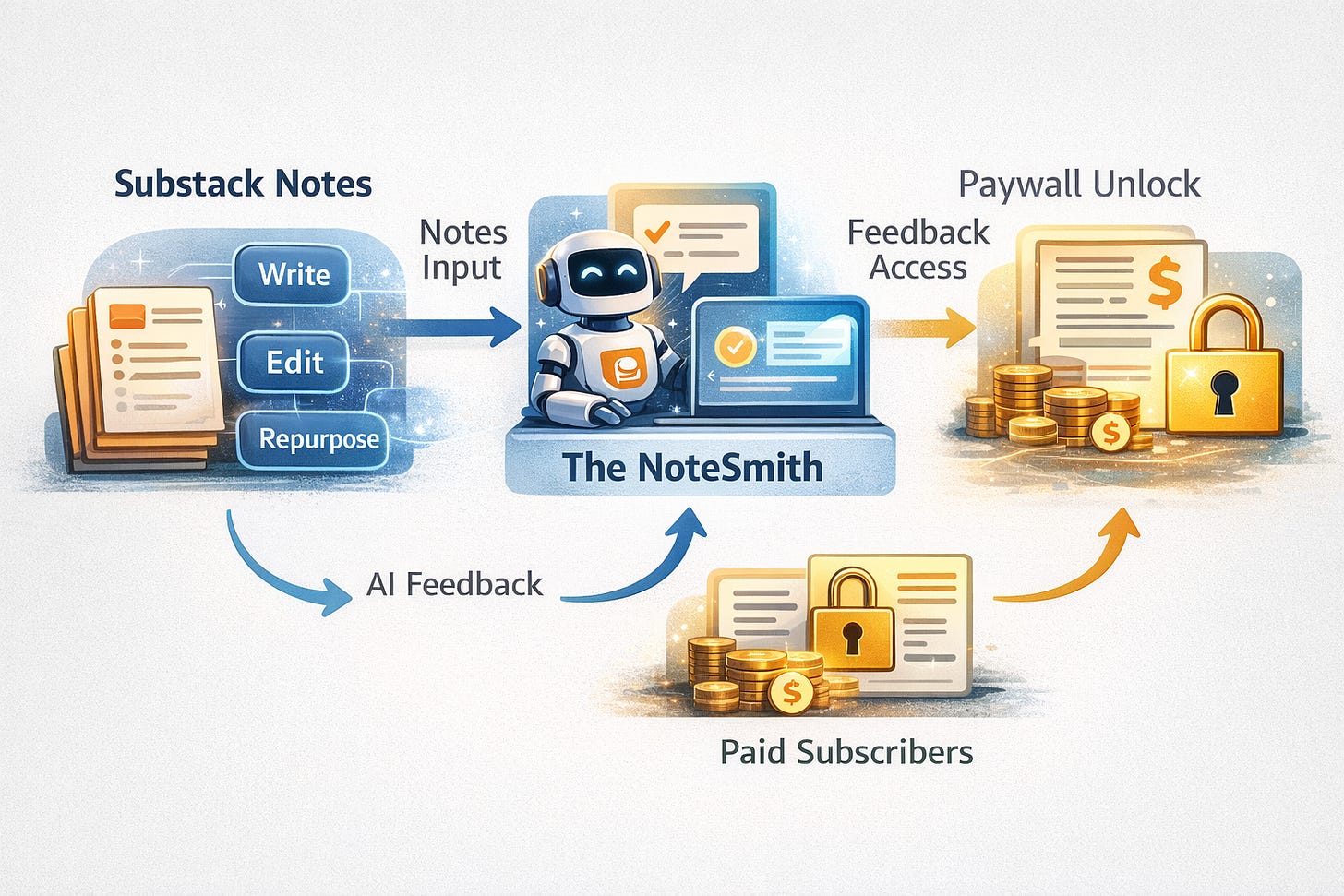
So you see — that is exactly what this model looks like when it works: narrow pain point, & immediate utility.
The next model will also not leave you indifferent.
Model 2. Productized services powered by agents
A lot of creators are sitting on underpriced know-how. They know how to turn podcasts into clips. Or how to build better webinar flows. Or even how to qualify leads. Or how to brief editors. Or how to write stronger outbound messages. Or how to turn messy research into useful strategy.
Instead of selling “my brain for an hour,” you sell an outcome:
- audit plus setup.
- workflow plus onboarding.
- monthly optimization.
- or a white-labeled agent for a client niche.
That is often the fastest bridge from audience to cash. So to be clear:
- You publish the method in public.
- You sell the system in private.
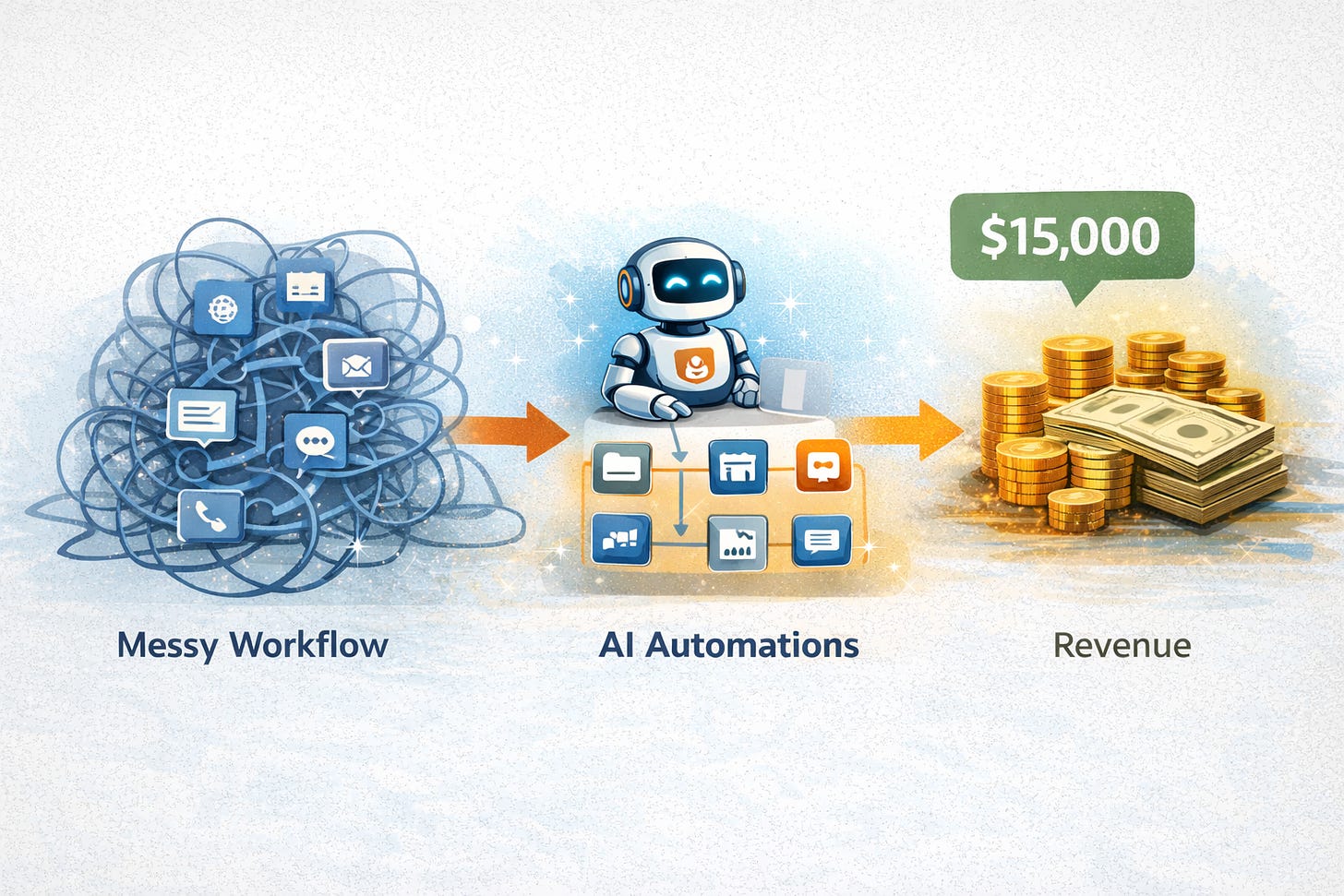
A useful early service-style proof point came from a builder who wrote on Reddit that he made $15.000 selling AI automations in five months. The part that matters is not the topline. It is the delivery logic: packaged workflows, clear outcome, client value. That is the same transition creators can make when they stop selling advice and start selling implementation.
Have you already read our post on how solopreneurs are using full AI agents to run work that used to need a team? A sharp look at how one person can build a much bigger machine with the right setup.
Still thinking? The following model will definitely change your mind about common monetization methods for creators.
Model 3. Members-only agents that make subscriptions stick
Most memberships do not die because the content is bad.
They die because people forget to use them.
A members-only agent changes that, because now the subscriber is not only paying for posts behind a wall. They are paying for on-demand access to your framework when they need it.
That is a much stronger habit loop.
We are already seeing this logic take off in the so-called AI clone economy. The appeal is obvious: instead of waiting for the next post, the subscriber gets a version of the creator’s thinking available whenever a problem appears.
That turns passive content into active utility.
And once that happens, churn becomes a different conversation. People do not cancel tools they actually use in the middle of a real task.
There is already a simple proof point for that. In a Homebase interview, Me4U says creator Ludella Hahn, with 60K Instagram followers, earns $1.200-1.700 in MRR from an always-on AI twin linked from Stories and DM flows. Same audience, same expertise, but now the subscription keeps working between posts because members can actually use it.
Enjoying this insight? Share this post with one creator who still thinks AI monetization starts and ends with first-class content.
And, finally, the last, but pretty impressive model. Skills — are the base.
Model 4. Skills and extensions as the next digital product
This is the newest layer of modern monetization.
You sell a capability that plugs into somebody else’s stack.
That is why skills ecosystems matter. A reusable skill sits in an interesting middle ground: smaller than software, more useful than a PDF, and often easier to distribute than a full application.
For creators with technical audiences, that can become a real business.
A strong early signal came from Nick Dobos’s coding GPT, Grimoire. Dobos posted that it logged 18.000+ conversations one week after OpenAI Dev Day and 55.200+ chats three weeks after; WIRED later reported 2 million+ conversations, and Dobos said pilot monetization started at around $1.000 per month. That is still early-market data, but it shows the direction clearly: useful capabilities inside an existing ecosystem can become a creator product.
The key point is this: creators need to own one valuable slice of work.
Subscribe if you want more creator-first breakdowns on how AI turns attention into revenue.
What people actually pay for
That’s right — most creators will price agents the way they price content.
That is the wrong frame.
If an agent saves time, increases output, improves conversion, reduces support load, or helps qualify revenue, it should not be priced like a PDF or a bonus download. It should be priced similar to labor, software, or a small operational tool.
Have you checked out our new post on how creators are turning digital versions of themselves into actual revenue streams? This one breaks down why AI clones are quickly becoming a real business model.
A simple pricing ladder usually works best? Here you are! Entry layer looks like this:
- template.
- prompt pack.
- workflow map.
- starter kit.
Core layer — no more difficult:
- agent subscription.
- premium member perk.
- paid bot access.
High-ticket layer:
- done-for-you setup.
- customization.
- team onboarding.
- retainer support.
The strongest businesses often use all four.
That is how a creator stops selling only information and starts selling systems, access and implementation at different price points
Tools worth watching in this market
For building automation logic — n8n is still the One.
For branded agent businesses — Pickaxe gives creators a cleaner wrapper for packaging and billing AI tools.
For chatbot and agent templates — Botpress remains useful when the product is closer to conversational automation.
For skill-based extensions — Anthropic’s skills ecosystem is worth watching. Especially if your audience is more technical and likely to buy reusable capabilities instead of a front-end product. Or maybe they just need automation.
Please, check out our new post on how creators are automating research with ChatGPT agents. It is a practical example of how to save hours and move from idea to execution much faster.
The main risk in this market
There is one part of this market that is moving fast for a reason. I mean, it is easy to build fast. And just as easy to trust the wrong thing.
That is especially true once skills, extensions, open marketplaces, and copyable templates enter the picture. A creator can now buy, remix, relabel, and resell pieces of AI functionality with very little real expertise behind them.
So in 2026 it is built something narrow, trusted, clearly useful, and attached to real distribution.
Trust is doing more work than hype now.
To sum up all of the above, let’s voice the new monetization shift — from 2024 to 2026:
Have you seen our new post on using n8n to build AI apps and agents that actually do useful work? A strong pick for anyone who wants to connect tools into systems that can scale.
The bigger opportunity for creators
Most creators still believe that AI helps them create content faster.
That is the shallow use case.
The deeper one is this:
AI agents let creators productize judgment. Once that happens, the business takes on a new shape.
Your newsletter becomes a data source.
Your framework becomes an interface.
Your expertise becomes a tool.
Your audience becomes a user base.
That is why 2026 feels different.
The creator economy is increasingly about turning trust into software-shaped revenue. And the creators who win this next wave probably will be the ones quietly turning one repeated problem into one paid system people use every week.
Enjoying this insight? Please, comment on this post — we want to discuss what is best for you and other creators. Your comments help us create first-class content.
This article was first published in the Creators AI newsletter. View the original edition.