50 Most Popular GenAI Apps: Explained
What tools are top of the line right now?
AI is growing so fast that anyone could get confused. One month's experimental toy can become next month's must-have tool. Frankly speaking, even we find it hard to keep track of all the most important updates (although we check for them every day).
But the other day, I came across a good list of the 50 most in-demand AI tools, and now I want to discuss it with you. And why don't we do it from the perspective of creators and entrepreneurs?
Today, we break down what’s hot, what’s working, and where opportunities lie in the AI world. Let’s get started.
Get 20% OFF Full Access subscription!
What Do Users Want from AI?
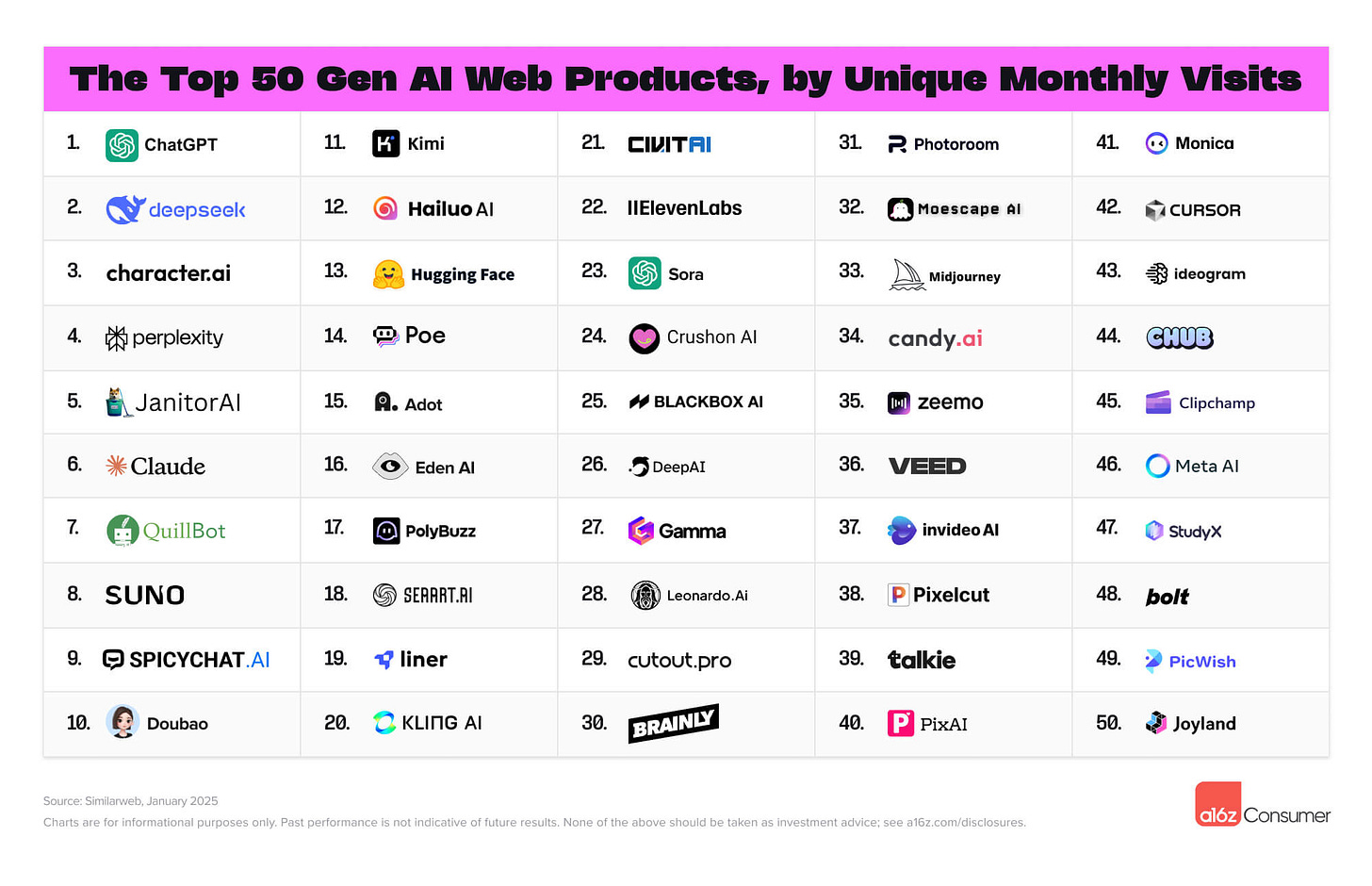
I'm talking about the 50 most used GenAI web apps compiled by the a16z investment fund. This is one of the largest venture capital firms paying significant attention to AI over the last few years. And, happily, it's doing so in a handy format.
These top 50 AI apps come from analyzing web traffic and usage patterns in late 2024 and early 2025. Essentially, these are the AI-first tools that internet users visit most.
Notably, the list excludes older platforms like Canva or Notion that only added AI features. The focus here is on AI-native services.
Let's quickly review the changes over the last six months.
Trends in Consumer AI Apps
The past year saw major shifts: 17 new companies joined the top ranks since the previous report. This churn shows how quickly the GenAI space is evolving.
One more big change is the rise of brand-new AI assistants.
DeepSeek rocketed from obscurity to become the #2 most-used AI product virtually overnight, overtaking last year’s darling, Character.AI. Meanwhile, many creative tools now dominate the rankings. People are flocking to AI image generators, design helpers, and video creators in huge numbers.
AI-powered visual apps (for generating and editing images/videos) have especially grown, reflecting how much creators want these capabilities.
Another trend is the growing presence of AI tools for developers and “no-code” builders. A year ago, creators mostly used GenAI for text or art; now, we see apps gaining traction by helping people build software without a programming background.
In short, user interest is expanding from simple chatbots to more specialized and creative applications. Now, we can get to an overview of the tools.
Conversational Agents & Chatbots
This category covers AI assistants and chatbots, the tools that carry on human-like conversations. These models serve as brainstorming partners, research aides, or even the product (like virtual friend apps).
The big theme is that users want helpful or entertaining conversations on demand, whether for information, companionship, or creative roleplay. Many startups are experimenting with niche chatbots, from uncensored anime characters to personal finance advisors, to satisfy specific audiences.
But at the top of the list, of course, are the mastodons.
- ChatGPT (#1)– The flagship conversational AI that started the craze by OpenAI. It’s a general-purpose chatbot that can answer questions, help write content, brainstorm ideas, and more. Millions use ChatGPT daily as a sort of AI assistant for everything. Its success set the stage for all the others on this list.
- DeepSeek (#2) – A newcomer who became a top ChatGPT challenger. DeepSeek is an assistant known for advanced reasoning abilities. It gained popularity for its accuracy in complex Q&A.
It is also the very tool that has dropped the stock of the entire American big tech. We did a detailed comparison of DeepSeek with ChatGPT.
- Character.AI (#3)– An AI chatbot focused on entertainment and persona-driven chat. Users can pick or create characters (fictional, historical, etc.) and chat with them for fun or creative storytelling.
For solo creators, Character.AI showed there’s huge consumer appetite for AI companions and roleplay – it’s not just about productivity, but also play.
- Claude (#6)– An AI assistant from Anthropic that many consider an alternative to ChatGPT. Claude can handle similar tasks with a different model that sometimes excels at longer-form responses. Startups have integrated Claude via API, but the public-facing Claude.ai chatbot also has a growing user base.
Anthropic is deservedly at the top of the list in terms of demand. This startup was one of the first to introduce its browser management agent:
- Perplexity AI (#4) – one of the best examples of a chatbot with built-in search. Perplexity functions like a Q&A engine: you ask it a question, and it fetches information from the web, citing sources in its answer.
Everyone who works with large amounts of content familiarizes themselves with Deep Research. It is the only AI tool that can focus on academic and social sources at the click of a button.
Other notable chatbots include Poe (Quora’s multi-bot chat app), community-run AI chat hubs like JanitorAI and SpicyChat for uncensored roleplay, and country-specific AI pals like ByteDance’s Doubao in China.
Share this post with friends, especially those interested in AI Insights!
Creative Visual & Content Generators
These tools help users create visual art, written content, or presentations, with AI doing much of the heavy lifting.
This category is gold for creators: it unlocks abilities to produce high-quality graphics, illustrations, or copy without specialized skills. The past year cemented that beyond chatting, people love AI, which makes things they can use in their projects.
And while we know from last week that your primary image generator should be ChatGPT, the apps below can still handle just about any task.
- Midjourney (#33)– the platform that turns text prompts into visuals and has become a go-to tool for designers and artists prototyping ideas. Its popularity proved people crave easy ways to generate custom art and graphics.
- Leonardo AI (#28)– a basic solution for image generation tailored for creators, especially illustrators. Leonardo allows for more fine-tuning – you can train it on your style or assets to generate consistent artwork.
Leonardo used to be one of my favorite image generators. However, now I can't recommend it as a one-size-fits-all solution. We have too many alternatives.
- Ideogram (#43) – An image generator that solved a problem generating legible text inside images (Who knows what will happen to him in the future). Ideogram can still produce nice logos or posters with authentic AI lettering.
- QuillBot (#7) – An AI writing assistant that specializes in paraphrasing and refining text. QuillBot isn’t about long essays; it’s used to polish sentences, adjust tone, or summarize writing.
It’s hugely popular among students, bloggers, and professionals who need quick writing help. For solopreneurs creating content, tools like QuillBot offer a shortcut to improve copy or generate variant phrasings.
- Gamma.app (#27)– An AI tool for generating slide decks and visual documents. You feed Gamma a topic or outline, and it produces a polished presentation or webpage-like document with text and graphics. It’s like a designer-editor combo that turns your notes into a pitch deck or report.
This kind of content generator illustrates the demand for AI to save time on format and design, letting startups focus on products while the model handles the polish.
- Civitai (#21) - A community hub where creators share and download custom Stable Diffusion models to generate art. Perhaps it is the only type of project dedicated to image generation that still deserves attention.
First of all, because of access to LoRA, a tool that allows you to train your model. We covered how to do that in this post:
Creators’ AI could be a valuable gift for your friend, colleague, or family member. Gifting books is bright, but giving an AI newsletter is a superb move 😎
Video & Image Editing Tools
Beyond pure generation, a class of AI tools is centered on editing and enhancing media. Especially video and images. These are popular among creators who must produce polished content without a large budget or team.
In the last year, AI has made video creation much more accessible, and some new entrants are effectively generating videos from scratch. This category reveals how AI is creating content and smartly editing and transforming it.
Here are the tools you should be looking at:
- Hailuo AI (#12) – An AI video editor that emerged from China as a surprise hit. Hailuo can take a prompt or script and produce a short video clip. It’s still early, and the videos are relatively simple, but the tool points toward a future where you might prototype entire video concepts with just a few clicks.
- OpenAI's Sora (#23) – A generative AI model that also converts text prompts into video content. It uses a diffusion model combined with deep learning and natural language processing to generate videos up to one minute long. It was fine-tuned for different entertainment, advertising, and education scenarios.
It removes the technical complexity for users making ad videos.
- Veed (#36) – An online video editor known for its simplicity and AI features. Veed automatically transcribes and subtitles videos, removes background noise, and can even resize or reformat videos for different platforms in one click.
It’s especially popular among TikTok and Instagram creators.
Developer & AI Platform Tools
Not all GenAI apps are about making content directly – some are tools to build other tools. This category includes AI platforms and coding assistants, which are especially interesting to technical founders and “builders without borders.”
Or just for vibe coders.
They serve the users who want to create software, AI applications, or integrate AI into projects, but faster and easier than before. For creators who code (or want to), these apps offer shortcuts in development and new ways to prototype ideas.
- Hugging Face (#12) – Often described as the GitHub of machine learning, it is a platform hosting thousands of AI models and datasets. While not a traditional consumer app, its web traffic is huge because developers, researchers, and even hobbyists go there to find pre-trained models.
Digging on Hugging Face can take hours.
But there is an option to save a lot of time:
- Cursor (#42) – An AI-assisted coding environment. It’s essentially a code editor (like VS Code) with an AI pair-programmer baked in. As you write code, Cursor’s AI can autocomplete functions, explain errors, or even generate whole blocks of code from comments.
The popularity of Cursor shows how “vibe coding” is catching on, letting one creator do the work of many.
- Bolt (#48) – A text-to-app platform: you describe an app or website you want to create, and Bolt generates the initial code and design for you (right in the browser). It’s like having a startup engineer on demand. Makers have used Bolt to spin up quick web demos or MVPs without writing code from scratch.
Bolt is my favorite tool for vibe coding. I don't know why, but this particular platform helps me create apps without bugs and headaches:
- Blackbox AI (#25) – A toolbox for developers that started as a browser extension to find and generate code. Blackbox AI can search a massive code base to “find the function that does X” or autocomplete code similar to GitHub’s Copilot.
It’s popular among engineers looking to speed up routine programming tasks. For indie founders maintaining projects solo, an assistant like Blackbox can be a force multiplier (less debugging syntax, more time-building features).
Audio & Voice Generation
While images and text often steal the spotlight, AI for audio and voice is another growing area. These tools synthesize human-like speech, clone voices, and generate music.
The relatively more minor number of audio tools in the top 50 belies their impact. But voice AI is behind the scenes in many apps and is a key opportunity for new startups.
- ElevenLabs (#22) – The leader in AI voice generation. ElevenLabs allows you to turn text into very realistic speech in dozens of voices, and even clone a voice from a sample.
Many YouTubers use it to generate narration or character voices. For others, ElevenLabs offers the ability to add professional voiceovers without hiring voice actors – you can give your project a voice (literally) in minutes.
- Suno (#8) – A company offering AI models for both music and speech. Suno’s technology can generate short music tracks based on prompts (think background music or jingles) and also has a model called Bark for expressive text-to-speech.
A creators might use Suno to craft a unique soundtrack for a video quickly, or to have a custom AI voice read their script with emotion. It represents the cutting edge of AI moving into creative audio production, not just static text or images.
Startups use these tools to produce product demo voiceovers and e-learning creators to voice educational materials. And sometimes for weirder things:
Utility & Niche AI Solutions

Rounding out the list are various specialized AI tools that serve a specific niche or solve a specific problem. They might not be as universally known, but they have dedicated user bases and often generate revenue from loyal subscribers.
These represent areas where AI makes inroads into everyday tasks: education, research, personal productivity, and leisure.
- StudyX (#47) – An AI tutor and homework solver specializing in step-by-step solutions. Unlike Brainly’s community model, StudyX is more of a direct AI tool: you input a problem (even upload a photo of it), and StudyX’s AI explains how to solve it.
- Liner (#19) – A reading and research assistant that uses AI to summarize and highlight content. Liner started as a web highlighter tool; now it leverages AI to give quick summaries of articles or even entire web searches.
For professionals who slog through lots of reading, Liner offers to cut the time by telling you the gist instantly. It’s a niche utility, but a very useful one – pointing to opportunities for AI to act as an info filter in our information-overloaded lives.
- Monica (#41) – An all-in-one personal AI assistant that bundles multiple models and skills. Monica can chat (using the latest GPT-style models), but also help with tasks like summarizing a webpage you’re on, translating text, or generating an image.
Tools like Monica are a Swiss Army knife for power users and solopreneurs, replacing the need to juggle several separate AI apps. Its presence in the top 50 suggests an appetite for consolidated personal assistants that save people time across many small tasks.
Final Thoughts
Let's be honest: The AI ecosystem in 2025 is remarkably fragmented.
There is no single platform to build on or one tool that does it all; instead, there’s a web of apps and platforms, each with its strengths and quirks. But sometimes, it's good (and nice) to slow down a bit and exhale.
It's also useful for understanding where we're going and what people want. This list shows that while the audience is expanding and the focus on AI is growing, the industry is also going off the deep end. Users are often turning to such tools to edit a video, prepare a podcast, or even write an app.
We can now say that we are witnessing a large-scale democratization of complex technical solutions, and we can back this up with numbers.
Share this edition with your friends!
This article was first published in the Creators AI newsletter. View the original edition.