Agentic Commerce: The Shift You Can’t Opt Out Of
Agentic Commerce in 2026: AEO, GEO, and the 4 AI Channels That Matter
AI agents are already shopping, researching, and deciding on behalf of real users. Whether you run a store, a SaaS product, a portfolio of content, or a one-person agency — the same shift (being optimized for an AI reader, not a human one) is coming for whatever you sell. This is the working map: AEO/GEO/AOO, the four channels worth showing up in, and the people defining how it plays out.
Hey everyone!
One in five Cyber Week 2025 orders involved an AI agent. Roughly $70 billion in GMV, according to Salesforce. And most of the brands, creators, and operators whose businesses depend on being found don’t actually know if their visibility was part of that number or not.
That’s what agentic commerce looks like in early 2026. It’s not the thing that will happen — it’s the thing that’s quietly already happening, and the users aren’t telling you because they just think they decided to buy, sign up, or subscribe on their own.
The traditional funnel (impression → click → browse → cart → checkout, or its SaaS equivalent: impression → click → trial → activation → conversion) is collapsing into a single chat bubble. In that bubble, the AI pulls data, compares it against everyone else’s, and either recommends brand or doesn’t. If it doesn’t, brand weren’t just outranked — brand were invisible.
Agentic commerce could generate up to $1 trillion in US B2C retail revenue by 2030, with global projections of $3–5 trillion (McKinsey via VGS, January 2026).
Tobi Lütke put it more bluntly on X: “Shopify is building the foundation for agentic commerce.” Sundar Pichai followed with: “AI agents will be a big part of how we shop.” When the CEOs of Shopify and Google are saying the same thing in the same week, it’s worth a closer look.
A note on audience. This post is the generalist view — what agentic commerce is, why it matters for anyone dependent on being found by AI (not just eCom), and the framework to think about it. If you run a Shopify store or DTC brand and want the operational playbook — catalog audits, channel toggles, attribution setup, startup ecosystem — that’s living on Agentique, my other newsletter focused specifically on agentic commerce for operators. I’ll link the Practical Playbook in a callout further down.
At a Glance
In this post:
- What agentic commerce actually is (and what it isn’t yet)
- How discovery and agentic commerce are different problems with different optimization work
- The new acronym soup — AEO, GEO, AOO — and what each actually means
- The 4 AI channels worth showing up in (for anyone who depends on being found)
- The voices defining the space, and the critics worth taking seriously
- What’s working, what’s broken, and where to focus
Keep your mailbox updated with practical knowledge & key news from the AI industry!
What Agentic Commerce Actually Is
Agentic commerce is any transaction where an AI agent — not a human — does the discovery, comparison, or checkout work. Often all three.
A user tells ChatGPT “find me the best noise-cancelling headphones under $300 with 30+ hours battery life.” The agent queries product data across merchants, reads aggregated reviews, checks price and stock, and either shortlists 3 options or, with permission, completes the purchase. The shopper never sees a Google SERP, never opens ten tabs, never visits anyone’s product page.
Same pattern for SaaS: “find me a project management tool under $20/user that integrates with Linear and has native time tracking.” The agent hits review sites, aggregator content, company docs, and returns a shortlist. Two or three years from now it’ll sign up for the trial on your behalf.
The numbers behind the shift are no longer abstract:
- 23% of Americans made a purchase using AI in the past month (Morgan Stanley)
- 805% YoY traffic growth from generative AI channels in July 2025 (Adobe)
- 4.4x higher conversion for AI-generated product recommendations vs traditional search (McKinsey)
- 44% of US consumers are comfortable with an AI agent browsing and buying on their behalf — rising to 59% among 18-34 year olds (Worldpay)
- AI-referral conversions grew 1,247% in late 2025 (Signifyd). MetaRouter projects agent traffic moving from sub-1% to 15–25% of total ecommerce traffic by 2027.
And the protocol layer actually stabilised in the last six months, which is what makes this practical instead of speculative:
- Sep 2025 — OpenAI + Stripe launch the Agentic Commerce Protocol (ACP) with Instant Checkout in ChatGPT
- Nov 2025 — Perplexity ships Buy with Pro to all US users via PayPal
- Jan 11, 2026 (NRF) — Google + Shopify announce the Universal Commerce Protocol (UCP) with 20+ retailer partners
- Winter ‘26 Edition — Shopify launches Agentic Storefronts, connecting merchants to ChatGPT, Google AI Mode, Gemini, and Microsoft Copilot from one admin toggle
- Mar 24, 2026 — Agentic Storefronts activated for all eligible US Shopify merchants. ~5.6 million stores now technically connected.
The plumbing is done. The mental model shift isn’t.
Discovery vs. Agentic Commerce: Not the Same Problem
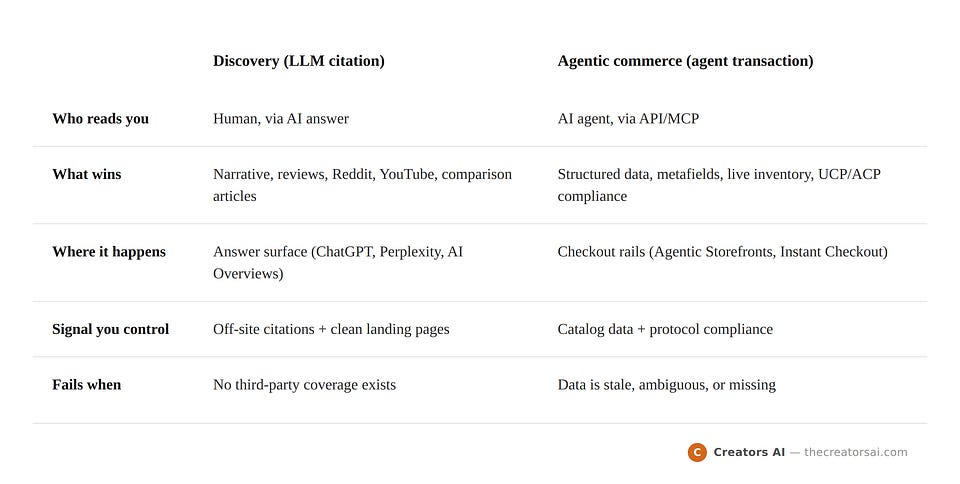
Here’s the distinction most posts skip, and it’s the one that changes your optimization work.
Discovery is when a human asks ChatGPT “what’s the best noise-cancelling headphone under $300?” or “what’s a good lightweight CRM for a 5-person sales team?” and reads the answer. The reader is the customer. Your job is to be cited — mentioned in the prose, linked as a source, surfaced in the carousel. You’re optimizing to be read about.
Agentic commerce is when an AI agent queries your site or catalog programmatically, parses structured data, compares options against constraints, and completes a transaction — often without a human ever seeing your page. The reader is a machine. You’re optimizing to be transacted with.
Both matter. They reward different work.
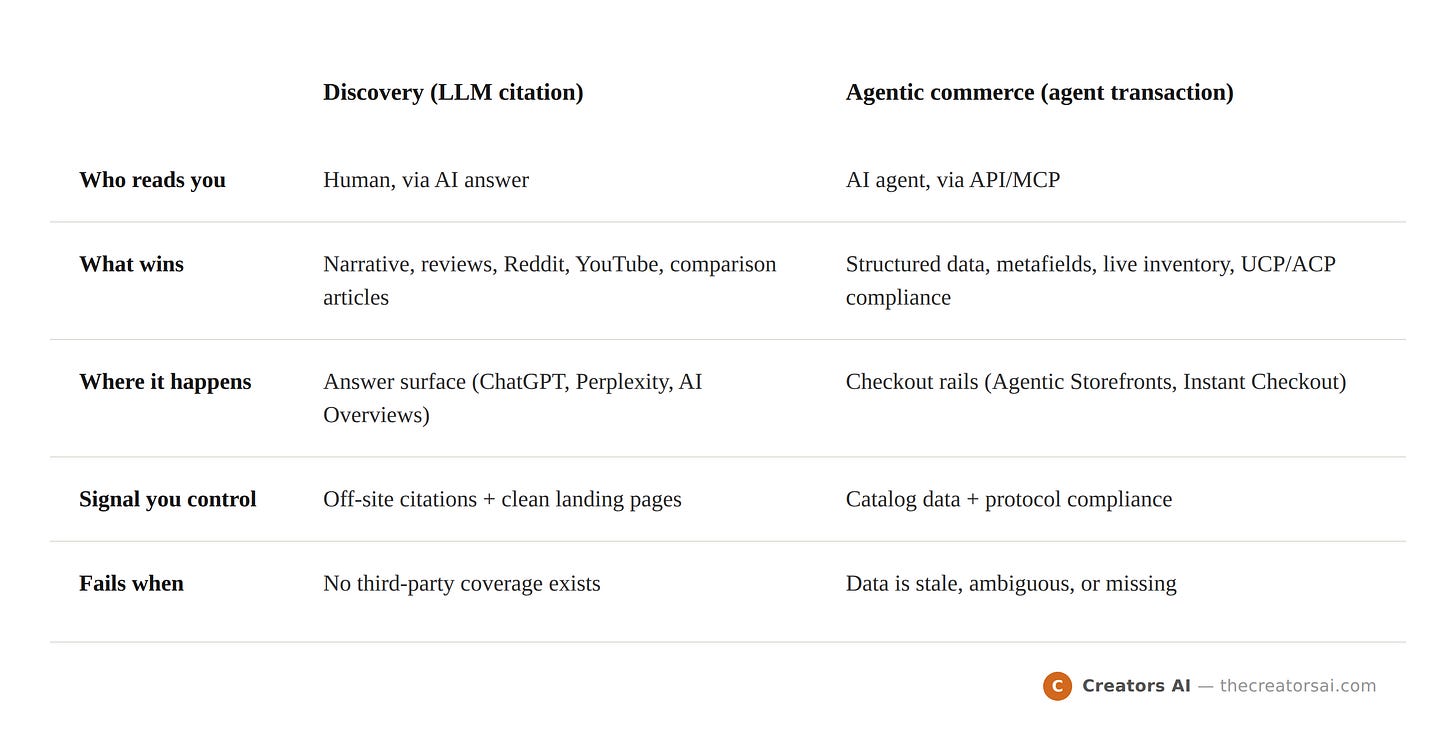
If you only invest in one, you can still show up but not close. If you only invest in the other, agents can check you out but you never enter the consideration set.
To unwrap Agentic Comemrce and keep up with ultraspeed development of new protocols and partnerships in Commerce there is a Agentique newsletter.
[ Agentique
Agentique - a monthly dispatch on agentic commerce. Field reports on AI agents, autonomous checkout, and the new mechanics of DTC, retail, and marketplaces.
By Daniil Andreev](https://agentiquecommerce.substack.com?utm_source=substack&utm_campaign=publication_embed&utm_medium=web)
AEO, GEO, AOO: The Acronym Soup, Decoded
Twenty years of SEO is now spawning three overlapping acronyms — and they’re not interchangeable.
AEO — Answer Engine Optimization. Optimizing your content so AI answer engines (ChatGPT, Perplexity, Claude, Google AI Overviews) cite you when answering a user’s question. The work overlaps with classic SEO but the surface is different: instead of ranking for a query, you’re being quoted in a paragraph. Wins look like: clear definitional content, structured FAQs, comparison-ready specs, inclusion in the “best X for Y” listicles that AI training data ingests.
GEO — Generative Engine Optimization. A near-synonym for AEO that’s gained traction with the SEO community (Olga Zarr, Julian Goldie, Brad Smith are among the practitioners writing about it most). Some treat GEO as a superset that includes how your brand appears across the entire generative experience — not just answers but also recommendations, summaries, and image-based results. In practice, AEO and GEO are used interchangeably by 80% of people writing about them. Don’t lose sleep over the terminology.
AOO — Agent-Oriented Optimization. This is the one most operators haven’t internalised yet. ARK Invest popularised the term: optimizing not for a human reading an answer, but for an AI agent transacting with your store, your SaaS, your booking flow. The signals that matter are completely different — MCP endpoint compatibility, data freshness, predictable checkout or signup, structured attributes that an agent can filter on. As ARK put it: “MCP compatibility is key.”
The split is simple:
- AEO/GEO lives on the discovery side of the table above. Win these and you get cited.
- AOO lives on the agentic commerce side. Win this and agents can actually transact with you.
Most “AI SEO” content circulating in April 2026 is really AEO/GEO advice repackaged — we went deep on the citation-and-ranking side in LLMs Optimization (AI SEO) if you want the playbook. Genuinely useful AOO writing is much rarer because the agent surface is newer and the data signals (MCP server quality, catalog/data accuracy, transaction reliability) are harder to measure than citation rates. Expect AOO tooling — the equivalent of Ahrefs or Semrush, but for agent traffic — to be a major startup wave through 2026.
Every previous platform shift in commerce — search, social, mobile — eventually settled into a stable equilibrium where operators knew how to be visible. Agentic commerce probably won’t.
If you are form the eCom / Marketing and want to learn practical aspects of implementing Agentic Comemrce check Agentique’s Practical Playbook for Operators:
The 4 AI Discovery Channels You Can’t Ignore
Four channels matter in April 2026. Each behaves differently, and the work to show up in each is not the same — whether you’re selling products, SaaS, content, or services.
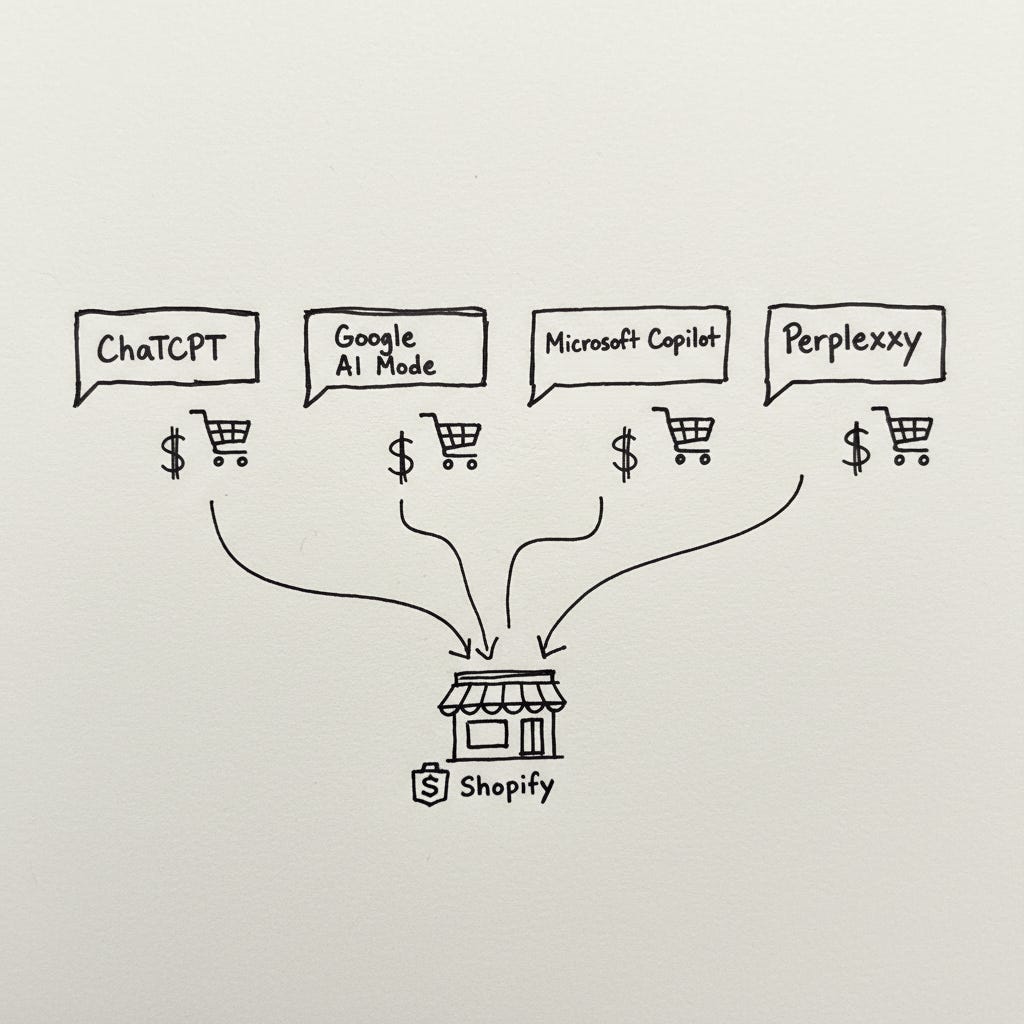
1. ChatGPT — 880M MAU, discovery-first
OpenAI launched Instant Checkout with Stripe in September 2025. The launch tweet from @OpenAI hit 10.3M views — the biggest single agentic commerce moment of the cycle. Then the company quietly pulled Instant Checkout back on March 4, 2026 — only about 30 merchants were live and pricing/inventory data was too unreliable. ChatGPT now routes checkout to apps like Instacart, Target, and DoorDash, or sends users through an in-app browser.
There’s a separate, more strategic question hanging over ChatGPT: a Forrester report from March 18, 2026 flagged that a deeper OpenAI–Amazon partnership could dominate agentic commerce, given Amazon’s catalog depth and OpenAI’s distribution. Nothing’s been announced, but it’s the structural play that would change the competitive map most.
What this means, regardless of what you sell: ChatGPT is the largest discovery surface. If your content, product, or service doesn’t show up when people ask relevant questions, you don’t exist to 800M people every week. Getting cited here is the highest-leverage work for generalist audiences.
2. Google AI Mode + Gemini — the most complete stack
Google’s Shopping Graph has 50B+ product listings, with 2B refreshed every hour. AI Mode has 75M+ daily active users. UCP-powered checkout is already live with select merchants — Brodie Clark spotted Wayfair UCP-powered checkout running directly in Google AI Mode in March, with free listings, no merchant page visit required.

The March 2026 UCP update added multi-item carts, live catalog queries, and identity linking for loyalty programs. As Gagan Ghotra put it: “No need to visit product pages — checkout from AI Mode.”
What this means: Google is the most mature AI surface across the board — not just for shopping, but for any query where it wants to give a definitive answer. If your market has been anchored to Google rankings historically, this is where your existing SEO work most directly translates (and also where the biggest disruption is coming).
3. Microsoft Copilot — the enterprise play, not the volume play
Copilot Checkout launched January 8, 2026 with Shopify, PayPal, Stripe, and Etsy at NRF. The announced performance stat — 53% more purchases within 30 minutes of interaction, and a 194% conversion lift with shopping intent present — is a session-quality metric, not a volume disclosure. Microsoft has not published GMV, order count, or merchant count for Copilot Checkout.
What this means: Copilot matters where work happens — inside Microsoft 365 — not where discovery happens. If your product or service has a B2B or productivity-adjacent angle, Copilot is worth claiming the beachhead. If your audience is general consumer, it’s a minor channel.
4. Perplexity — the independent, ad-free bet
Perplexity was the earliest mover (Buy with Pro launched November 2024) and now reaches 5,000+ merchants through a PayPal partnership. The company hit $500M ARR in April 2026 at a $20B valuation and shipped its agentic Computer product in February.
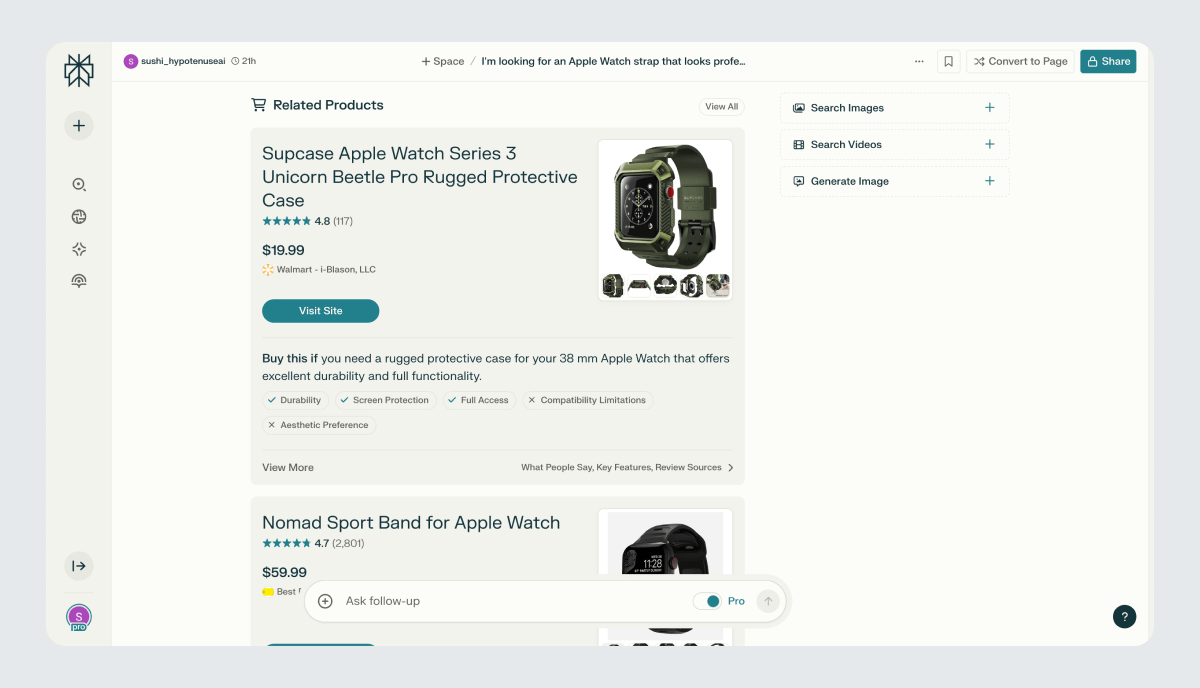
Perplexity’s “Buy with Pro” surfaces product cards directly inside the chat answer, with pricing, retailer, and a one-click buy button. Cards are unsponsored; ranking is driven by the merchant program and structured data.
One caveat: Perplexity is currently in a legal fight with Amazon over whether AI agents can shop on closed marketplaces. The Nov 2025 suit has a preliminary injunction hearing that could redraw the boundary lines for the entire category.
What this means: Perplexity punches above its user count because its users are high-intent. Smaller audience, deeper engagement, cleaner signal. If you can be cited here, it compounds across the smart-user segment faster than raw MAU would suggest.
And then there’s Amazon (and Walmart)
Amazon Rufus has 250M+ customers and projected $10B in incremental sales, but Amazon has explicitly blocked third-party AI agents from its site. Meanwhile, Walmart unveiled four agentic AI super agents — including the consumer-facing Sparky — and Walmart execs went on record calling search boxes “obsolete.” These are walled gardens; they matter most to sellers operating inside them.
The Protocol Layer, in 60 Seconds
You’re going to see ACP and UCP mentioned a lot. You don’t need to implement either one directly if you’re on a modern commerce platform or SaaS stack — but understanding them helps explain why some channels work better than others.
ACP (Agentic Commerce Protocol) — co-developed by OpenAI and Stripe, launched Sep 2025. Narrower scope: handles checkout sessions and secure payment transmission. Adopted by 25+ partners including Salesforce, Squarespace, Adobe Commerce. Powers ChatGPT Instant Checkout.
UCP (Universal Commerce Protocol) — co-developed by Google and Shopify, launched Jan 2026. Broader scope: covers discovery → cart → checkout → orders. Partners include Visa, Mastercard, American Express, Stripe, Adyen, Walmart, Target, Etsy, Wayfair, Meta (soon). March 2026 update added multi-item carts, live catalog, identity linking.
UCP uses a layered protocol: core primitives, independently versioned capabilities (Checkout, Orders, Catalog), and extensions merchants or vendors can define themselves. Source: Shopify Engineering.
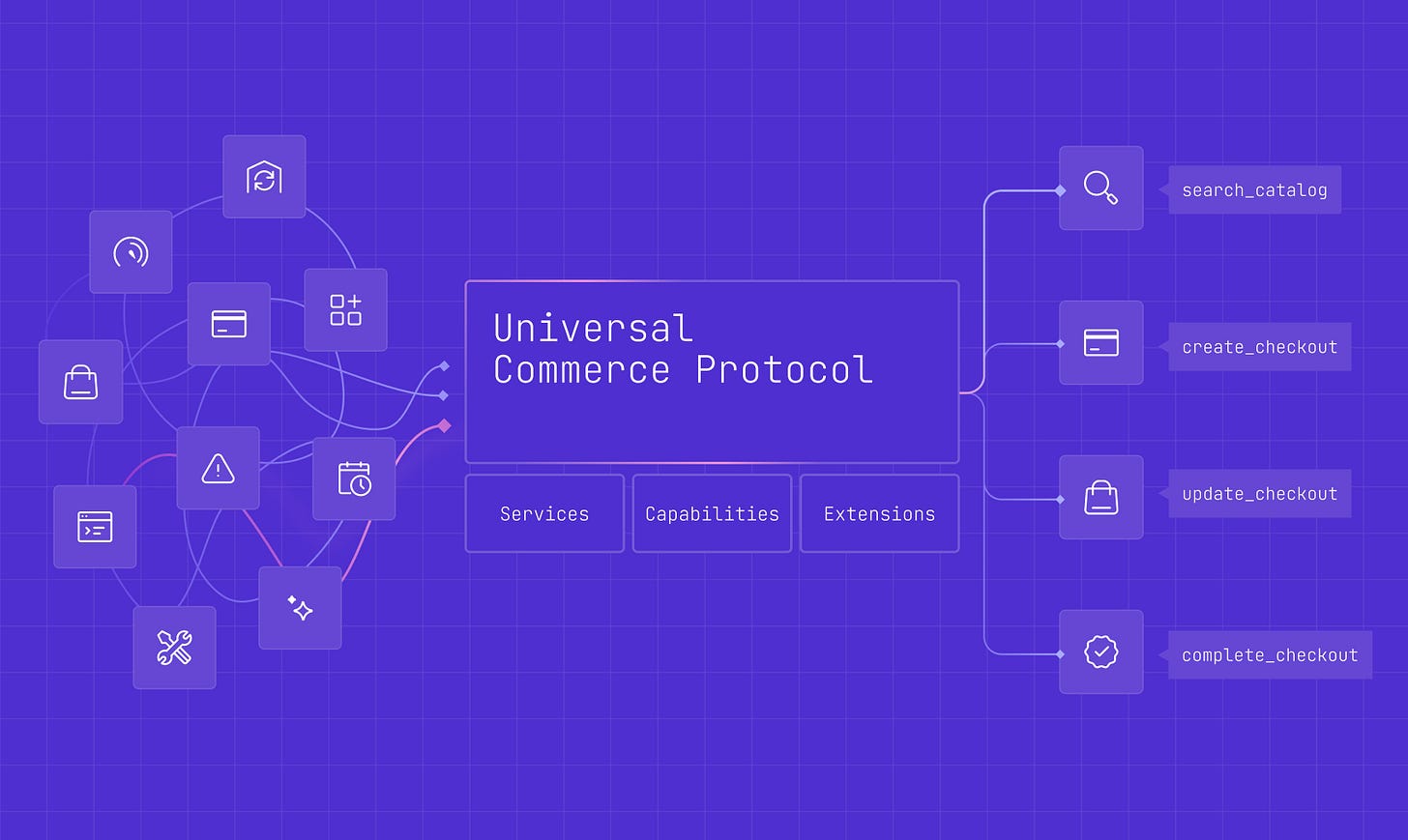
The simplest read: ACP is checkout-only; UCP is end-to-end. Most analysts (Ayush, c4lvin) have been drawing this same line since the UCP launch. Both are MCP under the hood.
🛒 Running a Shopify store or DTC brand?
The operational playbook — catalog audits, the exact channel toggles, attribution setup, startup ecosystem map, loyalty and post-purchase flows.
[Agentique
The Shopify Operator’s Playbook for Agentic Commerce: Part 1
Hey operators…
Read more
5 hours ago · Daniil Andreev](https://agentiquecommerce.substack.com/p/agentic-commerce-playbook-for-shopify?utm_source=substack&utm_campaign=post_embed&utm_medium=web)
Voices to Follow (and the Critics Worth Reading)
A working follow-list — the people whose posts have actually told us something useful in the last six months.
The operators shipping product:
- Tobi Lütke (@tobi) and Harley Finkelstein — Shopify’s framing sets the agenda for half the ecosystem.
- Patrick Collison (@patrickc) — ACP, Stripe Agentic Commerce Suite, Shared Payment Tokens.
- Greg Brockman (@gdb) — OpenAI’s commerce moves.
- Ilya Grigorik (@igrigorik) — called the Shopify MCP rollout the “giant sleeper feature.”
- Davi Strazza (@davistrazza, Adyen) — most articulate on merchant infrastructure.
The analysts and educators:
- Brodie Clark (@brodieseo) and Gagan Ghotra (@gaganghotra\_) — sharpest on the search/AI Mode crossover.
- Sam Boboev (@samboboev) — clean educational threads on agentic commerce fundamentals.
- ARK Invest (@ARKInvest) — coined “AOO” and tracking MCP adoption.
- Greg Isenberg (@gregisenberg) — strong on the SaaS-meets-agents framing (we wrote our own version of this thesis in AI Agents Are Better Than SaaS).
The skeptics worth taking seriously:
- Eric Seufert (@eric\_seufert, Mobile Dev Memo) — argues there’s a “fundamental flaw with agentic commerce — it violates retailer motivations.” The retailer-incentive problem is real and worth wrestling with.
- Andrew Lipsman (via Marketecture) — frames the current moment as a “collective hallucination.” A useful counterweight to the “agentic commerce will be everything” tweets.
If both bulls and bears are correct in different ways, the truth is probably: agentic commerce is a structural shift in how a slice of commerce works, and the incentive misalignment between platforms and operators will create real friction that doesn’t just disappear because everyone shipped a protocol.
If I were building from scratch in 2026 — whether it’s a DTC brand, a SaaS product, or a content business — the rebuild order would be different from 2020. Clean structured data first, brand identity second, paid acquisition third. That’s almost the inverse of what most consultants will tell you. The reason is that paid acquisition is getting more expensive while agent-mediated acquisition is getting cheaper — and agent-mediated acquisition only works if your structured signal is clean. So clean data is now one of the cheapest customer acquisition channels you have. Most founders I talk to underweight this because it doesn’t feel like marketing work. It is marketing work. It just doesn’t look like it.
What’s Actually Broken
Most write-ups gloss this part. Worth being direct.
Attribution is still broken. You’ll know a sale or signup happened. You’ll often see which AI platform facilitated it. You usually won’t know why that agent picked you over a competitor. This is the “dark funnel” problem podcast advertising had for years — and agentic commerce is worse, because the whole transaction happens in seconds with one-click checkout that strips every identity-capture mechanism. Expect mature attribution to be a 2027 problem, not a 2026 one.
Instant Checkout was oversold. OpenAI pulling Instant Checkout after only ~30 live merchants is a useful reality check. The “buy inside the chat” narrative ran far ahead of the product. For the next 6–12 months, optimise for being recommended, not for completing transactions inside the AI surface.
Protocol fragmentation is real. Eight+ standards now exist (ACP, UCP, AP2, A2A, Visa TAP, Mastercard Agent Pay, Klarna APP, and more). If you’re on a major commerce or SaaS platform, you’re insulated. If you’re on a custom stack, you’ll be maintaining integrations for a while — and the integration sprawl is the same trap we wrote about in Your AI Agent Stack Is Spaghetti — It Should Be Lasagna.
Amazon’s walled garden may widen the gap. The Perplexity lawsuit outcome matters. If Amazon wins the “agents must identify themselves and comply with site rules” argument, expect more marketplaces to follow. That’s bad for cross-platform shopping, good for independent brands who get recommended elsewhere.
The retailer/operator-incentive problem is unsolved. Eric Seufert’s critique stands: AI agents disintermediate the customer relationship. Why would operators genuinely embrace channels that strip them of post-purchase data and direct email lists? The honest answer is: most won’t, until the volume forces it. Watch which ones move first — they’re the ones who’ve decided the cost of being absent is greater than the cost of being present on an unfavourable channel.
Structured data outweighs brand storytelling. This is the harder cultural shift. If you’ve spent years on narrative-heavy pages and beautiful editorial content, you now need a parallel investment in machine-readable signals. Brand-led teams find this uncomfortable, which is exactly why it’s the lever still mostly unpulled.
Twenty years ago you optimized for crawlers that read HTML. Today you optimize for agents that read your HTML and then summarize it back to a human who never wanted to read it in the first place. The middleman keeps changing but somehow the gig is always “write things you hope a machine will like.” The only real difference is that this machine has opinions about variant labels.
Where to Focus
If you only do one thing this month, audit your structured signal. Whether that’s product data (ecom), docs and landing pages (SaaS), or schema/FAQs (content) — every downstream optimization depends on it.
If you only do one thing this quarter, decide whether you’re in or out on Google AI Mode. It’s the channel with the cleanest infrastructure, deepest integrations, and most predictable upside. Being invisible there in Q3 is the equivalent of not showing up in Google Shopping in 2015 — or not being on the first page in 2010.
The brands, creators, and operators still optimising only for Google rankings in late 2026 are optimising for the last channel, not the next one.
Some good read we’ve written on the agent economy and AI shift:
- 4 Ways Monetize AI Agents in 2026
- LLMs Optimization (AI SEO)
- Your AI Agent Stack Is Spaghetti — It Should Be Lasagna
For operators: the companion Shopify/DTC playbook is on Agentique.
[Agentique
Agentique - a monthly dispatch on agentic commerce. Field reports on AI agents, autonomous checkout, and the new mechanics of DTC, retail, and marketplaces.
By Daniil Andreev](https://agentiquecommerce.substack.com?utm_source=substack&utm_campaign=publication_embed&utm_medium=web)
Are AI agents already sending buyers, signups, or subscribers your way? What’s stopping you from leaning in — structured data, attribution, or just not believing the shift is real? Drop it in the comments, I’d love to know which objection is most common.
This article was first published in the Creators AI newsletter. View the original edition.