Are You an AI Early Adopter or Laggard?
Figuring out the AI Adoption scale + QUIZ inside!
👋 Hey, I’m Stepan and welcome to a ✨ subscriber-only edition ✨ of Creators’ AI. By subscribing, you directly support Creators' AI's mission to deliver top AI insights & practical knowledge without ads or clutter. Your subscription allows us to grow our dedicated team and curate the most important AI Tools, Stories, and Tutorials in one place. - Stepan
Intro
Technological progress today is developing fast. And one of the main transformative forces in our world is artificial intelligence. AI Tools are already helping us run multiple businesses without partners and employees, automate routine tasks, and simply earn more (you'll find many more examples in our previous newsletters!).
But how not to get lost in the process of adapting to AI? Are you sure you're on the cutting edge of progress and not missing out on anything?

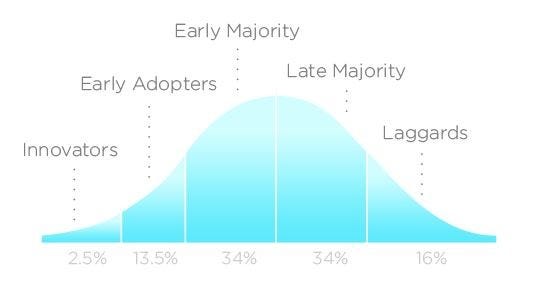
Today, I'm offering you a step-by-step breakdown of what AI Adoption looks like from a user's perspective. First, we'll take a peek into the world of AI from a skeptical retrogrades (Laggards) point of view, and then, we'll gradually rise to the level of experts in their field (Innovators). In the process, we'll try to figure out where we stand and what we need to do to get to the next steps.
Sharing is caring! Refer someone who started a learning journey in AI!
Find out your AI Adoption score
But before we get into the terms and the Adoption scale, I have a quiz for you. This test will help you determine whether you are a Laggard or an Innovator.
At the end, you will know which AI ownership group you belong to, and you will also get a summary of the other levels. The quiz will take you no more than five minutes.
Types of AI Adopters
Laggards
The first point is the easiest and, in my opinion, a bit sad. In a fast-paced world, there are always people who refuse to embrace innovation. They often attribute their slowness to skepticism towards anything new, including AI.
But sometimes, you can see bigger issues. For laggards, the path to AI adoption seems daunting and uncertain. Many hesitate to explore chatbots and other models because of misconceptions about the technology. But by embracing change and using the right tools, laggards can gradually overcome their fears and get on the path to AI adoption.
Along the way, users must receive support, training, and resources to be empowered to harness the transformative potential of AI. With the right approach and mindset, even the most skeptical individuals can use the models to grow in their fields.
What tools can we recommend for those who are behind on technology? The most basic are the free version of ChatGPT, Dall-E 3, Grammarly, and Fathom. These tools don't require skills but make our lives a little easier. They will allow you to familiarize yourself with the capabilities of AI and understand the functions it can perform.
Late Majority
The late majority occupies a significant part of the AI adoption spectrum. This is a very general group that combines "not the very first" with "not the very last." I would call these users conservative pragmatists.
These users approach AI adoption with caution, observing those who have already done it. They also look for proven solutions before implementing changes in their work. For the late majority, the path to AI integration looks like balancing skepticism and curiosity.
One of the main challenges facing the late majority is the need for real evidence of the benefits and effectiveness of AI. To address this problem, tools that offer clear value and ease of implementation become invaluable assets.
For such users, I recommend exploring ChatGPT alternatives to find the best model.

One of these: Google Gemini, Bing AI, or Claude. They can make it easier to work with documents, write articles, or explore new areas.
If you are having a hard time deciding which one to choose, check this newsletter:
In addition, you should also look at more specialized tools. In particular, you might like Midjourney for creating images and Synthesis for translating text into speech.
Early Majority
The early majority is a key force driving the widespread adoption and integration of AI across industries. In contrast to the cautious late majority, these users demonstrate a proactive approach to innovation, recognizing the strategic importance of AI for competitive advantage.
For these forward-thinking individuals, the path to AI adoption is characterized by a willingness to explore new technologies and invest (not only money but also their time) in scalable solutions that promise tangible benefits. One of the biggest challenges faced by the early majority is integrating AI into existing workflows.
As they look to use AI to improve productivity, compatibility with legacy systems becomes a critical factor. These users are no longer satisfied with simple chatbots and consumer models. Instead, they want highly specialized tools for their work or content creation.
At first, they should check out Jasper AI & Copy.ai for writing quality posts or Descript & Runway for working with video and audio files.
For marketers and startups, platforms like HubSpot, Pardot, or Marketo, as well as standalone platforms from the GPT Store, can be a good choice.
If you fall into this category, check out this article:
Early Adopters
At the forefront of AI adoption are its early adopters, forward-thinking individuals, and organizations that enthusiastically embrace innovation. Unlike the majority, these pioneers are not satisfied with the status quo. They eagerly seek cutting-edge technologies and applications for AI to gain an edge and shape industry standards.
For early adopters, the path to AI adoption is marked by bold experimentation, collaboration with AI developers, and a search for transformative solutions. As pioneers in their fields, these users often explore new frontiers in the world of technology. Some are testing the newest models that only a select few can access.
At this point, it becomes increasingly difficult to recommend valuable tools, but I will still suggest a few useful things.

DataRobot, Dify, Verta AI, and Voiceflow offer advanced machine learning and deep learning platforms that enable early adopters to create solutions customized to their unique requirements. By leveraging big data, these platforms enable the creation of applications that drive industry transformation.
Some early adopters are also willing to look really deep. For example, to study computer vision. Such enthusiasts use the following tools: Amazon Rekognition, Clarifai, and CloudSight. Additionally, users often comprise a limited pool of individuals who can test new models like OpenAI's Sora.
If you identify as an early adopter, it may be time to contact big tech!
Subscribe to stay in tune with AI breakthroughs!
Innovators
At the forefront of AI adoption, we look at innovators. Those who strive to push the boundaries of what's possible and drive breakthroughs in the industry through a relentless pursuit of innovation. They are no longer just early adopters who use proven AI solutions.
Innovators are exploring and independently developing new technologies for our bright future. These are the ones we talk about in our newsletters, and they make headlines in major media outlets. Typically, innovators are founders of AI startups, next-generation entrepreneurs, or leading professionals from IT companies.

Innovators utilize Deepset AI, Paperspace Gradient, Domino Data Lab, Replicate, and other sophisticated tools. These platforms go beyond basic AI and delve into complex areas like user model development and large language models. So, if you don't see opportunities for their applications, that's fine; they just don't fit into your daily tasks.
Conclusion
Different user perspectives, needs, and concerns shape the demand for AI models. From the initial skepticism of laggards to forward-thinking innovators, each stage opens up opportunities for people looking to use AI. So, you should realize that no single graph or test will provide a completely accurate assessment of your knowledge.
For example, I'd like to put myself in early adopters, as I've tested many platforms in early access. However, my AI tools align with what the early majority used. So I encourage you not to box yourself in but keep your ears open.
Don't try to automate everything at once and use all possible AI Tools. This will only burden you more, not make life easier. Instead, think about weaknesses in your work, studies, or hobbies. Then, pick a few suitable models that will help you regularly.
How do we choose such AIs? Well, that's what we're here for. We will continue to follow new AI solutions and test models to tell you about the most valuable platforms!
So, where are you on the AI Adoption scale? Tell us in the comments!
This article was first published in the Creators AI newsletter. View the original edition.