Buy & Sell AI Startups: from $1K TO $100M
"Hey, guys, I have a startup for you."
Hi!
It seems that building startups for sale is morphing into an increasingly reliable business model. According to Acquire founder Andrew Gazdecki, more than 500 buyers and 100 startups join the platform daily. Against this backdrop, more and more entrepreneurs are planning a profitable exit from day one.
Let's explore this topic today. I invite you to look at an example of a successful exit, discuss selling AI startups, and identify a few critical factors for an excellent deal.
In this newsletter:
- A great example of selling an AI startup
- Where to sell ( and buy) AI startups
- How to prepare your startup for listing
How It Works | Real Case Study

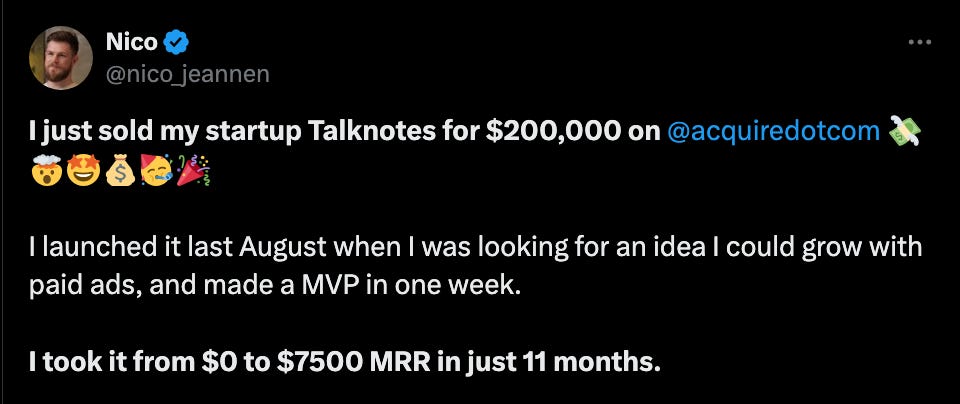
Today, we have a fairly recent example: Nico Jeannen, who sold his Talknotes startup for $200,000 through the Acquire platform. Early last month, Nico wrote a post on X (ex-Twitter), where he revealed details about the startup, its development, and the decision to sell the startup via the Acquire.
For now, we’re not interested in the company, so here's your quick reference:
Talknotes is a notes app that records your thoughts and uses AI to transcribe, clean, and structure the information. It supports over 50 languages and is now available on Android, iOS, and the Web.

Nico launched Talknotes in August 2023, about a year ago. Since then, the creator has been developing the platform, improving its features, and promoting it through popular AI project marketplaces. Talknotes found its customer, so 11 months after release, Nico reached an MRR of $7500. And then... Well, he burned out.
Multiple bugs slipped into the app, and I had to spend 2 days fixing everything in an emergency while revenues plummeted. This completely fucked me up mentally and had a hard time working on the app after that.
To avoid even more burnout and depression, Nico listed Talknotes on Acquire (we'll talk about this platform a bit later) for $200,000, spoke about the planned deal on his social networks, and waited. He also mentioned that he could have sold the app for $300,000 as well but wanted to close the deal as soon as possible.
Pretty quickly, Nico found a buyer, almost lost the deal due to Escrow (you can read what it was about here), but was still able to do an exit later on. The creator took some time off to reboot, rest, and plan new projects to launch.
Keep your mailbox updated with practical knowledge & key news from the AI industry!
I see a few small conclusions that can be drawn from this case study:
- Sometimes you must let go: You shouldn't dwell on one startup if you're close to burnout. Even if your product is booming and even if you feel like you're about to conquer a new peak.
- Don't chase the maximum price: Although Talknotes could have been sold for $300,000, Nico suggested a lower price. And it makes sense: this way, you'll commit faster and get more time to prepare for your new startup.
- “You only need to win once to snowball everything.” And the last, rather motivating conclusion from Nico himself is that you need to try all the time. He has launched over 40 projects in 7 years. Most of them failed, but a few took off, which was worth it.
By the way, if you want to know how to build a startup quickly and not burn out, this newsletter is for you:
Now, let's move on to an overview of the marketplaces and the AI projects you can find there. This will help us understand the market, evaluate our own startup, and understand what we can expect as buyers.
Buy & Sell: From $1K TO $10M
Starting with Acquire's review, it's a fairly obvious choice. The Nico case proved the effectiveness of this platform, and it is also one of the most popular: there are enough sellers and buyers on it. I propose to go from more to less: we will first deal with the most affordable offerings and then move on to the big companies.
Of course, with an eye on artificial intelligence.
$1,000 — $30,000
So, we're looking at starting offers in the $1,000 to $30,000 range. Acquire has the most of these offers. This category typically includes nascent AI startups or projects in the very early stages. These startups may offer unique ideas or proof-of-concept products but generally lack significant traction, revenue, or a large customer base.
Buyers in this range often look for innovative concepts, potential intellectual property, or development teams with promising skills. This is a suitable category for entrepreneurs who want to experiment with AI or add small-scale innovations to existing businesses.
Like this one:

It is an AI startup from France that has developed a platform for building, testing, and distributing specialized AI agents without code. The development team consists of just one person and the trailing 12 months (TTM) revenue is $4,000.
The asking price for this startup is $11,000.
It is not a very outstanding performance, but it is not a huge amount to buy a viable business either. I'd say this looks like a pretty good deal for someone who knows how to set up the development of this product or integrate it into a larger platform.
And we're moving on.
$100,000 — $1M
Startups in this valuation range have likely developed a more mature product with some level of market validation. They may have a functioning AI product, initial customer traction, and some revenue. These companies are appealing for buyers looking to scale their business with a more reliable and established AI solution.
The risks are lower compared to the lowest range, but there's still room for growth and innovation. Ideal buyers include mid-sized companies seeking to enhance their AI capabilities or investors aiming to nurture and grow a startup.
Here's one example:
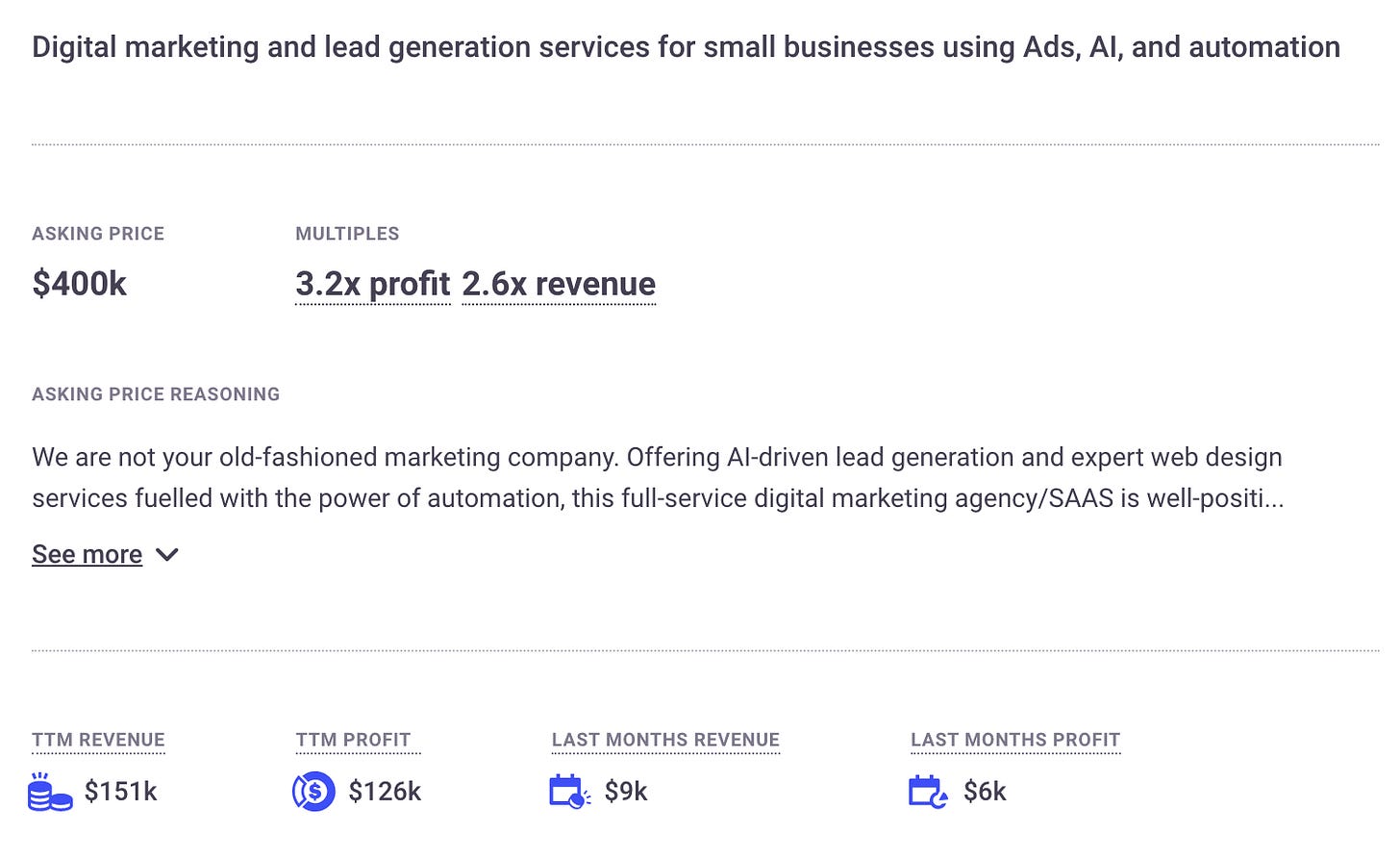
Here, we are dealing with a Canadian SaaS startup that specializes in AI-based lead generation. The platform automates processes, turning cold leads into loyal customers 24/7, and also offers web design services and other solutions. The project team consists of 2-20 people. TTM revenue is $151,000 and TTM profit is $126,000.
The asking price for this startup is $400,000.
Here's an offer that looks more serious, especially if we fully trust the current owner's description (which we clearly shouldn't). Nevertheless, this product has a ready user base, partners, and reasonable financials.
There are not very many such offers on the market.
Sharing is caring! Refer someone who started a learning Journey in AI!
$1M+ AI Startups
These are typically well-established AI startups with significant market presence, a solid customer base, and consistent revenue streams. Acquisitions in this range often involve strategic investments, where the buyer seeks to integrate the AI solution into a larger business ecosystem or acquire technology and talent that can give them a competitive edge.
Due diligence is crucial here, as the stakes are higher. Typically, buyers include large corporations, private equity firms, or other established companies in the AI space looking for high-impact acquisitions.
Here's an example of a really impressive startup:
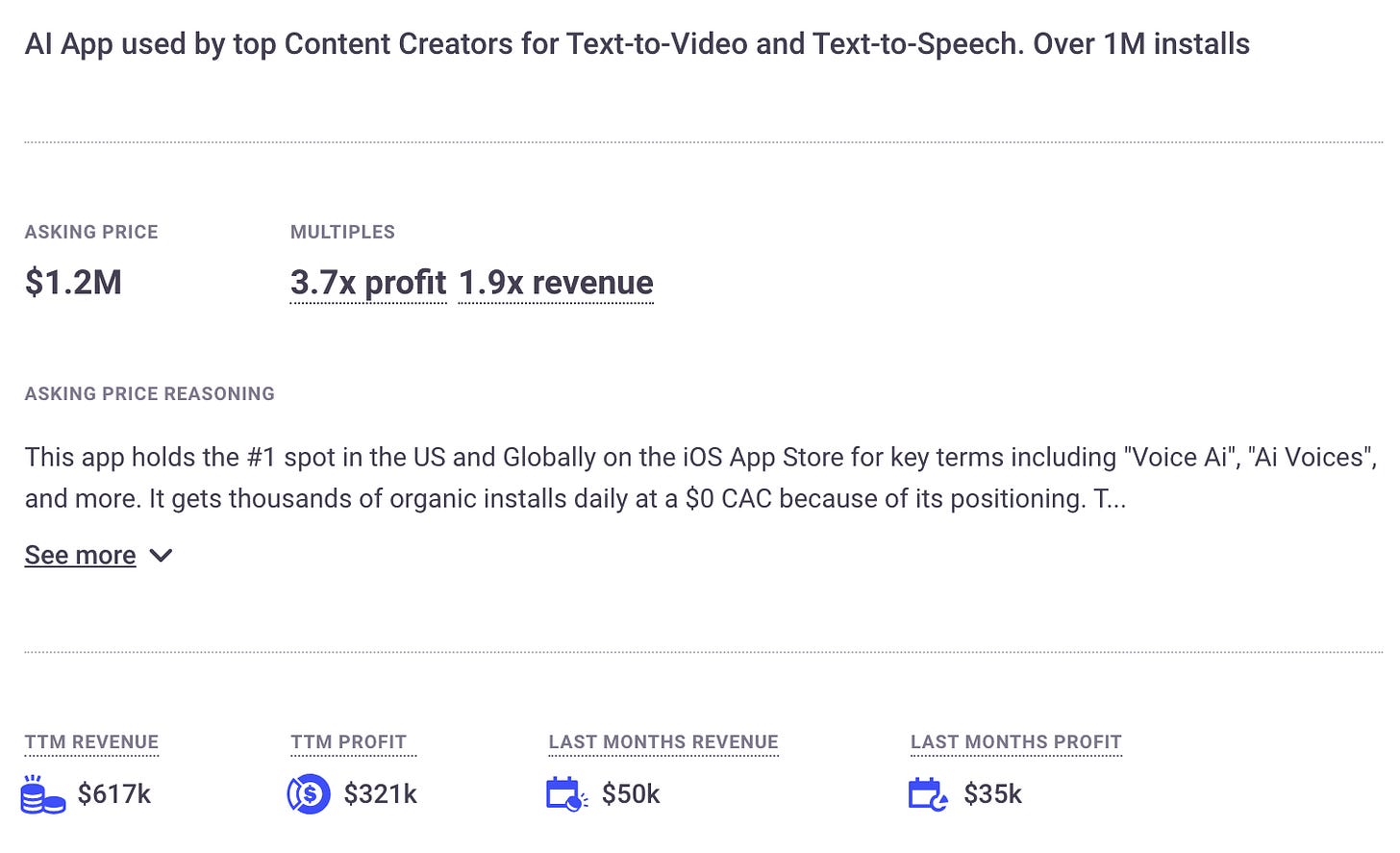
And yet another Canadian AI startup. This time, we're talking about a mobile app that generates digital voices and covers from any song using your voice or the voice of other characters. TTM revenue is $617,000, and the profit is $321,000. In addition, the company says it now has over 100,000 users, and the audience continues to grow.
The asking price for this startup is $1.2M.
In some ways, analyzing such projects is even easier than in the case of more affordable offerings. There are not very many such projects. Furthermore, the owner claims that his app holds the #1 spot in the App Store when you search for “Voice AI” and “AI Voices.” So, you should have no trouble figuring out who they're talking about without contacting the ad author.
How to List Your AI Startup
The process of listing your project is quite simple. When you log in to Acquire, the platform will immediately offer step-by-step instructions on how to list your startup.
Here's what you need to do:
- Choose a Category: Select the category that best fits your product.
- Enter Basic Information: Provide your startup's name and URL.
- Add Founder and Startup Details: Include essential information such as your name, launch date, team size, and location.
- Describe Your Business Model: Detail your business model to give potential buyers a clear understanding of how your startup operates. Include specifics to make your business more attractive.
- Technology and Competitors: Discuss the technology behind your startup and outline your competitors.
- Growth Opportunities and Sale Reasons: Explain potential growth opportunities, reasons for selling, funding sources, and what assets are being sold.
- Share Key Metrics: Provide important metrics such as revenue, profit, and growth rankings. Be honest; this is often the first thing a potential buyer will review.
- Complete Your Profile: Fill in any remaining fields, including details about yourself and your startup.
- [Optional] Upload Financial Documents: To boost credibility, consider adding a profit and loss statement and other supporting documents.
- Marketing Your Startup: Craft a compelling description, add relevant keywords, and set your asking price. Ensure that your pricing is justified to attract serious buyers.
The last step is to leave your contacts and wait. If your offer is good for the market, a buyer will be found.
Acquire Alternatives
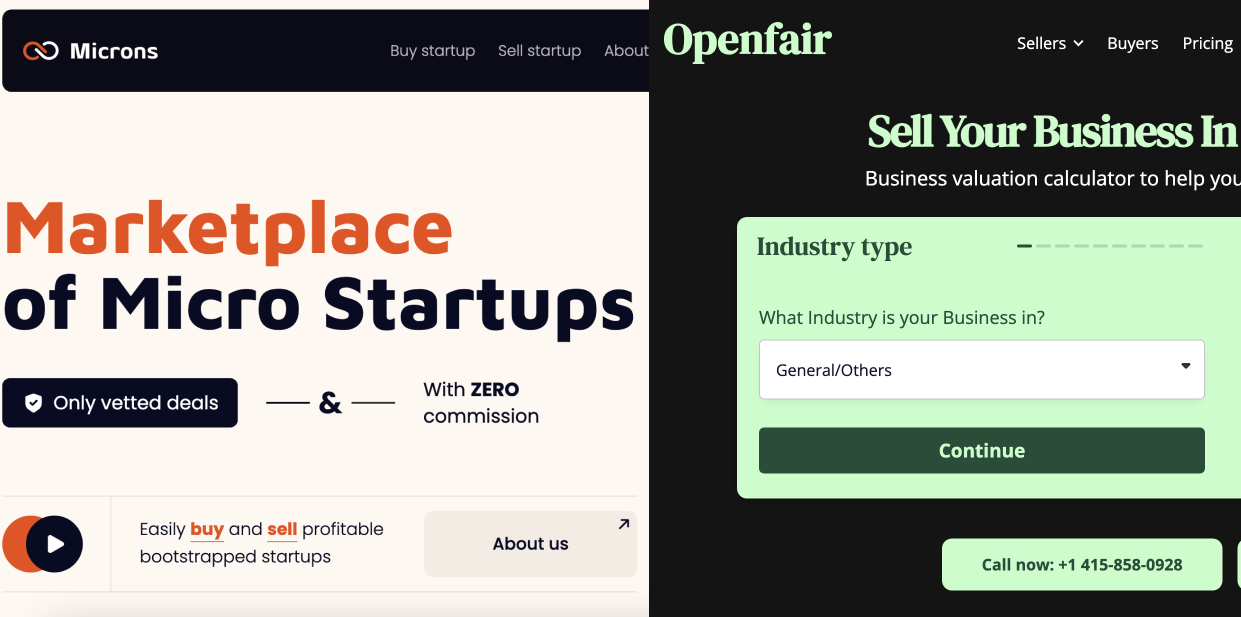
If Acquire doesn't meet your needs, you might want to explore other platforms like Microns.io and Openfair.co. These alternatives offer a range of opportunities for buying or selling startups and projects that align better with your specific goals.
Microns.io focuses on helping entrepreneurs find micro-startups that are ready for acquisition, making it an excellent choice for those looking for smaller, more manageable ventures. Openfair.co, on the other hand, provides a marketplace for startup projects and online businesses, offering a broader selection of opportunities.
Final Tips
Instead of the traditional conclusion, today I'm going to allow myself to give you some tips on buying and selling an AI startup. Here are a few thoughts on the subject:
For Buyers:
- Assess Technology: Ensure the AI tech is robust and scalable. Request demos, technical audits, and customer testimonials.
- Market Fit: Verify the startup addresses a significant market need. Conduct a market analysis to confirm demand.
- Review Financials: Check the financial health and business model viability, focusing on profitability and growth potential.
- Post-Acquisition Integration: Plan for integration costs and team retention to ensure smooth operations.
- IP Verification: Confirm the startup owns all IP to avoid legal issues.
For Sellers:
- Highlight USP: Clearly communicate what sets your AI startup apart, emphasizing your competitive advantage.
- Clean Financials & Legal: Organize financials and legal documents to build trust with buyers during due diligence.
- Realistic Valuation: Price your startup based on market trends to attract buyers without undervaluing your business.
- Prepare for Due Diligence: Be ready with all necessary documentation and anticipate buyer questions.
- Transition Planning: Offer a clear plan for post-sale transition, including potential involvement to ensure success.
Looking for a new startup or planning to sell yours? Tell us in the comments!
This article was first published in the Creators AI newsletter. View the original edition.