ChatGPT Will Be Your Doctor?
Benchmarks & Real Cases of AI in Healthcare
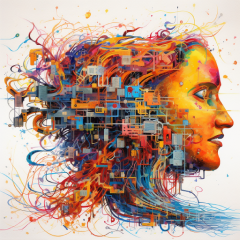
Would you trust an AI to give you a diagnosis? Or spot cancer before a human doctor could?
We’ve seen AI excel in coding, sales, and even law, but now it’s entering the operating room, the therapist’s office, and even your smartphone’s wellness tracker. I’m not sure if I’d trust an AI agent to treat me, but I’m curious: How good are these tools really? Should your doctor be worried?
Today, we explore OpenAI’s HealthBench, wild Reddit health experiments, and hands-on tools you can try on your own body (yes, really).
# What is HealthBench? And Why Does it Matter?
HealthBench is an open-source benchmark created to test how well large language models (LLMs) perform in real-world healthcare situations.
Think of it like a standardized test for AI, but instead of math or reading, it evaluates medical reasoning. The benchmark includes 5,000 multi-turn conversations, each scored against over 48,000 physician-written criteria.
The goal? Measure how well AI handles tasks like emergency advice, symptom evaluation, and global health queries.
Keep your mailbox updated with practical knowledge & key news from the AI industry!
# Why is HealthBench Important?
You’ve probably heard the phrase "failure is not fatal." But even the best motivational speaker wouldn’t say that to their doctor.
An error in image generation might just ruin your day; however, AI giving you the wrong health advice might end your life. This is why we need benchmarks to essentially measure how bad AI tools can be.
HealthBench addresses this by tracking high-risk errors using “worst-at-k” scores, which reveal how often models produce dangerously incorrect answers.
It was built using real medical questions and tasks from expert-reviewed public datasets like MedQA, MedMCQA, and PubMedQA. These questions cover all kinds of scenarios doctors, patients, and medical students deal with every day. With input from 262 doctors across 60 countries, the benchmark includes a wide mix of situations, making sure models are tested on real clinical reasoning, not just memorized facts.
HealthBench gives AI startups a clear way to test and improve their healthcare tools—not that there weren’t benchmarks before, but this one raises the bar for proving safety and reliability. For AI healthcare startups, that’s a big deal when pitching to hospitals, regulators, or investors.
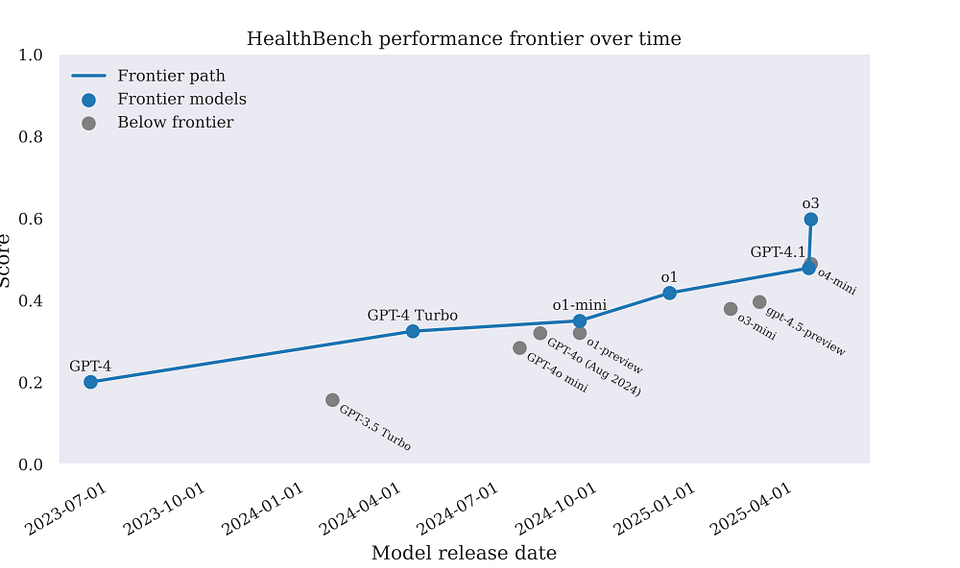
Open AI models HealthBench
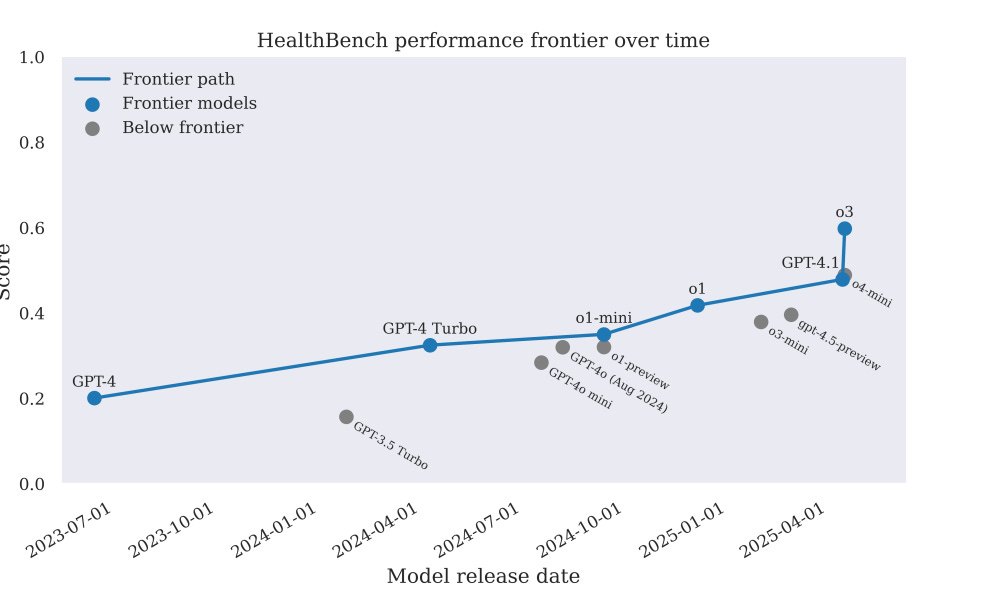
Comparing the performance of OpenAI models over time using HealthBench.
Frontier AI ≠ every new model: Not all newer models are better in the medical domain. Specialized or smaller models (like “mini” or previews) often underperform compared to full models.
HealthBench by OpenAI is a power move that sets the gold standard for medical AI performance, turning clinical credibility into a leaderboard game where only frontier models matter—and startups either align fast or get buried under irrelevance.
Applicable AI Cases in HealthCare Today
You may not trust AI to give you injections (yet), but here are a few areas where specialists and consumers believe in AI (or API wrappers)
OpenEvidence
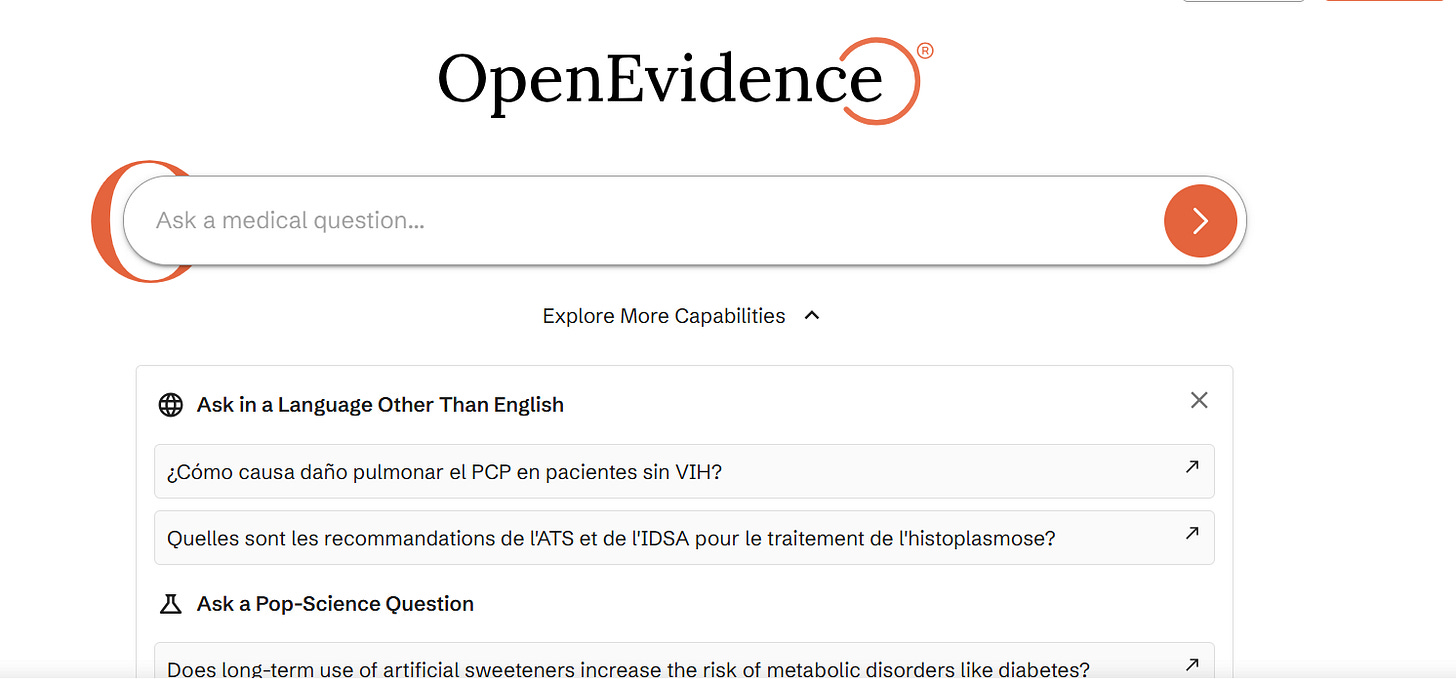
Imagine being a doctor trying to keep up with twice the number of journals you have on the internet every 5 years. Sounds crazy, but it’s one of those things doctors need to do to keep themselves informed and help us stay healthy.
That’s where OpenEvidence comes in: it’s a smart medical search tool that helps healthcare professionals quickly find and understand the research that actually matters. That way, they can focus on treating patients, not digging through papers.
Key Features
- Medical Research Aggregation – Gathers vast amounts of clinical research into a single platform.
- Evidence Synthesis – Analyzes and summarizes complex medical literature for easier understanding.
- Multiple Language Support – You can ask questions in Spanish and other languages aside from English
- Clinically Relevant Insights – Focuses on practical, actionable information for healthcare decision-making.
Glass Health
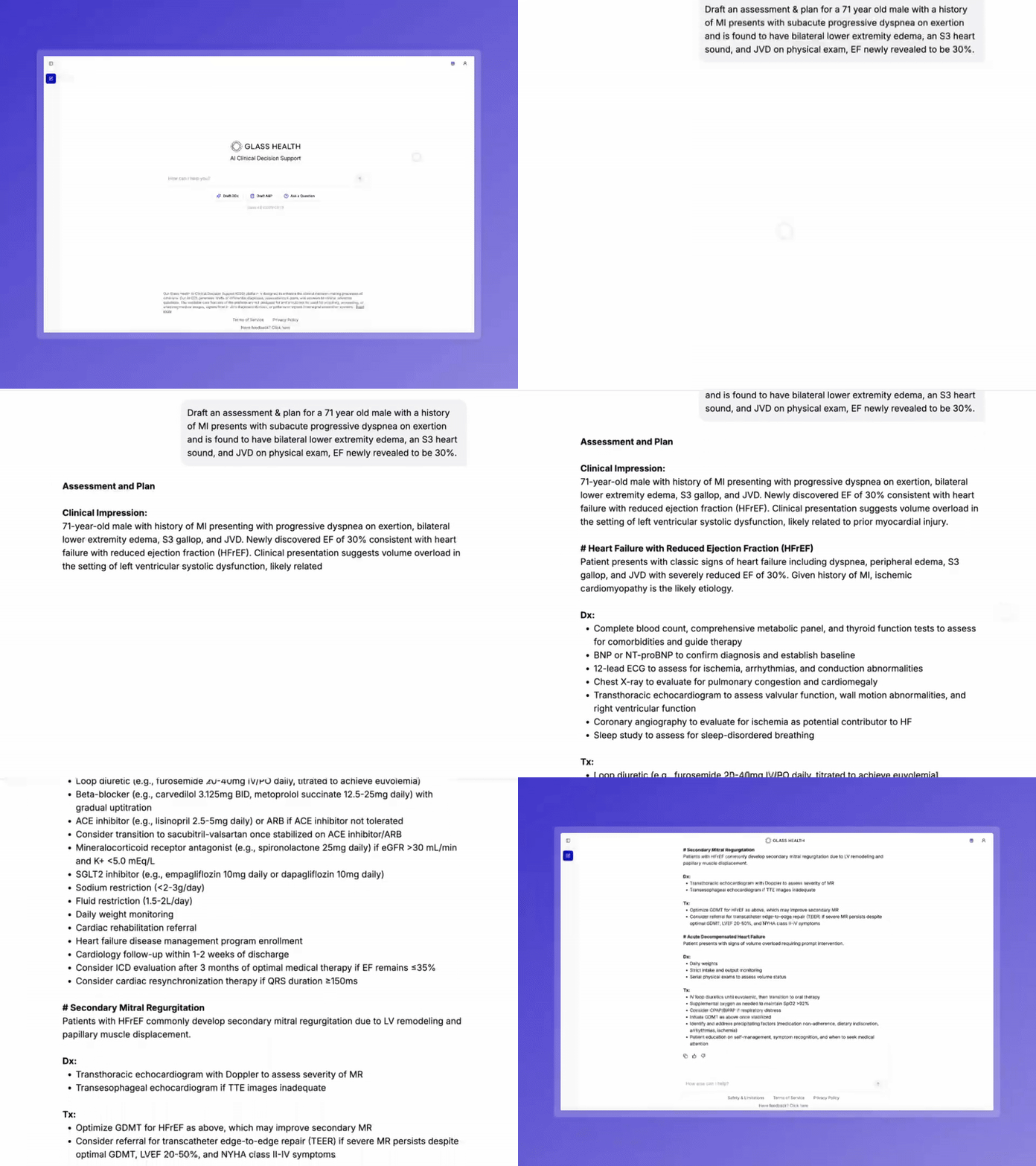
Glass Health helps medical students and doctors generate differential diagnoses and clinical plans, accelerating how they approach complex cases. It doesn’t replace medical judgment, but acts like a clinical brainstorming partner that can reduce cognitive load.
By integrating evidence-based medicine with cutting-edge AI, Glass Health strives to boost diagnostic accuracy, promote health equity, and optimize patient outcomes globally.
Key Features of Glass Health
- AI-Powered Clinical Decision Support – Combines advanced AI with peer-reviewed medical knowledge to assist in diagnosis and treatment planning.
- Differential Diagnosis Tool – Analyzes patient summaries and suggests potential diagnoses to explore.
- Clinical Plan Drafting – Generates assessment and plan drafts based on patient summaries, incorporating evidence-based recommendations.
- Guideline-Driven Recommendations – Applies up-to-date clinical guidelines to ensure accuracy and relevance in care plans.
- Clinician-Designed Platform – Developed by experienced physicians from top institutions to align with real-world clinical needs.
- Workflow Optimization – Streamlines diagnostic and treatment decisions to improve efficiency in medical practice.
For non-doctors, this means your doctor can get faster, smarter support when figuring out what’s going on with your health. Instead of starting from scratch, they can use tools like Glass Health to quickly explore possible diagnoses and treatment plans, so you get the right care sooner, backed by the latest medical knowledge.
If you ask me, I think it’s amazing!
Google Med-PaLM 2
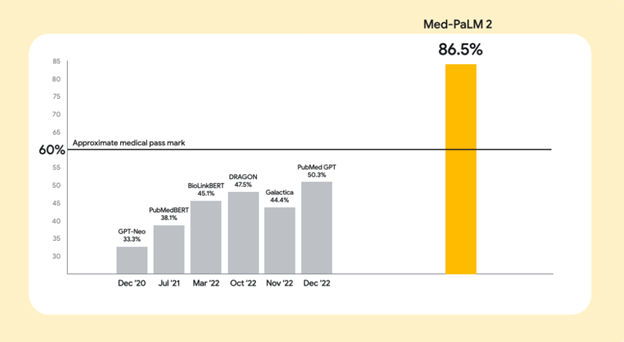
Still in development, Google’s Med-PaLM 2 has been trained on a wide range of medical data to answer health-related questions with a high level of accuracy. While it is not yet available for public use, it offers a glimpse into the future of healthcare where AI could help doctors make faster and more informed decisions, and give patients better access to reliable information.
And knowing Google, especially with the amazing work they are doing with the Gemini platform, we can expect that MedPaLM 2 will be a major breakthrough. Once it is ready for release, it could raise the bar for how AI supports medical professionals and improves healthcare experiences around the world. Until then, fingers crossed.
Youper
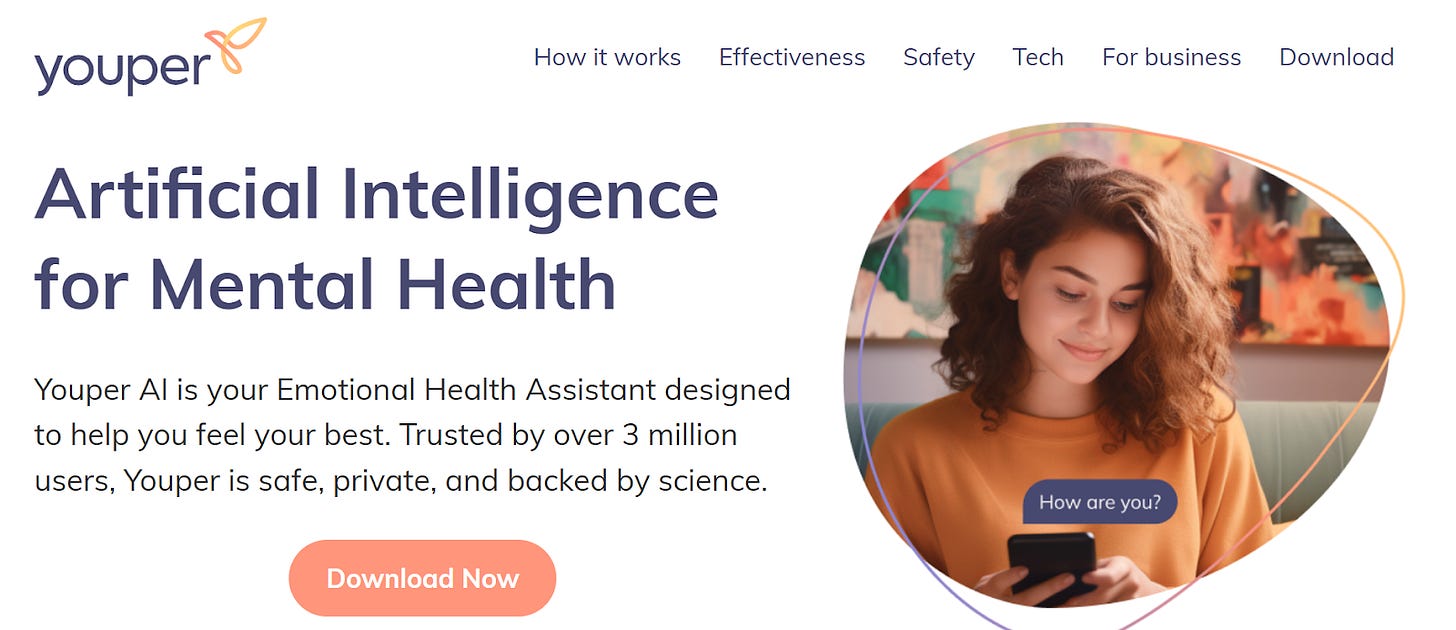
Youperis an AI-powered mental health app that uses Cognitive Behavioral Therapy (CBT) to provide quick, effective emotional support. It was developed by a team of medical professionals and engineers who wanted to make mental health care more accessible for people.
Backed by research from Stanford University, the app claims that over 80% of users reported feeling better after using it. The app offers personalized mental health assessments, real-time CBT-based chats, symptom tracking, and actionable insights to improve emotional well-being.
Key Features of Youper
- AI-Powered CBT Chat – Get instant mental health support through therapeutic conversations.
- Personalized Mental Health Assessment – Screen for common conditions and customize your experience.
- Symptom Monitoring – Track mood and symptoms to identify patterns over time.
- Mental Health Insights – Receive data-driven feedback to improve self-awareness and resilience.
- Secure Mental Health Record – Access past conversations and progress in a private, organized space.
While Youper and replica don’t replace licensed therapists, they offer accessible and judgment-free environments for emotional support.
Google Derm Assist
With Derm Assist, users can upload photos of skin conditions and get suggestions on what might be going on. It’s part of Google Health’s AI projects, designed to make it easier for people to get quick, helpful insights about their skin, without jumping straight to a doctor’s visit.
The tool asks a few questions alongside the photo and uses AI to narrow down possible conditions from a dermatological database.
Right now, it’s not available as a public app or website that you can just download or browse. It’s mostly in testing and only available in certain regions like the EU, where it’s been cleared as a Class I medical device.
It’s not meant to give a full diagnosis, but rather to help you figure out what might be worth paying attention to. Unlike other tools here, it's a glimpse into how AI could soon help us keep tabs on our skin health right from our phones.
# Personalized Health Coaching with AI
Last week, there was a post about coaching and how you can use GPT and its memory feature to consult on your personal questions, and how ChatGPT can offer helpful suggestions. We discussed using ChatGPT as a health coach and explored a variety of prompts related to personal well-being and self-coaching. If you’re interested in more examples and a deeper dive into eco-friendly and supportive prompts, definitely check out that earlier post:
New Portion of Prompts
Act as my wellness coach. Ask me daily questions about sleep, diet, and stressAnalyze my Strava/Fitness App workout log and suggest recovery strategiesThe best part of all these is that, with AI memory (like ChatGPT’s new memory feature), you can even get more out of your AI health coaching. Since the generative AI tool retains a few specific details about you, it can give you more tailored and effective suggestions.
For instance, instead of asking you how you sleep, ChatGPT can look through your sleep pattern and offer you insights. So, a new ChatGPT prompt using the memory function might look like this:
I have logged my seep for the past two weeks. Can you check my sleep patterns and suggest if I am getting enough sleep and how I can improve?You could also use it to check your symptoms like this:
I’ve had headaches every afternoon this week. You know I work long hours on screens and drink less water when busy. Could this be the cause, or should I worry?# ⚠️ The Limits: Why You Should Stay Skeptical
The possibilities of bringing AI into healthcare are huge and exciting. However, even with advanced tools and their thinking capacities, it’s important to know the limits. AI, like any tool, is not infallible—especially in matters as critical as your health.
Here’s why caution is essential:
❌ Hallucinations and Errors
One of the biggest challenges in using AI for healthcare is the risk of hallucination—a term for when language models generate information that is factually incorrect or entirely made up.
In a medical context, that could mean:
- Suggesting non-existent conditions
- Mixing up symptoms
- Recommending inappropriate treatments
The danger is that hallucinations often sound plausible and confident, making them easy to believe. If these outputs aren’t verified by a medical professional, they could mislead users and lead to harmful decisions.
🤷 Lack of Human Nuance
AI can process vast amounts of data, but it still lacks the ability to fully understand context or emotional subtleties, both of which are crucial in healthcare.
For example:
- A doctor might notice hesitation in a patient’s voice and dig deeper, uncovering hidden stress or a family medical history.
- AI, on the other hand, relies solely on what is typed or spoken—it can't read facial expressions, body language, or tone in the same way a human can.
This limitation makes AI poorly suited for personalized diagnoses or empathetic care, both of which are core to the medical profession.
🔒 Privacy and Data Concerns
When you use AI for health, you’re often handing over some pretty sensitive personal info. You probably wouldn’t tell someone at a bus stop about your weird rash or recent blood test results—but an AI? Sure, why not?
And now, with most AI tools like ChatGPT having the ability to remember things you’ve shared, that trust needs to be earned and protected. Without the right safeguards in place, it opens the door to a few not-so-great possibilities, like:
- Your data is being stored insecurely
- Third parties snooping where they shouldn’t
- A data breach puts your health info on display
These risks might sound far-fetched—until you ask ChatGPT to remind you of the health condition you last discussed. Now, imagine you left your computer unlocked and someone else did the same.
That’s why, before using any AI health app, it’s essential to understand how your data is being collected, stored, and shared. Look for tools that are transparent about their privacy practices and, ideally, compliant with health data regulations like HIPAA.
Also, try not to leave your computer open and unattended; you can never tell who might be watching.
🧭 The Golden Rule: AI Is a Helper, Not a Replacement
AI should not be seen as a replacement for doctors, but as a complementary tool. It can help you:
- Track your habits and symptoms
- Ask better questions at your next appointment
- Understand your health data more clearly
But when it comes to diagnosis, treatment decisions, or any serious health concern, always consult a licensed medical professional. Human judgment, empathy, and experience remain irreplaceable.
🔮 What’s Next? The Future of AI in Healthcare
The next five years will radically transform how we interact with healthcare. As AI moves into the real world and becomes more accurate, secure, and seamlessly integrated, it will move from a passive backend tool to an active presence in patient care.
Here’s a look at what’s coming next:
⌚ 1. AI Doctors on Your Wrist
While wearables like the Apple Watch and fitness trackers already monitor your heart rate and sleep, the next generation of devices is starting to offer much more. A great example is Whoop, a wearable that uses generative AI to give you recommendations to improve your training and overall health. Simply choose your goals and areas where you want support, and the AI Coach takes it from there, guiding you with customized advice to help you perform at your best.
In the future, we are likely going to see more wearables that can:
- Analyze your vital signs and detect early warning signs
- Ask follow-up questions (“Have you been short of breath?”)
- Recommend next steps (rest, visit a doctor, take medication)
If you think of it, this might reduce emergency visits to the hospital. If users can discover issues very early, they can quickly see their doctors before it gets too late. It’s genius and life-saving at the same time!
Thanks for reading! Feel free to share it.
🏥 2. HIPAA-Compliant AI in Clinics
In clinical settings, privacy and accuracy are non-negotiable. Expect more hospitals to adopt HIPAA-compliant AI systems that:
- Transcribe doctor-patient conversations
- Assist in diagnosis and documentation
- Monitor patients remotely
These tools will reduce paperwork, improve accuracy, and free up doctors to focus on what matters most: patient care.
👵3. AI Caregivers for the Elderly
Elder care is one of the most promising areas for AI. Voice-activated assistants like Alexa or Google Assistant are already helping with reminders, but soon, they’ll do much more.
Next-gen AI caregivers could:
- Monitor medication schedules and vital signs
- Detect signs of confusion, anxiety, or loneliness
- Offer social interaction and support for independent living
By enabling seniors to safely age in place, AI will ease pressure on families and healthcare workers alike, while improving quality of life.
# Final Verdict: Should You Trust AI with Your Health?
Yes—but only as a supportive tool, not a replacement for medical professionals. Of course, LLMs especially those evaluated by benchmarks like HealthBench, can enhance healthcare accessibility, understanding, and management; they still lack the judgment and training of human doctors.
Today, AI’s most effective applications lie in supportive roles:
- As a diagnostic sidekick, LLMs can help clinicians generate clinical hypotheses and reduce cognitive overload by quickly synthesizing vast medical knowledge. A good example is GlassHealth.
- As a health coach, ChatGPT/Alternatives or domain-specific API wrappers can provide personalized guidance on fitness, nutrition, and mental well-being by delivering timely reminders, feedback, and motivation, especially in combinations with wearables like Whoop.
- As a symptom decoder, AI-powered tools can help users interpret early warning signs and prepare informed questions before a doctor’s visit.
Finally, the future of healthcare will belong to professionals and patients who understand how to use these LLMs & AI Agents. Thoughtful adoption of these tools will unlock faster insights, smoother care coordination, and more informed decisions.
This article was first published in the Creators AI newsletter. View the original edition.