DeepSeek R1: Everything You Need to Know
Perpetrator of Bloody Monday for the USA
DeepSeek and its new AI shook up the tech community.
Everyone in Silicon Valley, including Sam Altman, Andrej Karpathy, and Marc Andreessen, is discussing the latest R1 model. It’s also tearing up the App Store charts and has outperformed ChatGPT in severe tests.
And it's open source. So, you can try it out on your PC for free (I’ll show you how).
Let's talk about this “blue whale,” its AI model, and why it matters.
Keep your mailbox updated with practical knowledge & key news from the AI industry!
Where Did DeepSeek Come From?
Yes, from China, but that is not the point.
DeepSeek is a small company from the eastern Chinese city of Hangzhou, founded in May 2023. This city is well known for its large volume of technology firms. Like the developer of ChatGPT, the Chinese startup didn’t start as part of big tech.
DeepSeek is not among the four dominant Chinese tech companies: Baidu, Alibaba, Tencent, and Xiaomi. The leading investor (and startup founder) is the hedge fund High-Flyer, built by three engineers, Liang Wenfeng, Xu Jin, and Zheng Dawei.
These partners were immersed in AI in 2016 when they were using the technology in the trading industry. Two years later, they had more than $1.4B; in October 2024, they had about $7B. Some of these funds were spent on running its own supercomputer and the launch of DeepSeek.
But that doesn't mean the startup wastes money.
DeepSeek spent only $5.6M and two months building its best AI model. This is pennies compared to the amount OpenAI, Google, and Nvidia invest in the industry. And right after the release of DeepSeek R1, the stocks of major tech firms in the US plummeted.

In one day, Big Tech lost over $1.5T! Specifically, Nvidia's capitalization sagged by $600B, the company's biggest single-day drop. All thanks to one Chinese model.
Speaking of its latest AI.
DeepSeek R1: Hype, Performance, and Political Concerns
The main reason we gathered is the hype surrounding DeepSeek R1. It kicked off last November when the startup showed the R1-Lite Preview. That release went relatively unnoticed by the masses: the AI was limited to 50 messages and didn't offer an API.
However, top industry figures paid attention to the model even then.
Here is how OpenAI co-founder Andrej Karpathy reacted to the release (he was very impressed):
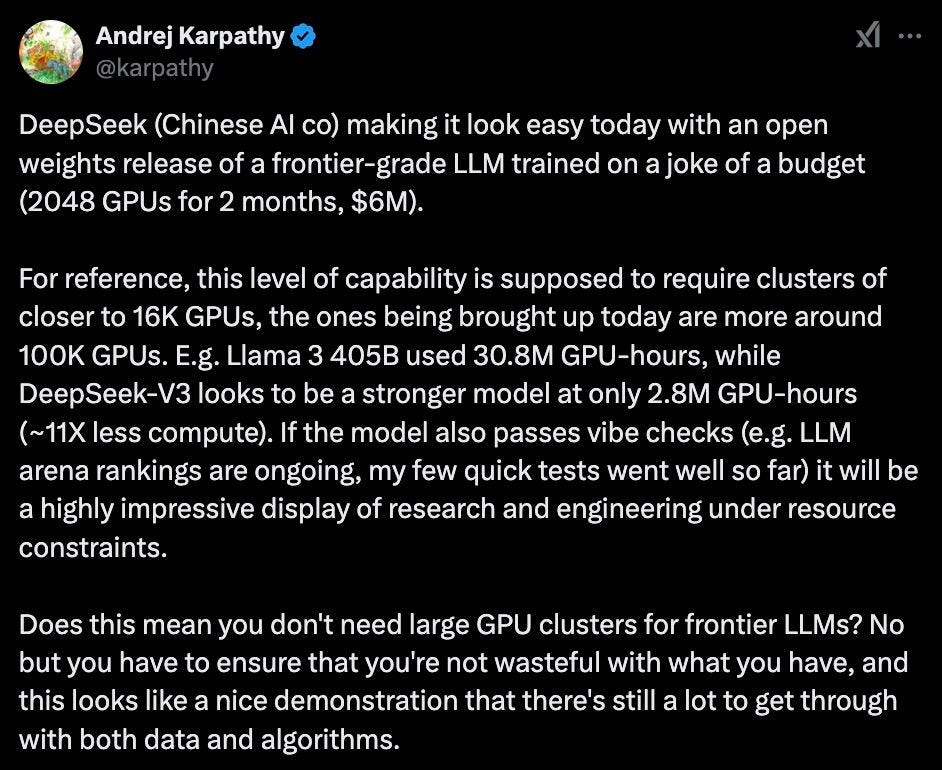
No stranger to the startup and tech industry, Marc Andreessen—co-founder of the VC firm a16z—said the R1 is “one of the most amazing and impressive breakthroughs” he has ever seen.

But some reacted with a great deal of skepticism. Among them was the well-known Sam Altman. Here's what @Sama wrote on X without mentioning DeepSeek directly:

Sam is one of the few people who has the credibility to write this sort of thing. If I had seen this from any other founder, I would have thought it was malicious envy.
However, DeepSeek has managed to win the hearts of AI enthusiasts. A few days after its launch, the AI from the Chinese startup came out on top in the free app category of the US App Store, leaving behind ChatGPT.
In addition, DeepSeek came out as the most downloaded model on Hugging Face. It is strongly beating all competitors—DeepSeek R1 has more than 149,00 downloads.
Let's see what it is capable of (and its main weakness).
Creators’ AI could be a valuable gift for your friend, colleague, or family member. Gifting books is bright, but giving an AI newsletter is a superb move 😎
Performance & Benchmarks
So, DeepSeek R1 is a new open-source large language model. And it's a far cry from other Chinese models that pop up in the public domain every few months. According to the developer, it outperforms almost all competitors, including the best OpenAI solutions in some mathematical, coding, and reasoning tasks.
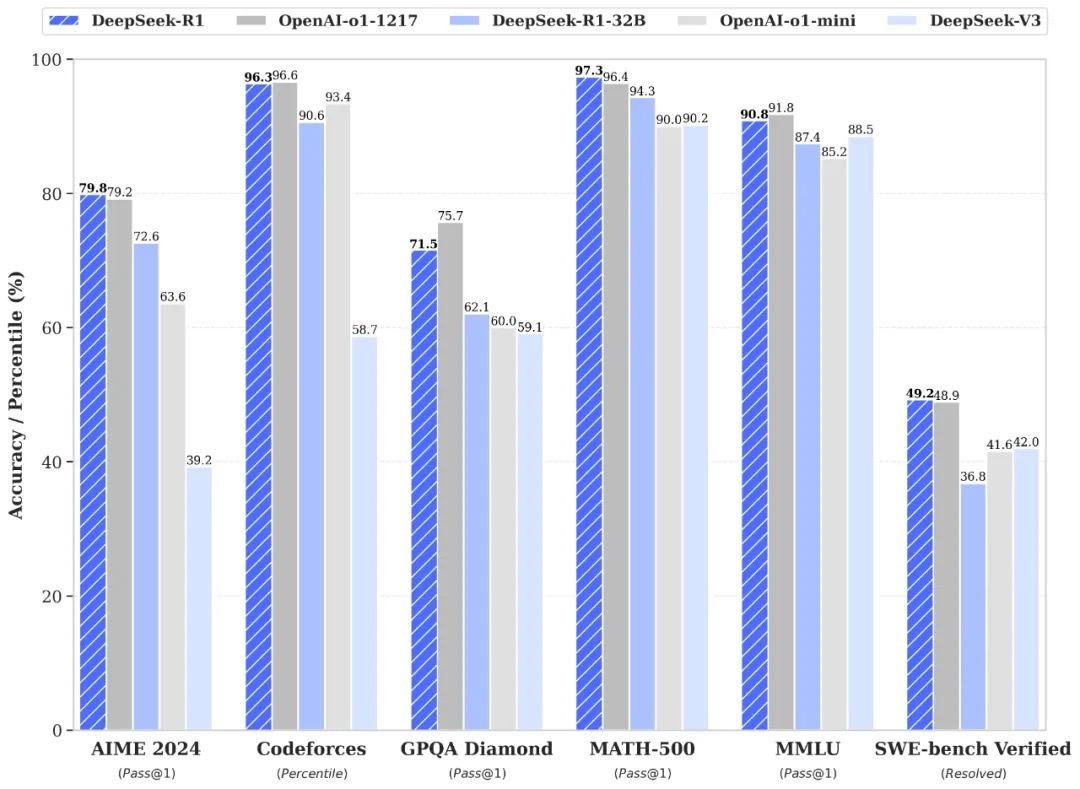
caption...
This model is built upon their previous release, DeepSeek-V3, a mixture-of-experts LLM comprising 671B parameters (more than Meta's largest model, the Llama 3.1 with 405B parameters), with 37B activated per token during inference.
DeepSeek-V3 was trained on 14.8T tokens using 2,048 Nvidia H800 GPUs over approximately 2.788M GPU hours. Like o1 by OpenAI, it uses chain-of-thought reasoning, breaking down requests into "thoughts" to provide accurate responses.
At the same time, it is an open-source project, and it’s much cheaper than GPT and Claude 3.5. DeepSeek-R1 is approximately 95% less costly to train and deploy than o1.
The Chinese model also offers pricing around 27 times cheaper for input and output token costs than o1. And all of this was released under the MIT license, allowing free commercial and academic use.
Many people now say that, in some ways, DeepSeek is more OpenAI than the real OpenAI.
As for limitations—like other Chinese models—DeepSeek-R1 abides by the rules of the Chinese government. This means that the AI won’t comment on Xi Jinping's decisions, Beijing politics, or the event related to Tiananmen Square. What other restrictions are placed on this model, you can tell from the tests.
Here's what you need to do to run them.
How to Try DeepSeek & How to Run It on Your PC
Due to DeepSeek being an open-source model, there are many options for trying it out. Here are the easiest ones:
- The chatbot interface on the website.
- iOS mobile app.
- Android mobile app.
However, this approach will only open us to a fraction of the possibilities. I believe running the model locally is much more interesting. It's safe, free, and fast.
Here's what you need to do.
The tutorial is suitable for macOS and Windows users.
1. Install & Launch Ollama
Ollama is a free tool that facilitates running AI models locally.
- Download the installer from the Ollama website.
For macOS users:
- Unzip the application and run it.
For Windows users:
- Install the app by following the instructions.
2. Choose the Version of DeepSeek-R1 Model
Now, we need to select the version of DeepSeek-R1 that suits us best (and that will fit on your PC). The selection is quite large, but the installation process is the same.
Choose the model that aligns with you:
- 1.5B Parameters: Suitable for systems with limited resources.
- 8B Parameters: Balanced performance for mid-range systems.
- 14B Parameters: Requires more robust hardware.
- 32B Parameters: Demands high-end hardware with substantial VRAM.
- 70B Parameters: Optimal performance but necessitates top-tier hardware.
3. Download the Model on Your PC
To download the selected model, we need to go back to Ollama.com.
- Open the website and type DeepSeek in the search box
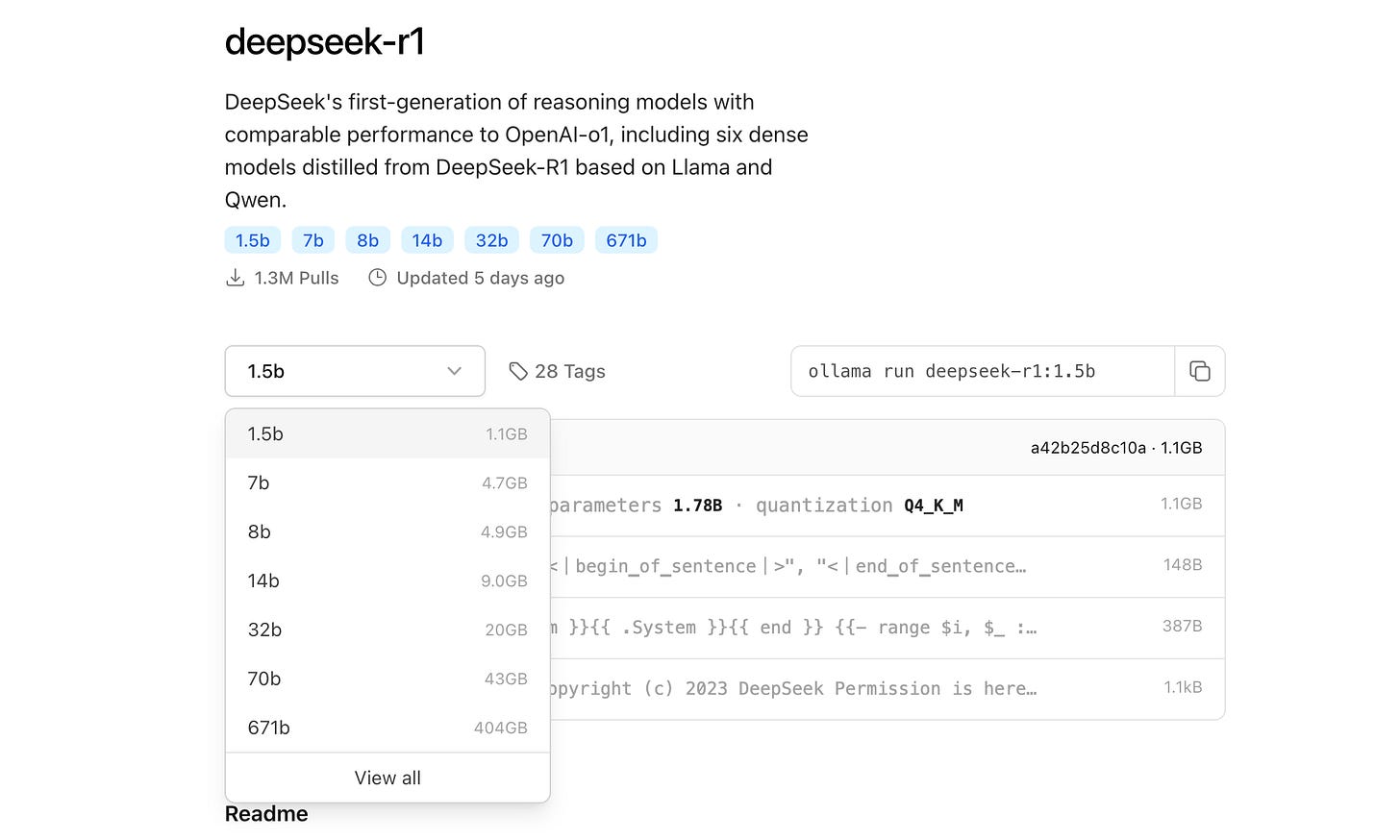
- On the left, select the model, and, on the right, copy the command.
Next, on macOS:
- Open Terminal, paste the command, and press Enter
On Windows:
- Open Command Prompt, paste the command, and press Enter
This will start loading the model. Just wait for it to finish.
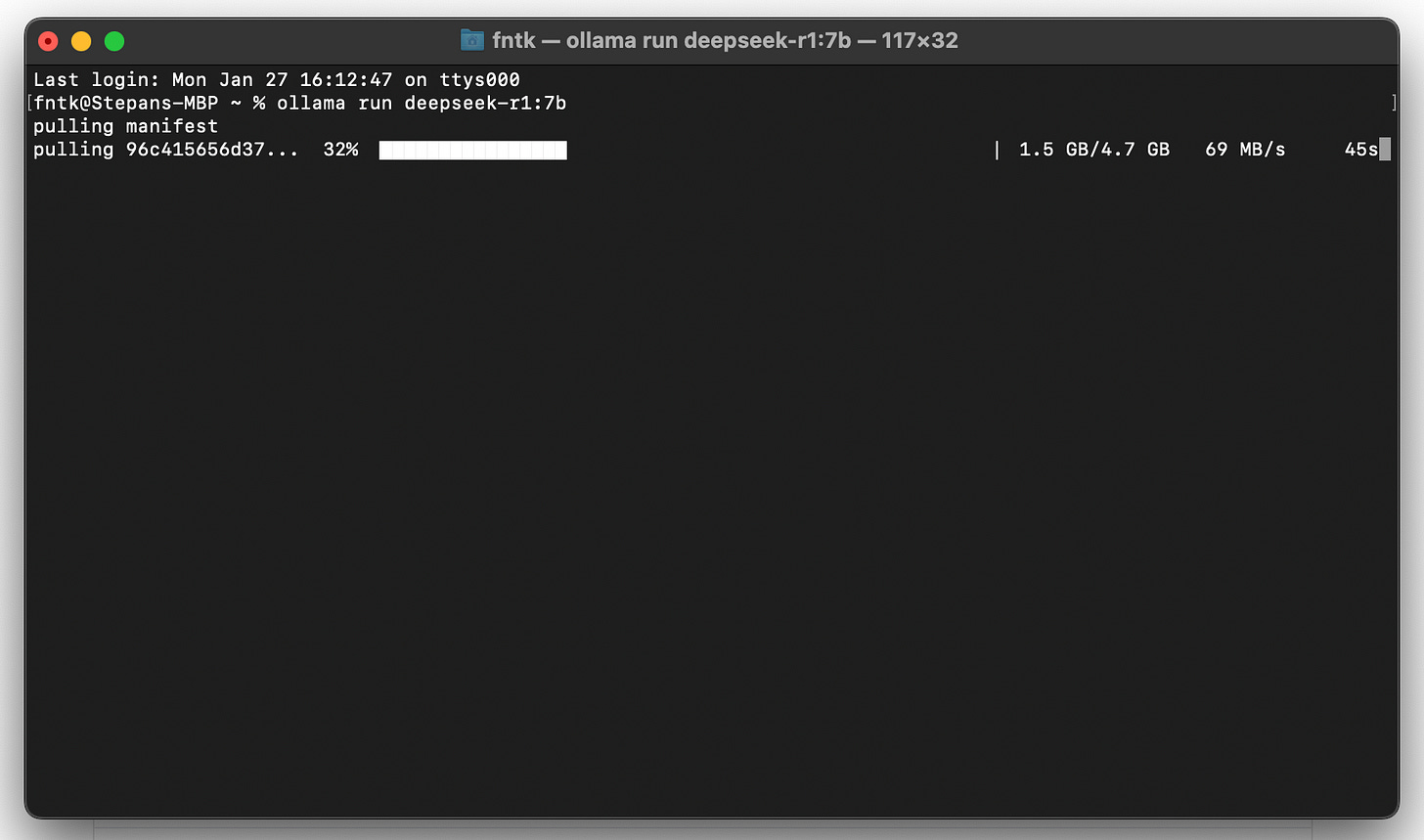
4. Run DeepSeek on Your PC
Now, you can start communicating.
- Ask questions and test the new model!
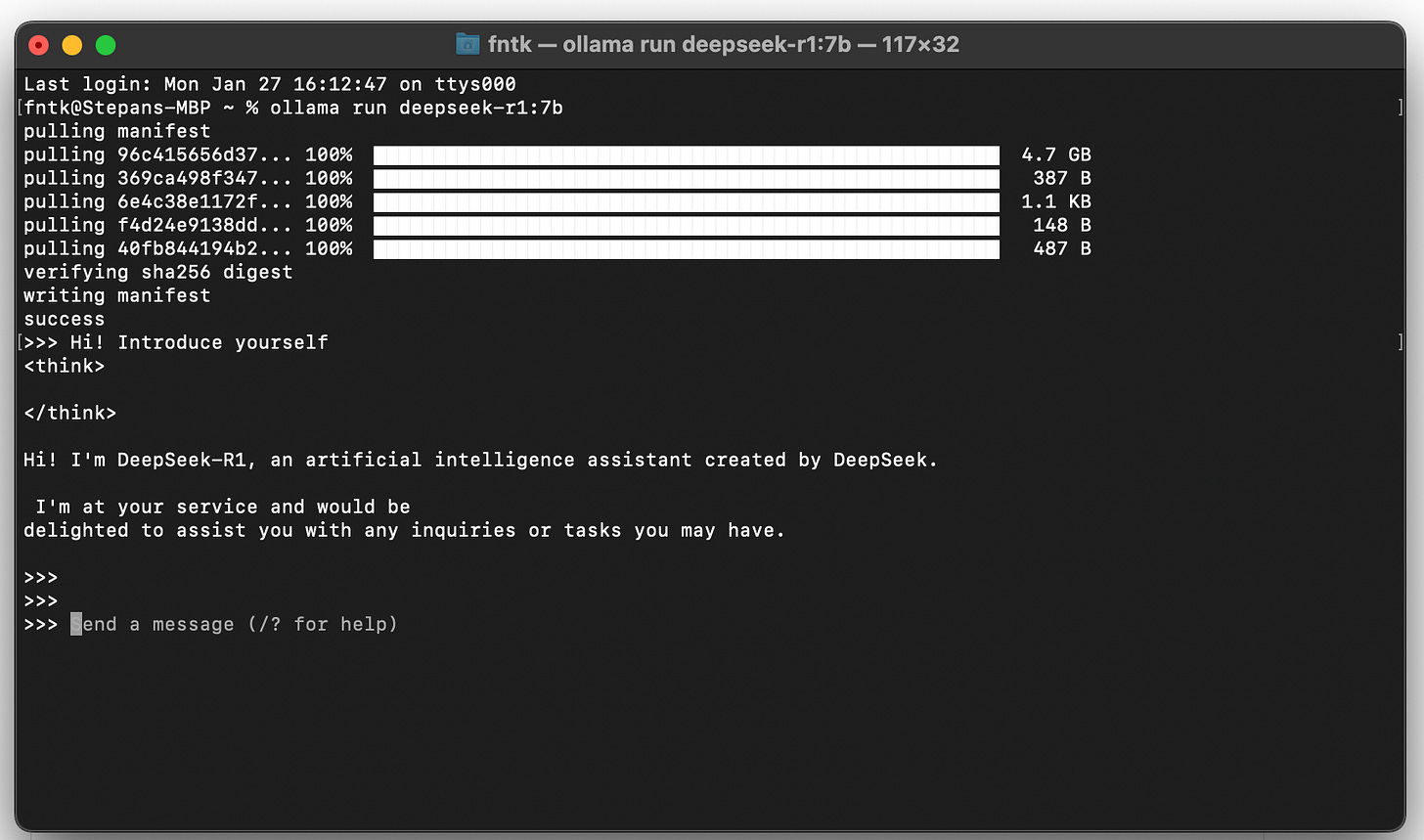
On Windows, you may also need the command “ollama run <model\_name>” Replace the model name with the one you downloaded.
Additional advice
Non-technical users who want to make communication with the chatbot more intuitive and visually appealing can also use additional software, such as Chatbox.
Here's how to set it up quickly:
- Download Chatbox: Visit Chatbox's official website and download the application suitable for your operating system.
- Configure Chatbox:
+ Open Chatbox and navigate to the settings. + Set the model provider to Ollama. + Save the settings.
You can now interact with DeepSeek-R1 through Chatbox's interface.
Prompts for DeepSeek R1
And if you don't know where to start, here are some challenging prompts I found (Thanks to creator Ruben Hassid).
They will help you understand the full range of possibilities of this model.
Prompt 1:
Act as a visionary strategist. For [X], first use DeepThink to define its *Why*, *How*, and *What* using Simon Sinek’s framework.

Then, use Search to validate:

- Are there **industry trends** or **consumer sentiment studies** that align with its *Why*?

- Find **3 real-world examples** of companies/initiatives that succeeded by operationalizing a similar *How*.

- Identify **2 risks** where the *What* might misalign with the *Why*.
Prompt 2:
Act as a risk analyst. For [X], use DeepThink to:

- Build a decision tree with **3 critical choices** and their potential outcomes.

- Assign hypothetical probabilities/impacts (e.g., 30% chance of regulatory change).

Then, use Search to:

- Replace hypotheticals with **real-world data** (e.g., failure rates of AI startups).
- Add **case studies** where similar decisions succeeded/failed.
- Calculate **ROI/risk ratios** for each branch.
Prompt 3:
Act as a productivity consultant. For [X], use DeepThink to:

- Categorize tasks into the 4 Eisenhower quadrants.

- Explain why each task belongs there (e.g., “Crisis management = Urgent/Important”).

Then, use Search to:

- Compare your matrix with **industry benchmarks** (e.g., healthcare vs. tech priorities).

- Add **time-tracking stats** (e.g., avg. hours wasted on “Not Urgent/Not Important” tasks).
Final Thoughts
Despite the obvious censorship, I'm pretty excited about DeepSeek. Right now, this startup feels like the upstart that is getting the entire AI industry moving. And it's not even about how productive and good the new model is. It's about democratizing it.
If OpenAI, Google, Meta, and others want to maintain the status quo, they must move faster and offer more affordable products. This gives hope that we will definitely not stagnate in the coming years.
The ball is on the US side now…
Share this edition with your friends!
This article was first published in the Creators AI newsletter. View the original edition.