How This AI Note Taker Makes Up To $300K/Mo
+ AI Tools that will help you replicate its results.
Hi!
A couple of weeks ago, we discussed how AI Calorie Trackers are making inroads in social media and using their advantages to gain consumer trust (that post is here). The other day, I came across another category of AI apps that are also gaining momentum: Note-Taker Apps.
These are also a pretty popular startup type among creators; and there's much to learn from them. Both in terms of product creation and strategy and terms of viral marketing. Today, let's break down one case study (which grew to $300K MRR), discuss why it's hitting its target audience, and take tools to achieve similar results.
AI Note Taker Apps

To avoid wasting time on a typical explanation of this category of apps, I propose to look at such products from three perspectives: business, developer, and consumer. Next, we will also look at a specific example, but for now, you can keep in mind that there are dozens of similar solutions on the market, some of which offer minor differences in functionality and design.
Business Perspective
From a business perspective, AI-powered note-taking apps are part of a broader productivity software space that is growing but also competitive. These apps typically use AI to summarize meetings and create to-do lists. Many creators use AI wrappers to launch such apps and quickly generate revenue.
We talked more about AI wrappers in this post:
In terms of revenue model, most of these apps follow a standard SaaS approach, offering tiered subscription plans (free for primary users, paid tiers with additional features like real-time transcription or integration). It's a common model, and it's pretty hard to stand out unless the creator offers unique features.
The demand for AI note-takers is relatively high because of the broad audience: they can be both regular users and enterprise-level customers who need to share information with colleagues frequently and quickly. Depending on the choice, the monetization model can differ markedly.
Keep your mailbox updated with practical knowledge & key news from the AI industry!
Developer's Perspective
Developers create such apps relying heavily on natural language processing models for transcription, abstracting, and organization. Typically, the choice falls on GPT-4, which is quite affordable and the most advanced LLM in this matter. A powerful natural language processing pipeline is crucial. The developer needs to think about how the app handles different accents, languages, or terminology.
The latter is especially important for specialized industries like finance and law.
Customers Perspective
From a user perspective, AI-powered note-taking apps are just another tool to help automate tasks like taking notes during meetings or writing resumes. The average user wants something simple, nothing too complicated. If the interface is clunky or the app complicates things too much, they will quickly give up on it.
For some users, integration is also important because they won't use these apps in isolation. So AI note-takers need to integrate well with other tools they already use - calendars, email, Slack, etc. - otherwise, they're just another tool to manage.
Sharing is caring! Refer someone who started a learning Journey in AI!

Here are a few examples of such apps:
- Reflect
- Krisp
- Granola
- Taskade
- Coconote
Now let's break down the last app on this list. Coconote stands out from other solutions with several achievements at once. Not only has this app managed to reach an impressive $300K per month, but it has also reached over 80M views on social media and received over 10M likes.
How Coconote AI Note Taker achieved a $300K MRR
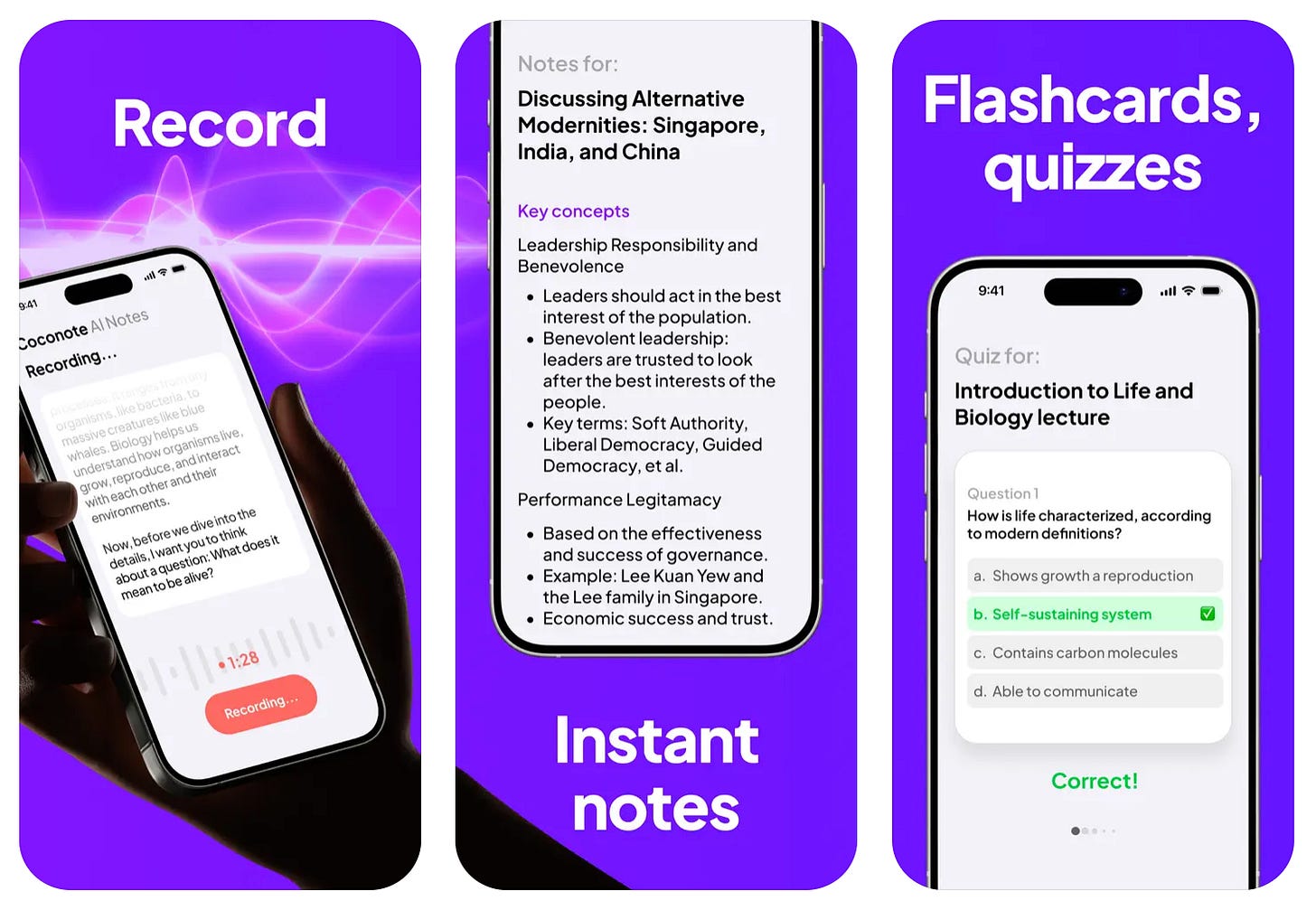
Coconote's story is quite interesting. The app was launched in 2019 as a primitive web service for transcribing video content. The user would attach a link, wait a few seconds, and get the result. Virality was out of the question. However, with the growing popularity of LLMs, the Coconote app was transformed and found its audience.
The platform's founders chose lazy students as their target, found their main pain point, and organized a thoughtful campaign.
Here are some examples of videos promoting Coconote:
This Reel has gained over 24M views, 521,000 likes and 14,000 reposts.
And this Reel has gained over 5,6M views, 26,700 likes and 720,000 reposts.
That's what makes them viral:
- Synchronizing the videos with the song
- Filmed in the setting of the target audience (college/school)
- Demonstrating most of the app's features in less than 10 seconds
- Emphasizes performance enhancement
- Touches emotional strings
Overall, Coconote manages to create very thoughtful content, even though it looks primitive. The creators hyper-target their client because they know that the market for AI note-taking apps is oversaturated. They push emotions and development opportunities and take into account what's trending with the target audience. And, of course, the content itself looks like it's organically created by users, which builds trust in the brand.
We also have a good post on how to create viral content on social media using AI. You'll find it here:
AI Tools for Advertising Your App
In this post, I've already mentioned a few good platforms to help you with your marketing. So today, let's look at a few other tools that will also be useful for creating viral content.
Lumen5 - a platform that can transform text content into engaging video promotions for your app
Ocoya - a tool specializes in writing and scheduling content, particularly useful for eCommerce
Audiense - a solution that offers intelligent social listening, particularly effective on X/Twitter
Share this edition with your friends!
This article was first published in the Creators AI newsletter. View the original edition.