How Tiny AI Startups Are Scaling to $10M+ ARR
New industry recipe for AI startups
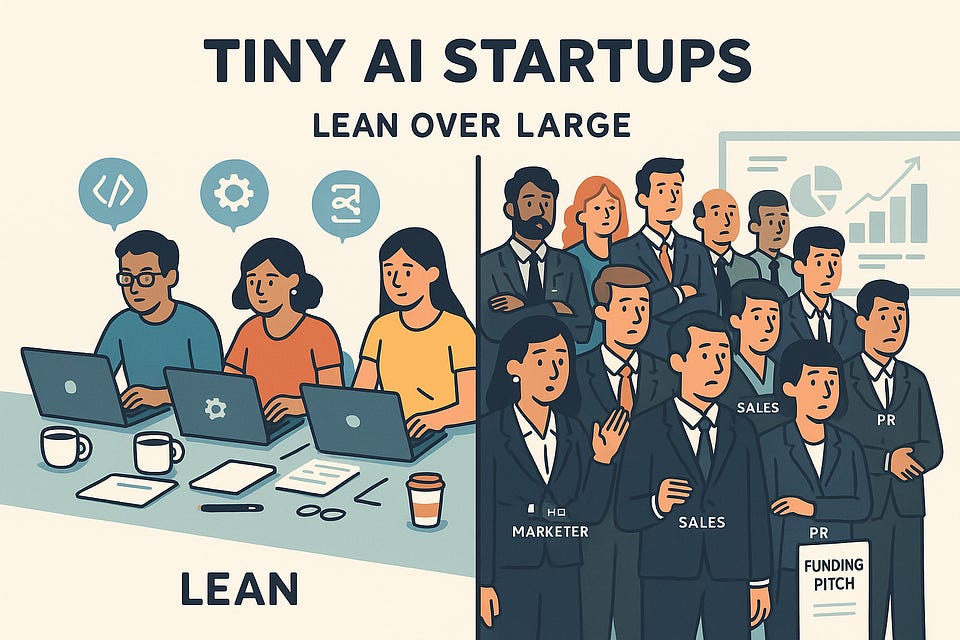
Discover how 2–3 person AI startups are hitting $10M+ ARR by leveraging GPT APIs, viral launches on X and TikTok, and ultra-fast feedback loops—no funding, no fluff, just raw execution
.
In the last 12 months, we’ve seen something wild happen.
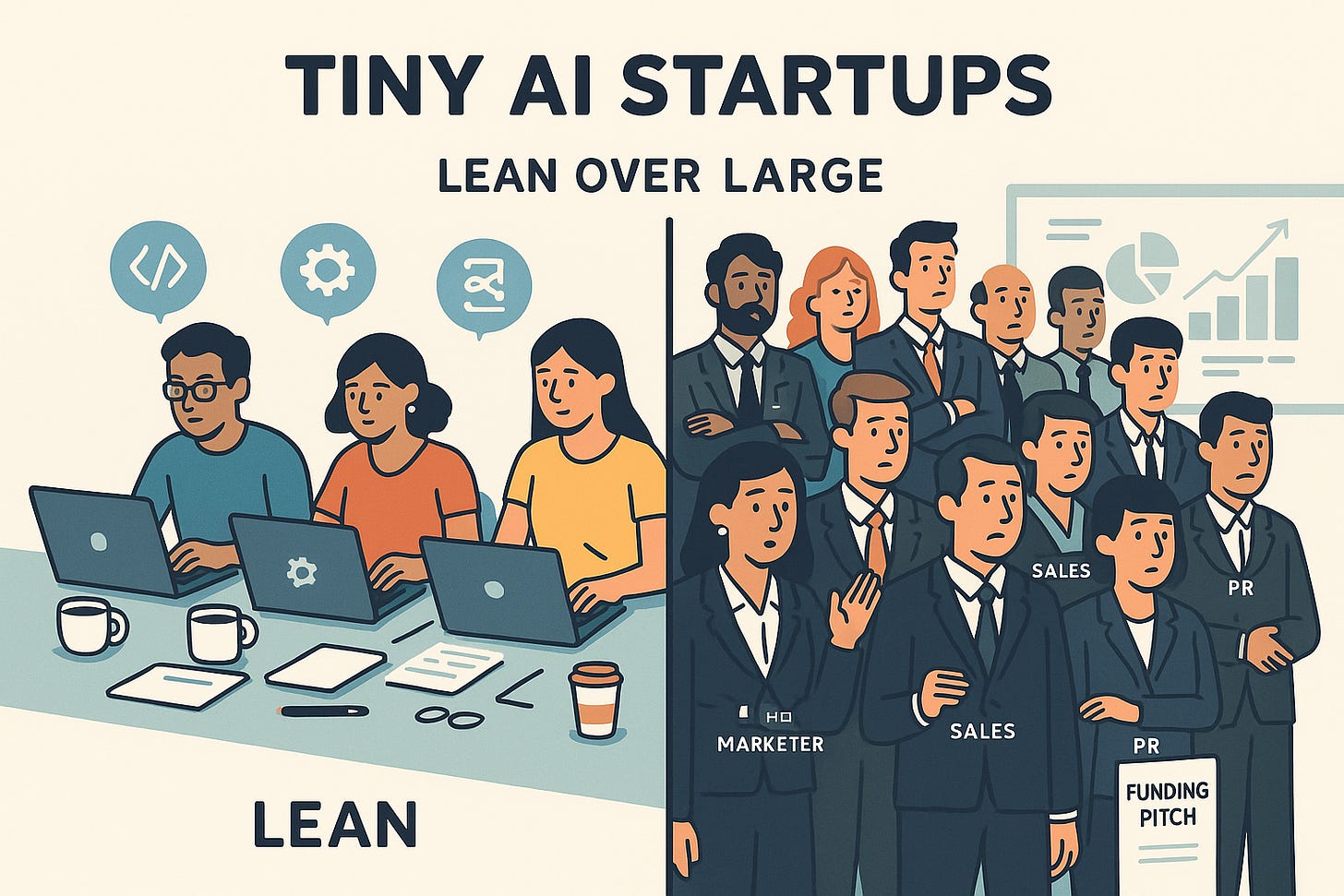
Tiny AI startups—just two or three people, often without a designer or even a fancy website—are crossing $1M, $5M, and even $10M in annual revenue. No VC rounds. No 50-person teams. Just a laptop, an LLM API ~~(OpenAI)~~ keys, and an X account.
What’s going on?
It’s not just about building faster. It’s about building differently. These founders are tapping into a new stack, a new way of shipping, and a new kind of product: small, AI-native, and ridiculously sticky.
Let’s break down how exactly this is happening—and what You can steal from their playbook.
Keep your mailbox updated with practical knowledge & key news from the AI industry!
Why Is This Now Possible?
A few years ago, this playbook didn’t exist. Today, it’s the only one that matters.
We’re in the middle of a platform shift. Not just in tech—but in how we build and market software. Here's how small AI teams are riding the wave to $10M+ ARR:
New Cycle: Foundation Models = New Infrastructure
GPT-4, Claude, Gemini, Mixtral, LLaMA 3—these models are the new cloud.
You don’t need a research team or even a training pipeline. You just call an API and wrap it in something useful.
Perplexity started as a search UI over LLMs (aka wrapper). It now does $50M+ ARR, with a lean, API-driven backend.
- Cursoris an AI-native code editor. It reads your repo, writes PRs, and feels like a junior dev. Now doing $10M+ ARR with <10 people.
- SmolAIbuilds agents that summarize research papers and auto-generate citations. One dev. HuggingFace + Claude. That’s it.
API-First, Not Product-Last
Top founders today don’t ask, “What can I design?” They ask, “What can GPT-4 already do that no one has wrapped properly?”
They skip the UX spec. They start with output—and build backwards.
Examples:
- MagicFormwas built in 3 days. It generates forms and workflows from a short prompt. Built on GPT + Airtable + Framer. First-month MRR? $30K.
- TypingMind is just ChatGPT with a better UI. No model, no team, no secret sauce. Yet it hit $1M ARR in under a year.
Vibe > Brand
Forget ads. Forget pitch decks. Modern distribution is all about vibe: shipping in public, short demos, founder energy.
Examples:
- Loveable went viral with a 30s TikTok showing the founder journaling through heartbreak—using her own product. 10K+ signups in 48 hours.
- Devon AI posted one raw X thread with a screen recording. No landing page. No brand. It hit $100K MRR in 3 months.
These aren’t edge cases. This is the new normal.
From solo devs to tiny duos, founders are skipping decks and teams—and going straight to product, traction, and revenue.
Here’s a quick breakdown of who’s doing it, how, and what it looks like in the wild:
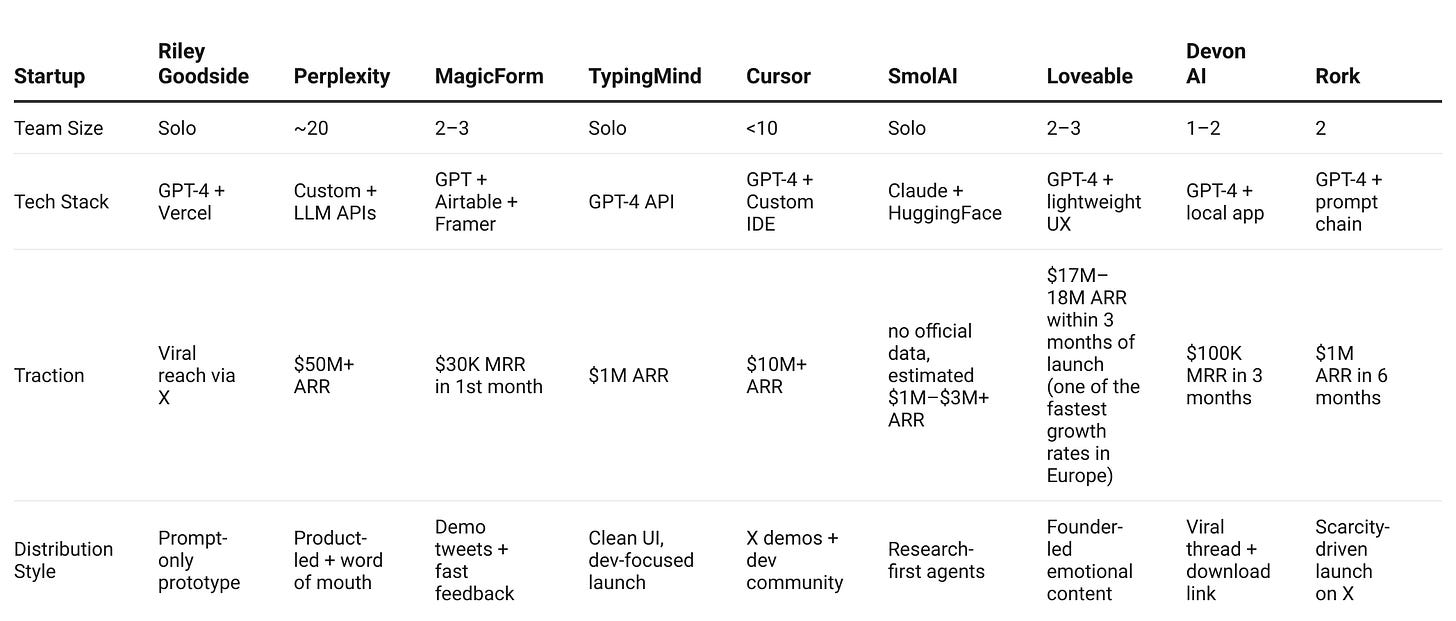
Tiny Teams, Big Numbers: How Small AI Startups Are Winning
Sharing is caring! Refer someone who started a learning Journey in AI!
Mini Case Studies: Who’s Already Made $10M+?
Here’s a look at the small teams already breaking the $10M barrier—by moving fast, building in public, and letting products do the talking.
Cursor: The AI Dev Tool That Hit $300M ARR Without a Sales Team
Team Size: Cursor was founded by four MIT grads — Michael Truell, Sualeha Asif, Arvid Lunnmark, and Aman Sanger. In its early days (2023–2024), the team stayed under 10. As of mid-2025, it has grown to around 30—but that’s still lean for a company generating hundreds of millions in revenue.
Revenue:
- December 2024: $100M ARR
- March 2025: $200M ARR
- May 2025: $300M ARR Cursor is one of the fastest-growing SaaS startups in history.
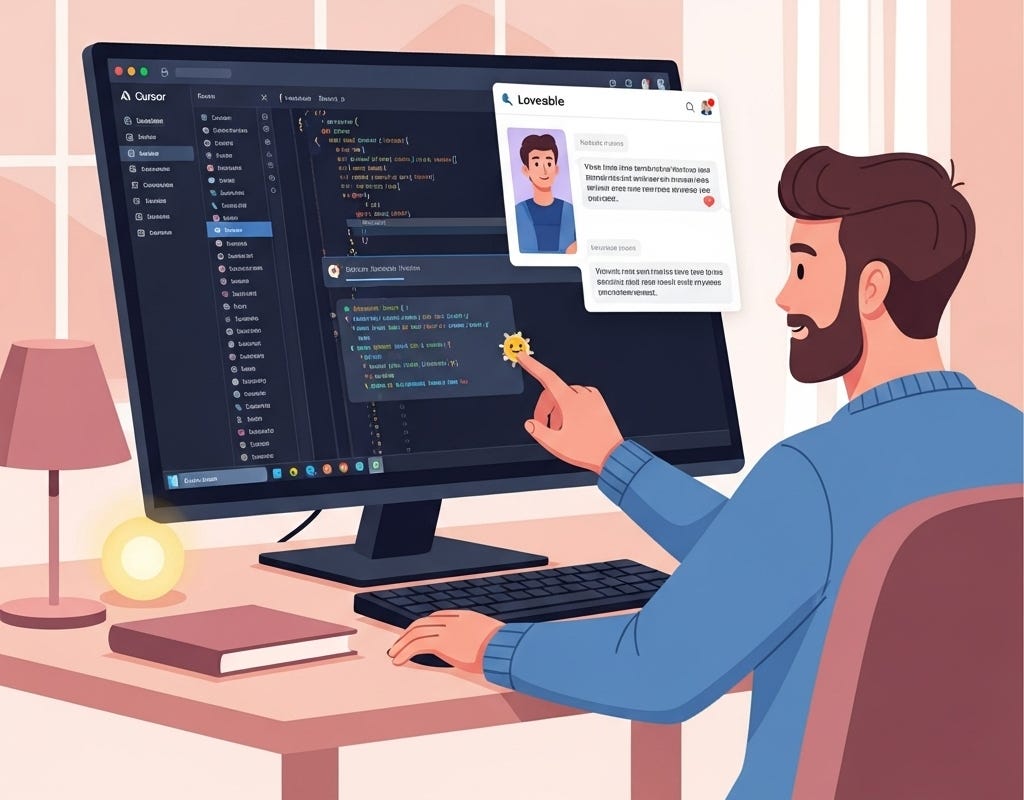
What It Does: Cursor is a fork of VS Code with GPT-4, Claude, and custom model integrations. It's not just a code editor—it's an AI pair programmer that understands your local context, helps you write and refactor code, and even explains it back to you like a teammate would.
How It Blew Up: Cursor didn’t run ads. They didn’t have sales. They launched fast and in public. Early demos on X—like one showing Cursor generating GitHub login flows from a prompt—went viral. Developers replied with featuequests, the team responded with live updates, and the product evolved in real time.
They embraced a product-led growth playbook, skipped the PM layer entirely, and scaled through vibe, speed, and execution.
In 2025, they raised a $900M Series B at a $9B valuation, backed by a16z, Accel, and Thrive Capital.
Read the full Cursor breakdown :
Loveable: Emotional AI That Turned a Side Project Into $70M ARR
Team Size: Founded by Swedish developer Anton Osika—previously at OpenAI and Google—and a small team of engineers from the open-source world. The crew behind GPT Engineer (which got 52K+ GitHub stars) reimagined their tooling into something far more accessible.
Revenue:
- $4M ARR in the first 4 weeks
- $17M in revenue within 90 days
- By early 2025: $70M ARR and over 300K active users
What It Does: Lovable is an emotional AI assistant that helps people journal, reflect, and manage their mental state. It turns mood into motion. Think of it as ChatGPT—but trained to actually care how you’re feeling.
How It Took Off: The team didn’t chase VC. They shipped a working prototype, told their story on TikTok and X, and let the internet do the rest.
One viral post showed Anton building Lovable to help himself get through a rough day. That video hit a nerve. Suddenly, thousands of people were journaling with AI. The interface mimicked a chat—not a dashboard. No onboarding, no fluff. Just type how you feel.
Lovable refused to back down when Figma pushed back on their “Dev Mode” name. The product stayed honest, and so did their voice. That authenticity fueled explosive word-of-mouth.
Read the full Lovable case study :
Deep Dive: How exactly this startup made $1M ARR in a few months
Sometimes, the most remarkable startups don’t look like much at the beginning. Rork didn’t launch with a brand, a pitch deck, or even a proper landing page. Just two founders, a Calendly link, and a clear idea of the kind of problem they could solve.
They weren’t chasing polish. They were chasing signal.
What they built
At its core, Rork is vibe-coding tool for Mobile Apps. Rork builds complete, cross-platform mobile apps using AI and React Native.
The tool is dead simple:
- Describe: Users input their app idea using natural language.
- Generate: Rork's AI generates the code for the app.
- Deploy: Users can easily deploy and share their web app links or publish iOS apps.
Here is their official demo:
How it started
Their MVP? Just a Notion doc, a Stripe payment link, and Calendly for onboarding.
No logos. No UI. No friction.
Then came a short tweet — a screen recording of their AI assistant in action, doing actual work: responding to emails, updating a deal in HubSpot, cleaning up a lead list.
The video wasn’t over-produced. It didn’t need to be.
It felt real — and it resonated.
What happened next
- The tweet went viral. Within hours, replies were filled with questions, feedback, and requests for access.
Within hours, replies were filled with questions, feedback, and requests for access.
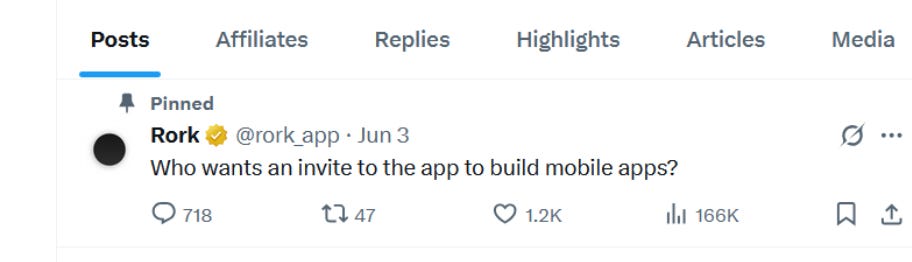
- They added a waitlist with a simple message: “1,000 seats left.” All were claimed within 72 hours.
- They iterated in public. Over the first 90 days, the team pivoted three times based on replies and DMs. What started as a broad productivity agent found its product–market fit in B2B sales automation.
- Funding: Rork secured $2.8 million in seed funding led by Andreessen Horowitz.
And here’s the twist: none of this was planned in a traditional sense. There was no roadmap, no growth strategy deck. Just momentum — and a willingness to listen.
Why it works
Rork didn’t just launch a product. They built a conversation around a real pain point.
And they built it where the conversation was already happening: on X.
Every new feature came from feedback. Every bug fix came from users. And every major decision was shaped by what people were saying — not in surveys, but in public threads.
Where they are now
- ARR: $1.2M in less than six months
- Team: Still just two founders
- Growth: 100% product-led and community-driven
- Tech stack: GPT-4, Claude, lightweight UI
- Funding: $2.8M secured
They didn’t wait to be “ready.” They launched early. Listened carefully. And built something people actually needed.
Common Patterns Behind These Startups
What do these teams have in common?
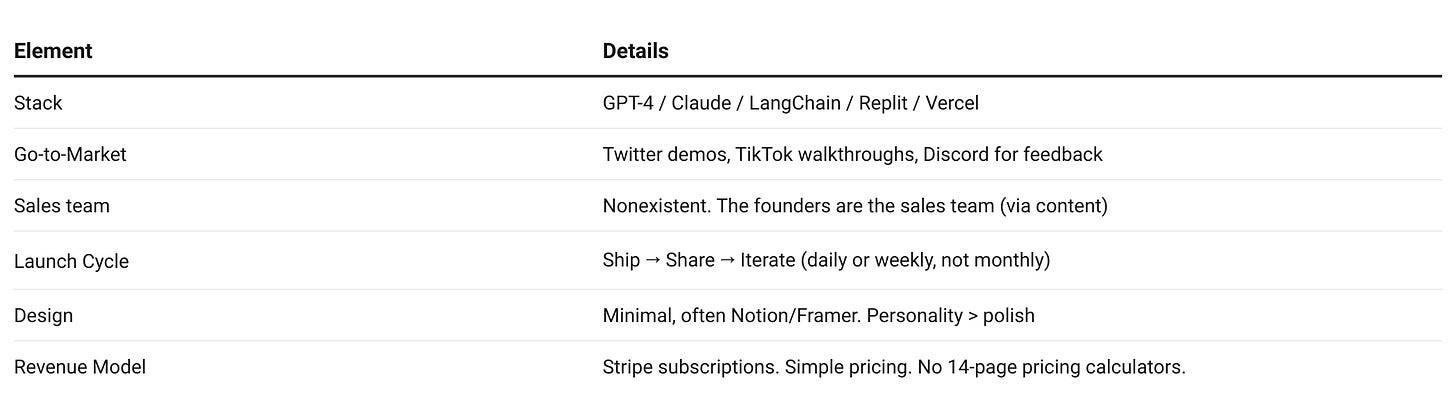
Inside the New AI Startup Playbook
These founders aren’t playing SaaS—they’re playing games. Rapid feedback loops, small surface area, and massive upside.
Conclusion: What Founders Should Do Right Now
Forget team size. Forget pitch decks. Forget chasing a seed round. Start thinking like a vibecoder.
You don’t need a cofounder. What you need is:
- An API key
- A story worth telling
- A feedback loop that never stops
Launch early. Share honestly. Ship messy. Ship loud. Ship lovable.
Don’t wait for permission or perfection—just move. The tools are here. The audience is listening. The playbook is working.
This isn’t hype. It’s the new default.
And we’re just getting started.
Want more drops like this? Stay ahead of the wave with Creators AI
This article was first published in the Creators AI newsletter. View the original edition.