How to Be Investable AI Startup in 2025
+ Green & Red Flags for Startups
While 2024 was a phenomenal period for AI startups (according to Crunchbase, such projects raised $314B!), 2025 promises to be even better. Today, let's find out what you need to know to build an attractive company for investors.
In this issue:
- Green & Red Flags for AI Startups
- AI Regulation (Where are the Best Conditions?)
- What AI Startup Should Be in 2025
We will also “paint” an image of an ideal AI startup according to VCs.
Keep your mailbox updated with practical knowledge & key news from the AI industry!
Green Flags for AI Startups
Summarizing the positions of venture capital firms and private investors, startups seeking attention in 2025 should focus on three major green flags.
1. AI Agents
And here we go again. AI agents, autonomous systems capable of completing tasks without constant human input, are reshaping the AI landscape. So, it's kind of obvious that startups leveraging agents to deliver practical, scalable solutions—whether automating customer interactions or optimizing workflows—stand out to investors.
One of the best examples is Loveable from one of our previous posts. It’s building an AI tool that allows you to create apps without coding skills. This product type is following SaaS and encroaching on the status quo. That’s why it's unsurprising that Loveable raised €6.8M even before the project generated revenue.
More on startups developing AI agents here:
2. Focus on Enterprises
Entrepreneurial startups are attractive because of their stability and revenue potential. By solving specific problems for organizations-especially in narrow and unwieldy areas-startups signal their own reliability.
Investors often prefer this approach to riskier consumer markets.
3. Task-Specific Solutions
The next green flag actually applies to more than just AI.
However, it is in this niche that task-specific solutions easily stand out from startups that are floundering. That's because it's a proven strategy. Task-specific solutions resonate with investors because of their clear value proposition and focused execution, making it easy to assess market fit and growth potential.
One area we’re looking at is companies that focus on task-specific models. While the foundational models are well established, I find models that excel at specific functions particularly intriguing, especially when combined with agents built on top of them.
Mark Rostick, vice president and senior managing director, Intel Capital
Benchmark Example: Harvey AI

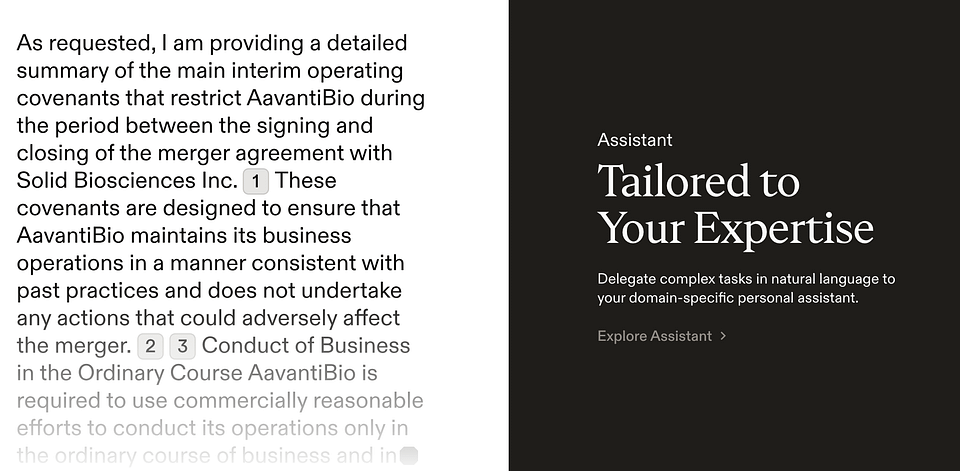
A good case study of a startup that combines all three green flags is Harvey AI. This company develops AI products for lawyers and law firms. It offers a unified and intuitive interface for all legal workflows, allowing lawyers to describe tasks in plain English instead of using a set of complex and specialized tools for niche tasks.
The founders of Harvey AI have assembled bingo from the correct elements are confirmed not only on paper, but also in practice. Since its founding in 2022, the startup has raised $206M in venture capital investment and achieved unicorn status last October. In 2024, Harvey's revenue reached $65.8M, up from $10M in 2023.
We talked about Harvey AI and other promising projects for 2025 in this post:
Sharing is caring! Refer someone who started a learning Journey in AI!
Red Flags for AI Startups
While the interests of VCs are quite broad (and vary from firm to firm), there are a few common red flags. If you expect to raise investment for your startup, you should probably avoid the following business model and approach.
API Wrappers

Yes, we're criticizing a model to which we've dedicated several posts.
API wrappers are an excellent solution for solopreneurs building a small but profitable business. However, it is extremely difficult to scale such projects. They have an obvious ceiling on ARR and it's almost impossible to pivot with them.
VCs realize this and prefer to focus on more scalable models.
Nevertheless, API wrappers remain a popular and valuable solution among creators. If you want to learn more about this topic, check it out here:
OpenAI's (or Google's, Anthropic's, or Perplexity's...) Rival
The situation is the opposite with developers of new LLMs and other products that define the industry's future. The potential for scaling is unlimited (at least now, we can't outline its limits), but the ROI is pretty sad. Even OpenAI, the undisputed market leader, doesn't expect to turn a profit until 2029 at the earliest.
So, getting involved in such a race may not be the best idea.
Unless you're part of OpenAI's mafia. Sutskever, Murati, and Karpathy are exceptions to the rule.
Sharing is caring! Refer someone who started a learning Journey in AI!
AI Regulation in 2025
Any new industry (provided it grows and is in demand) sooner or later faces regulatory attention. Of course, artificial intelligence is no exception. For many companies, funds, and private investors, AI regulation was a central theme in 2024.
And the trend will continue in 2025.
Is it worth dedicating a separate post to AI regulation?
When we talk about regulation, it is important to pay attention to the location we are talking about. We currently have three notional regions in AI: the US, EU, and China. (This doesn't mean there aren't cool projects outside of them! We're just talking about the market size)
The United States
The US regulatory environment for AI startups in 2025 is expected to be influenced by the shift to a more deregulatory approach under the Trump administration. This could lead to fewer federal restrictions but more state-level regulations.
At the same time, there are state-level restrictions. Some, like Colorado, have already enacted comprehensive AI legislation; others may follow suit, creating a patchwork of regulations.
The European Union

The European Union has historically had a rather strict regulatory policy, explaining it as safety, transparency, and accountability. As a result of this or not, we now have a relatively small number of serious AI startups in the region (perhaps only Mistral comes to mind). And, as many analysts believe, with the advent of The EU AI Act, it may become even more difficult for entrepreneurs.
On the plus side, there is a fairly low level of competition and government programs for small businesses. If you want to work in the local market, in certain areas (healthcare or fintech), Europe may be even more attractive than the US.
China
There's also China, but that's an option for really confident creators. I don't think there's much point in digging deep into local AI policy. So I'll just note that we've seen a lot of powerful models from Chinese companies recently. All of them were clearly designed not to contradict the government's positions on key issues.
In addition, China is cracking down hard on deepfakes, voice cloning, and other products that attackers can use. And it also restricts some projects.
What AI Startup Should Be in 2025
So, now let's summarize the above a bit and complete the picture with a few essential points. You can think of it as an image of an ideal AI startup that will attract the attention that makes startups attractive to investors.
Here are our checkboxes:
- Media Savvy: A startup that knows how to generate buzz and establish credibility through strategic media exposure has a strong edge. Think well-placed articles, thought leadership, and customer success stories.
- Super Simple Onboarding: Investors value startups that make it easy for users to get started. A frictionless onboarding process shows the company understands its audience and can scale without user frustration.
- Replacing a Bunch of SaaS with One AI Agent: The next big thing isn’t just incremental improvements; it’s consolidation. A single AI agent that can replace multiple SaaS tools demonstrates real value.
- Nailing a Niche: Specialization is a sign of focus and expertise. Startups that solve one problem exceptionally well are more likely to build loyal customers and gain investor trust.
- Clear Path to Profitability: Even in AI, flashy tech isn’t enough. Investors want to see a realistic, achievable plan to move toward profitability, particularly in a competitive funding environment.
- A Scalable Product: The ability to scale efficiently without ballooning costs is key. Whether it’s through cloud infrastructure or streamlined operations, scalability is a green flag for long-term growth.
- Data-Driven Proof: Whether it’s user adoption metrics, cost savings, or ROI, startups that bring clear, data-backed results to the table have a better shot at securing funding.
- Aligning with Regulatory Organicities: The company must ensure they don’t contradict regulatory requirements, even if they seem overly complex or unnecessary. Compliance builds trust and avoids costly setbacks, making it vital for long-term success.
Bonus point for more mature projects:
- For Those Looking to Raise an A Round: A substantial track record matters. Startups aiming for an A round should have proven traction and the ability to execute, ideally hitting $1M in revenue within two quarters. A high-performing, cohesive team is non-negotiable.
That's what Kirby Winfield, founding general partner of Ascend, believes in.
Launching an AI startup in 2025 is no small feat, but the potential rewards are more significant than ever. Yes, it's an apparent thought, but sometimes it's good to remind yourself of even simple things like that. I hope our list was helpful to you, and maybe, at some point, you will be our benchmark case!
And if you need a toolkit for building a startup, you'll find it here:
Did we miss any must-haves for AI startups? Share your options in the comments!
Share this edition with your friends!
This article was first published in the Creators AI newsletter. View the original edition.