How to choose LLM for your project in 2024
A discussion of the most popular LLMs for creators and entrepreneurs
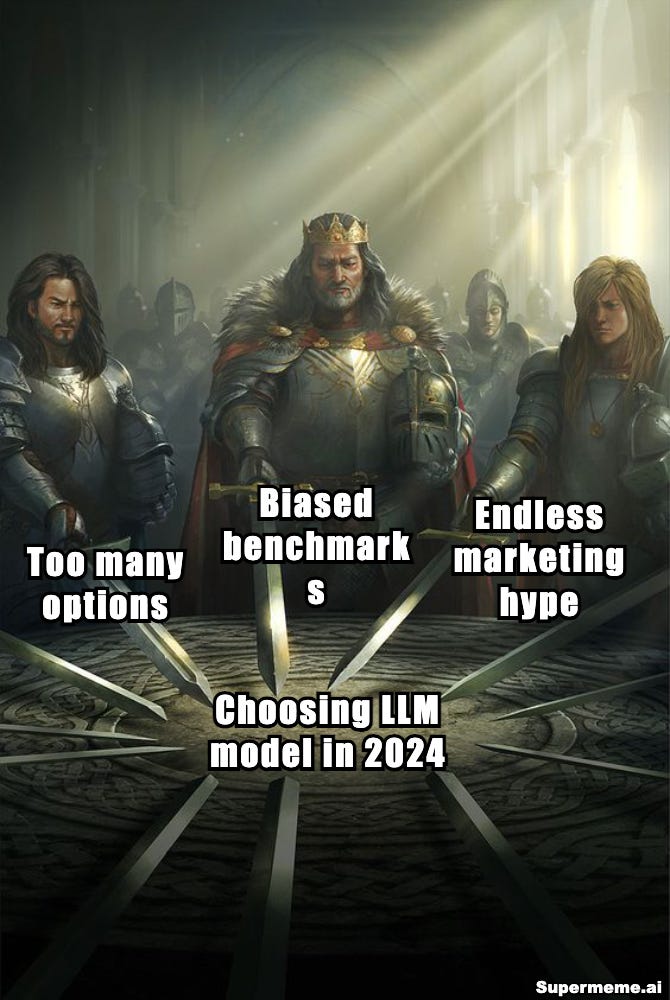
There are dozens of key and hundreds of (relatively important) large language models on the market today. And, given the speed at which new LLMs appear (now every couple of days), it is almost impossible to list them all. Fortunately, we don't really need to

Choosing is hard. Made with supermeme.ai.
Whether you are building an AI App or simply need to choose AI model to improve your unique personal use case, your choice will impact everything (from quality of responses to cost of usage).
In today's edition, we list four of the most useful and sought-after LLMs, key criteria for comparison, benchmarks, and additional helpful software. Let's get started.
How To Choose?

Just imagine that here I am listing all the major LLMs announcements over the past six months to highlight the speed of progress and how quickly some data becomes outdated (if this is causing you difficulties, follow our Friday weekly roundup!). The problem here is that not only are the models outdated, but also the platforms for evaluating performance are outdated.
Keep your mailbox updated with practical knowledge & key news from the AI industry!
Therefore, the first thing I recommend to you is to start not from specific models but from the cases of other developers, your experience, and basic criteria. Here are some of them (you can also add your own specific ones):
- Ease of use: The LLM should be easy to use for different team members with different levels of technical expertise. It should have an intuitive interface with resources that can shorten the learning curve.
- Scalability: The model should be able to handle huge amounts of training data without degrading performance.
- Integration Compatibility: The base models should be compatible with your existing technology stack. Full compatibility ensures optimized processes and data flow without radical changes.
- Computational Resources: Determining the hardware and infrastructure requirements for deploying and maintaining the LLM is important. Assess the quantity and quality of data needed to train and customize the model effectively.
- Language Support: The LLM should have multilingual and multidialect capabilities to scale business operations across geographic locations.
- Cost-effectiveness: Your budget should cover the total cost of ownership, including upfront costs, maintenance, and upgrades.
- Customizability: you should be able to tailor models to meet the specific needs of your business or product.
- Data Privacy: The model should have advanced data security and privacy features to protect your personal and sensitive business information. By implementing security measures and moderation mechanisms, you should also prevent the spread of misinformation and malicious content.
Of course, this is not everything. However, you will have to define further criteria independently, depending on your requirements and preferences. For example, some models are already customized for specific use cases, saving you time and computing resources. At the same time, others may offer more flexible customization with more features (but will take longer to work on).
So, let's go through the basic LLMs, one of which is sure to be a good fit for building your project.
Want to learn how to build a startup with AI tools? Here you will find the answer:
LLMs & Capabilities
GPT-4

- Developer: OpenAI
- Parameters: up to 1.76T (200B parameters for GPT-4o)
- Context Window: 128K (GPT-4o)
- Price: Input: $5.00, Output: $15.00 per 1M Tokens.
- Access: API
Yes, any list of LLMs must start with OpenAI models. Generative Pre-trained Transformer (GPT) is the main source of hype in the industry and the most popular solution among developers. Now, the company offers many versions: GPT-3.5-turbo, GPT-4, GPT-4o, and GPT-4 Turbo.
All of the above are general-purpose AI models with API access.
These models can understand and generate natural language and excel in various language tasks, including text, translation, question answering, and more. The GPT family of models is trained based on licensed data, codes, instructions, and human feedback.
Special attention should be paid to GPT-4o and GPT-4o mini. The latter are the most up-to-date OpenAI models with 200B and 8B parameters. Basic GPT-4o is now number two in the independent LMSYS ranking. GPT-4o provides GPT-4-level (or better) performance at much faster speeds and lower costs. It currently has a context window of 128k.
If you're a startup or small business looking for an affordable AI solution, GPT-4o Mini could be a great choice. It offers significant capabilities without the high costs associated with larger models. And it’s also good for simpler tasks that don’t require the full power of GPT-4o, such as basic content generation, simple coding assistance, and straightforward data analysis.
What It's Good For:
Summarization: Effective for summarizing long texts, articles, or documents into concise and coherent summaries.
Coding Assistance: Useful for writing and debugging code, offering solutions and explanations for various programming challenges.
Customer Support: Perfect for chatbots and virtual assistants, GPT-4o can handle customer queries accurately and efficiently.
We covered this model when it came out in May. Check it out:
Gemini

- Developer: Google
- Parameters: Undisclosed
- Context Window: 1M (Gemini 1.5 Pro)
- Price: Input: $3.50, Output: $10.50 per 1M Tokens.
- Access: API
Google's Gemini is the second most popular LLM. This family now includes four variants: Gemini 1.0 Ultra, Gemini 1.5 Pro, Gemini 1.5 Flash, and Gemini 1.0 Nano. They can generate text and handle images, video, audio, code, etc. Google hasn't disclosed the exact number of parameters, but presumably, Gemini has numbers comparable to those of competitors in the current GPT family.
As with the GPT-4o, Google has its own model that it wants to elaborate on: the Gemini 1.5 Pro. This is the company's best solution in terms of performance. It has a context window of up to two million tokens. Google says this is how Gemini 1.5 Pro achieves near-perfect recall in long context search tasks across modalities, opening up the ability to process documents accurately, thousands of lines of code, hours of audio, video, and more.
It is now the top model in the LMSYS rankings.
What It's Good For:
Enterprise Applications: Integrates seamlessly with Google’s enterprise tools and services.
Ethical AI Solutions: Perfect for industries like healthcare and legal, where ethical guidelines and safety are crucial.
Natural Language Understanding: Great for apps that need to understand user intent deeply, like virtual assistants and chatbots.
LLaMA 3.1

- Developer: Meta
- Parameters: 405B parameters
- Context Window: 128K (Llama 3.1)
- Price: Input: $3.00, Output: $5.00 per 1M Tokens.
- Access: API
Llama 3 is a family of open-source LLMs from Meta. This supports much of the AI functionality in Meta's applications (WhatsApp, Instagram, and Messenger), and allows you to download the source code from GitHub. The Llama family has recently been available in three versions: with 8, 70, and 405 billion parameters.
Llama 3 is good for text generation, summarizing information, and translation. Meta also offers various tools for developers, researchers, and enterprises. In particular, with Llama, you can quickly generate code and natural language prompts.
With the upgrade to Llama 3.1, the context length has been increased to 128 KB tokens, allowing it to handle long text much better than Llama 3, which had a context length of 8 KB tokens.
What It's Good For:
Research and Development: Ideal for academic and industrial research projects that require custom NLP models.
Educational Tools: Can be integrated into educational software for tutoring and providing explanations on various subjects.
Data Analysis: Useful in extracting insights and patterns from large datasets, especially in a research setting.
Just a few days ago, Meta unveiled LLama 3.1, as well as the AI Studio virtual character creation platform. We wrote about it in this newsletter:
Claude 3.5 Sonnet

- Developer: Anthropic
- Parameters: Undisclosed
- Context Window: 200K (Claude 3.5 Sonnet)
- Price: Input: $3, Output: $15 per 1M Tokens (Claude 3.5 Sonnet)
- Access: API, Amazon Bedrock, and Google Cloud’s Vertex AI
Claude is a family of models from Anthropic that includes Haiku, Sonnet, and Opus. These LLMs are designed to help users with a wide range of tasks. They understand and generate natural language well, making it useful for applications such as texting, answering questions, and content creation.
Claude 3.5 Sonnet is the Anthropic model introduced last month. It outperforms its predecessor (Claude 3 Opus), has a 200K token context window, and is oriented toward visual thinking. In particular, it is well suited for interpreting charts, graphs, and transcribing texts. The developers say Sonnet is particularly useful in logistics, finance, and retail.
What It's Good For:
Explainable AI Applications: Ideal for industries like finance and healthcare where understanding AI decisions is crucial.
Legal and Compliance: Ensures compliance with regulations by providing safe and explainable AI outputs.
Personalized Recommendations: Works well in recommendation systems where user safety and content appropriateness are key.
Sharing is caring! Refer someone who started a learning Journey in AI!
What Else You May Need
Of course, covering all the important models in one post is impossible. If none of the listed LLMs suit you or you want to understand the difference between different solutions better, I suggest using several platforms.
Chief among them is the LMSYS Chatbot Arena Leaderboard.
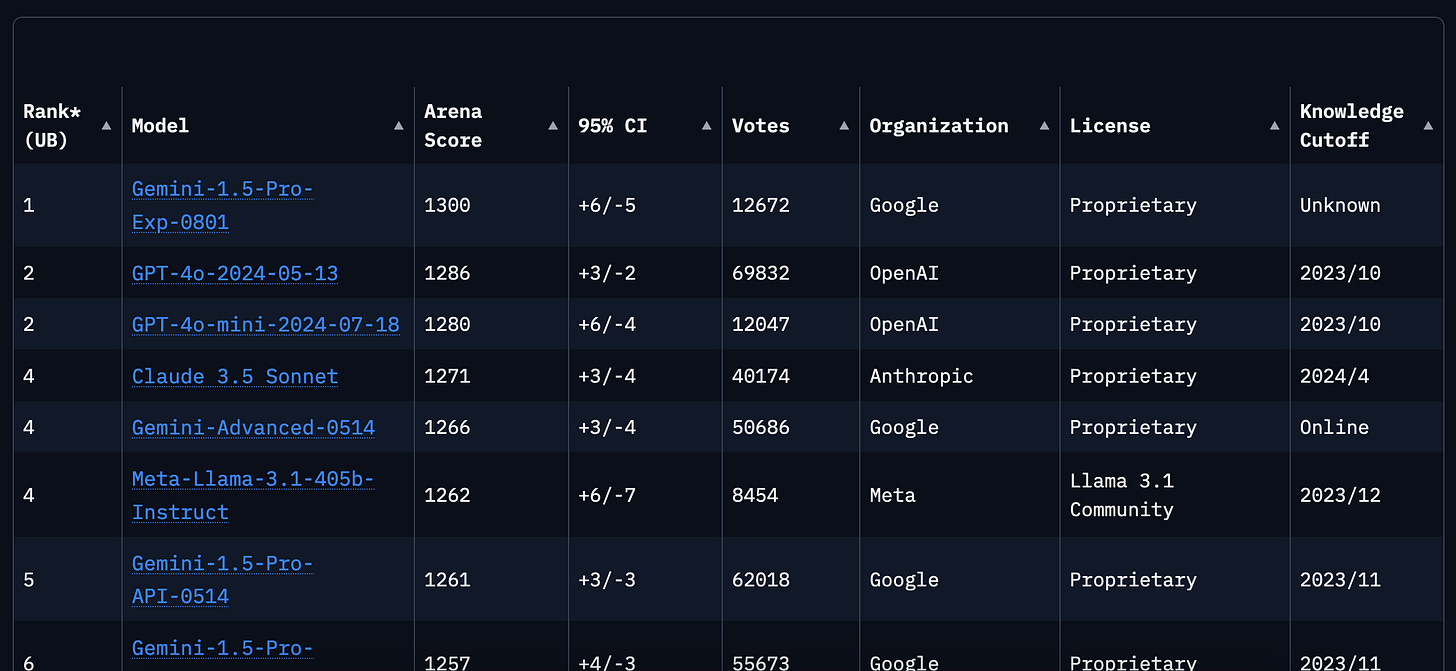
LMSYS is an open-source, crowdsourced platform for evaluating LLMs. It collects data on different models and user preferences to rank different models based on their performance. Users can participate in the ranking process by rating and voting on the performance of different LLMs.
After entering a hint, the system randomly selects two models, processes the hint, and responds anonymously to the user. The user can then vote for which model performed better. It's probably the most objective metric for measuring LLM.
Cost Effectiveness
Another, no less important issue (especially for beginning entrepreneurs) is pricing. Not all creators are ready to invest large sums in development unless a serious profit is on the horizon. To make our lives a little easier, there is LLM Price Check.
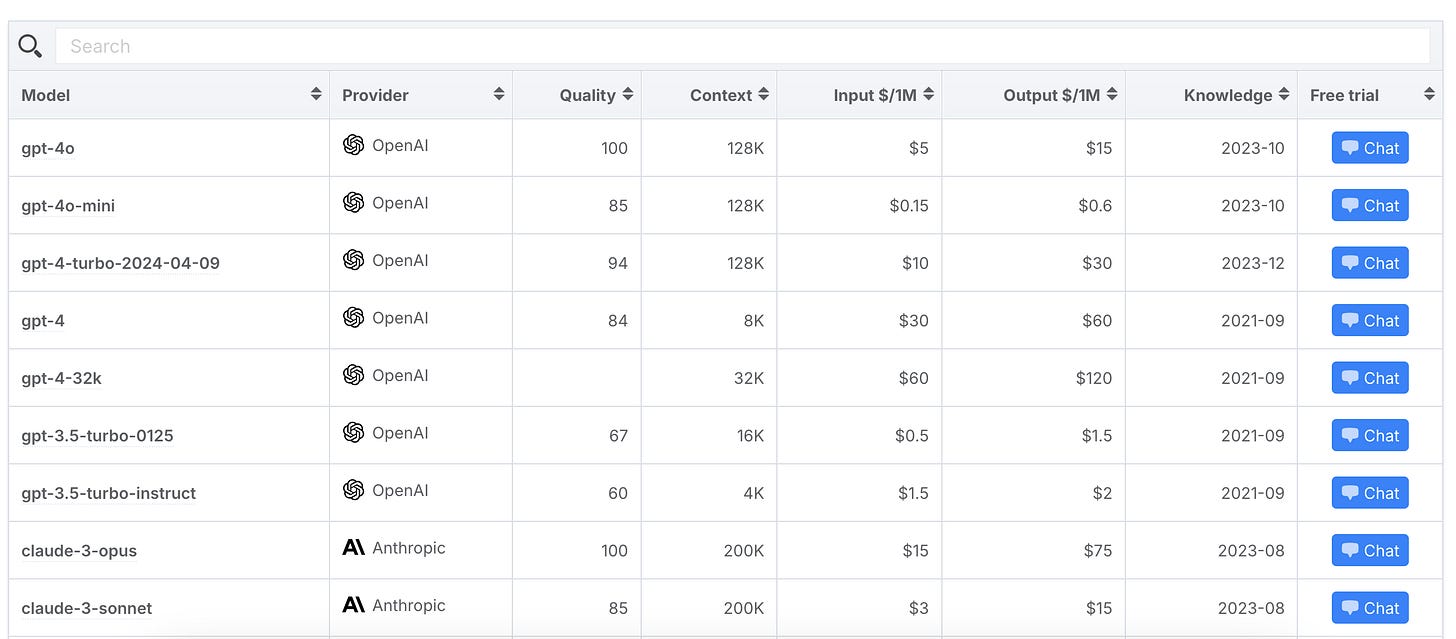
LLM Price Check is a website designed to help users compare prices of different models. It provides a detailed and up-to-date comparison of the costs associated with different LLMs from different providers, including subscription fees and usage rates.
The platform aims to help businesses and developers choose the most cost-effective LLM for their needs by offering transparent and comprehensive pricing information. Users can also find additional information on the features and performance metrics of each LLM to help make more informed decisions.
Frameworks

And, of course, you'll need the right framework to build a good application. When choosing the right language and framework, consider factors such as ecosystem and community support, performance and scalability requirements, integration with existing infrastructure, and the experience of your development team. Evaluate your organization's specific needs and priorities to make an informed decision.
The best frameworks for LLM-powered applications:
Final Thoughts
Choosing the right LLM for your application is a big deal. Understanding what different models can do and considering key factors such as what you need it for, how well it works, what data it is trained on, how easy it is to integrate, and how much it costs will help you make a smart choice that is perfect for your project.
In a nutshell, choosing the right LLM means scrutinizing your specific needs and what's available. And as AI continues to evolve, so will the opportunities to improve your app. So stay ahead of the curve, and good luck with your endeavors!
Which LLM model would you choose & why? Tell us in the comments!
This article was first published in the Creators AI newsletter. View the original edition.