Key AI Startup Deals in November
The most significant funding rounds of the month.
November is ending, which means it's time to look back and discuss AI startups. Today, we'll break down the five most significant deals of the month and review companies, their products, and market placement.
Let's go.
In case you missed it, at the end of last month we broke down the top AI deals of October. To keep up to date, follow along here:
Keep your mailbox updated with practical knowledge & key news from the AI industry!
xAI | $5B

- Founding date: 2023
- Total funding: $11B
- Products: Grok & Grok 2
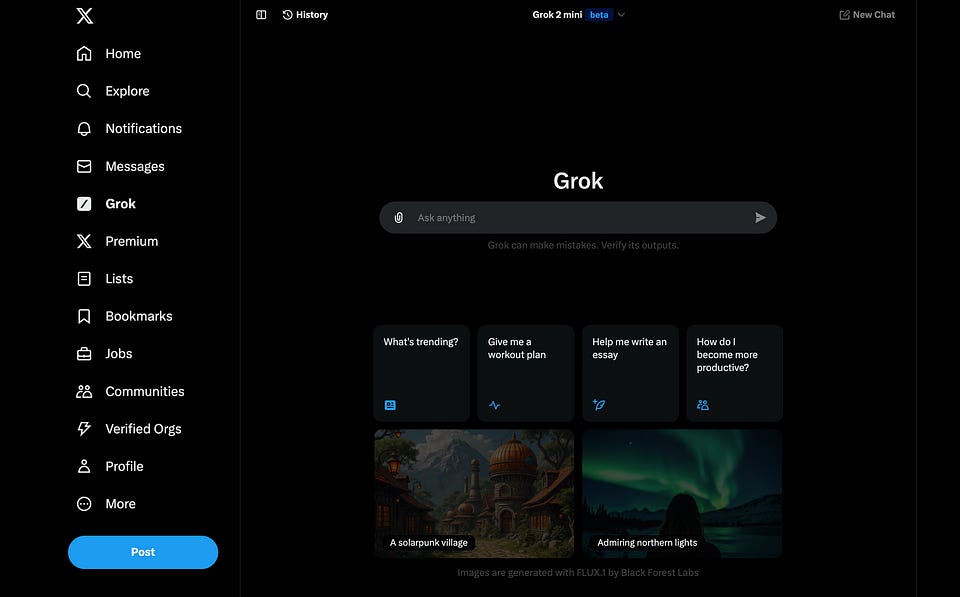
We start with the biggest deal of the month. xAI, the startup responsible for developing Grok, secured $5B in a funding round, valuing it at $50B. Elon Musk's company calls its mission “to understand the true nature of the universe.” If you want to speak without marketing slogans, xAI develops large language models (LLMs).
Its chatbot is aimed at both consumers and businesses. The first version of the Grok model was released in November 2023, and the second iteration became available in August 2024. X users can use it to generate text and images (and implement AI in their projects through the API).
What's special about it?
The general approach of xAI is similar to what OpenAI, Google, Meta, and others are doing. However, if you look at the details, there are many differences. First, there's the distribution model. The Grok chatbot is still unavailable for free (although there have been rumors recently that this is about to change) and is distributed through Twitter/X's premium subscription packages. Second, Grok is trained on content data from X, allowing it to provide insights from breaking news and discussions.
Well, and besides, Grok is much less politically correct than ChatGPT and Gemini. This chatbot easily generates harsh images and, in some cases, openly shows its developers' political views. Musk considers it more fair to users.
Since the release of the API Public Beta, the xAI model has proven to be a pretty good solution for creating AI agents. To figure out how to do it without coding skills, read this post:
Musk has plenty of ambitious plans for xAI. The company plans to deploy its AI at Tesla and use it as the basis for Optimus robots. Of course, in the coming years, xAI expects to make progress in the development of general artificial intelligence (AGI).
Sharing is caring! Refer someone who started a learning Journey in AI!
Anthropic | $4B

- Founding date: 2021
- Total funding: $13,7B
- Products: Claude family
xAI is followed by Anthropic, an equally significant project based in San Francisco and founded by siblings Daniela and Dario Amodei. A few days ago, Amazon agreed to invest another $4B in the startup to support the development of ChaGPT rival with its AI assistant Claude. Starting in 2021, Anthropic has released several LLM families and even surpassed OpenAI in some product categories. The most current startup models are distributed under the name Claude 3.5.
What's special about it?
Anthropic positions itself as the developer of the safest AI systems. This means the company is in no hurry to release new models and pays attention to fine-tuning. However, some features become available earlier than those of competitors. Anthropic's research covers natural language processing, human feedback, scaling laws, reinforcement learning, code generation, and interoperability.
The main product is Claude, a family of models designed to help users with writing, coding, math, and reasoning. According to some tests, Claude 3.5 surpasses GPT-4o, Gemini, and other top platforms.
It was the Anthropic product that became the main release of October in the AI industry. The startup has unveiled the Computer Use, which allows you to use Claude to control a PC. You can try it now, here is our tutorial:
Amazon, Antrhopic's primary sponsor and partner, conducted the latest round of financing for the startup. The company collaborates with Annapurna Labs, an AWS chip manufacturing division, to develop future generations of Trainium accelerators — specialized AWS chips for training AI models. These processors are assumed to accelerate progress in developing more advanced models.
Physical Intelligence | $400M
- Founding date: 2024
- Total funding: $470M
- Products: General-Purpose Robot Software
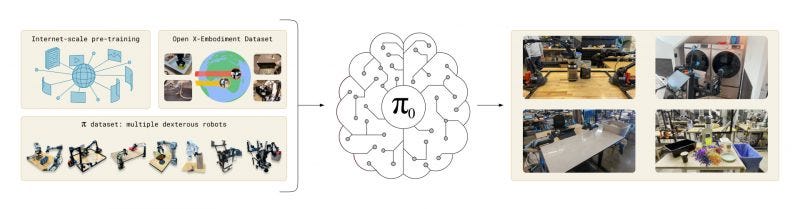
Physical Intelligence, founded by Karol Hausman (ex-Google robotics researcher), Sergey Levine (UC Berkeley professor), and Lach Groom (ex-Stripe executive), is perhaps the most unusual project on our list. In early November, the company raised $400M from Jeff Bezos and other investors, including OpenAI, to create AI for robots. The project's long-term goal is to create universal pi-zero software that can be integrated into the operation of any physical machine.
What's special about it?
Physical Intelligence's approach is rather pragmatic: the founders don't promise a breakthrough in the next few weeks. Instead, the company says its platform can now be compared to GPT-1, the very first published OpenAI model. To do better, Physical Intelligence needs datasets to train a proprietary model.
Unlike LLM, it needs to cover a broader spectrum from text, images, video, and “physical intelligence,” which is the embodied experience of moving limbs, grasping objects, manipulating them, and performing other actions. The company is now collecting that data.
We talked a bit more about the companies that are helping AI move from the virtual world to the real world in this post:
Predicting the future of this startup is a bit more difficult than with the other companies on today's list. If we look at the dry forecasts, we see the following: the total market size of humanoid robots is expected to reach $38B by 2035, which indicates a growth potential for such projects. However, in the case of Physical Intelligence specifically, I think we should be a bit more cautious and wait for the first news about real partnerships.
Sharing is caring! Refer someone who started a learning Journey in AI!
Writer | $200M
- Founding date: 2020
- Total funding: $326M
- Products: LLMs for enterprises
Writer is another San Francisco-based project that has caught the attention of investors this month. The startup, founded by May Habib and Waseem AlShikh, has raised $200M and is valued at $1.9B. Writer develops a full-featured AI platform for enterprises. Since its founding in 2020, the company has released many different products for various industries and created its own family of LLMs called Palmyra.
What's special about it?
Unlike many other startups, Writer doesn't focus on ordinary consumers. Its platform allows companies to create customized AI-powered workflows with products that accelerate content creation, align brand positioning, and increase department productivity. The developer claims its learning methods are far more profitable than building custom models based on other LLMs, including GPT-4o.
And apparently, many global corporations agree. Writer's clients include Mars, Salesforce, Uber, Accenture, Qualcomm, and many others.
Writer is now emphasizing the development of “AI agents” that can plan and execute workflows across systems and teams. The company aims to turn AI models into robust business tools, emphasizing security, adaptability, and enterprise-grade solutions. With the generative AI market projected to exceed $1T over the next decade, Writer wants to be a key player in the field.
If you want to get a handle on what AI agents are, check out these posts:
Tessl | $125M
- Founding date: 2024
- Total funding: $125M
- Products: AI for coding
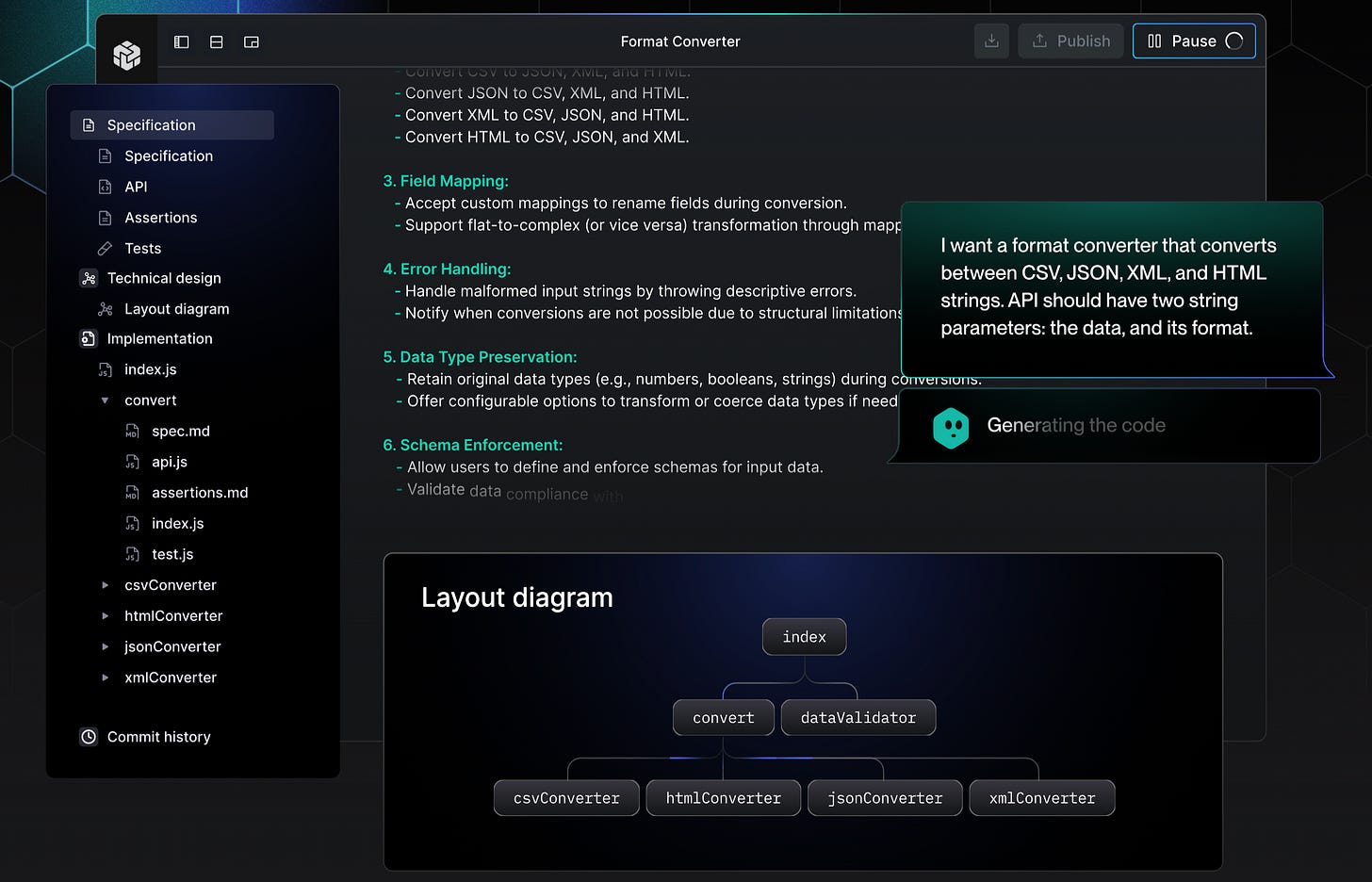
British startup Tessl has raised $125M and is valued at $725M nine months after its founding. According to founder Guy Podjarny, the company aims to revolutionize software development by shifting from the traditional code-centric approach to a specification-centric model. This approach will allow developers to express their ideas in natural language while AI handles the entire implementation.
What's special about it?
From the description above, you can understand that Tessl will enter a market where similar solutions like GitHub's Copilot and Cursor AI already exist. But the startup's philosophy is a bit different. Tessl's vision is to create an “AI native” platform that transforms how software is built, maintained, and improved over time. Tessl's AI models promise to handle coding, debugging, security testing, and maintenance simultaneously. It should ensure the software remains adaptable and portable across platforms.
Tessl is now in closed beta testing, with a release scheduled for early 2025. The platform will initially support multiple programming languages, including Java, JavaScript, and Python, and the developer will add more in the future.
AI is already helping many developers and creators build apps. To see which tool is best suited for the task, check out this issue of our newsletter:
Tessl is sticking to a rather secretive strategy, promising to reveal more about its product next year. This makes it difficult to assess its prospects. Nevertheless, seeing the excitement around Cursor, Poolside, Codeium, and Magic, one can guess that there is still room for new players in the market. Whether Tessl becomes the best of its kind, only time will tell.
Final Thoughts
Comparing this month with last month in terms of deals reveals quite an interesting pattern (or rather its absence). The five largest AI funding rounds brought startups about $1.05B in total. And over the last 30 days, VCs have invested more than $14.7B (and that's just the five major rounds). That makes November 2024 the biggest funding month for the AI industry.
Looking ahead, while these deals set a new precedent, let's not forget sustainability issues. Such rounds concentrate resources with a few players, potentially sidelining smaller startups. And as enthusiasm for AI continues to grow, it's worth asking whether these valuations are in line with long-term value creation - or whether the industry risks overheating amid heightened expectations.
What do you think? Tell us in the comments!
Share this edition with your friends!
This article was first published in the Creators AI newsletter. View the original edition.