Lovable: How AI Copilot Gained $4M ARR
Growthhacks and Platform Review

If you think coding copilots are a niche only available to a few “big guys” (like GitHub and Cursor), prepare to be surprised. The other day, we came across two creators who built a product that grew to $4M ARR in just four weeks after the subscription was introduced.
And now we're sharing it with you.
Today, we're breaking down:
- Strategy for successfully launching an AI startup
- Unusual approach to monetization and marketing
- How to use this platform to build apps
Keep your mailbox updated with practical knowledge & key news from the AI industry!
Background & How They Start

So, meet Anton Osika and Fabian Hedin—two entrepreneurs, developers, and AI enthusiasts from Stockholm, Sweden. Both have remarkable backgrounds.
Osika started developing apps at 12, founded the Stockholm AI community a few years ago, and became a co-founder & CTO at the startup Depict AI. This company went through Y Combinator and later raised $20M.
The second one, Hedin, also had good startup experience. He made his first exit from a PropTech project while still in school (!), worked as a developer at several startups, coded at SpaceX, and founded some other companies (Tentium and TenFast).
When Osika and Hedin met, they started by building an open-source project called GPT Engineer (it made quite a bit of noise at one point). It was essentially a test case for a future startup.

GPT Engineer has gotten over 50K stars on GitHub, which is a lot.
GPT Engineer is a platform for automatically generating web apps. It allows users to describe the features they want in natural language, and the AI generates production-ready code. This tool was designed for experienced developers and non-technical users, facilitating quicker iterations and providing feedback on coding tasks.
The founders invited the most active devs to join the board of directors.
Although GPT Engineer was positioned as a commercial project, it was too hard to monetize it. However, Osika and Hedin got something more important: an active community of loyal developers in Discord and on GitHub. Users maintained the code, fixed bugs, created new features, and attracted newcomers to development.
Thus, GPT Engineer built a basic audience without investing in marketing or hiring testers. However, they still wanted to profit from the project.
And that's what the founders did.
Spoiler: it didn't work out the first time.
Sharing is caring! Refer someone who started a learning Journey in AI!
New Brand, Marketing & Monetization
The founders knew that GPT Engineer was in rabid demand, but they needed to address a few issues before they could monetize the project. Namely:
- Avoid branding problems: Since the launch, other “GPT engineers" have appeared on the market, causing confusion among users. In addition, the original name made it seem like an OpenAI spin-off product.
- Broaden the audience: GPT Engineer was hosted on GitHub (and later hosted by gptengineer. app), although it was aimed at non-technical users. Osika and Hedin realized that potential customers might simply not know they existed.
New Brand
To solve these, they refused to generate code through the terminal and made a visually pleasing app. The startup was named Lovable.

One of the platform's main advantages is its self-correcting code. Competitors often break old solutions when they create new ones. But Lovable doesn’t have this problem: the founders (somehow) managed to get rid of one of the critical drawbacks of analogs.
Integrations with many ready-made libraries and tools, including Stripe, Supabase, Shadcn, and Resend, were also necessary. Other code generators don't always work with third-party solutions, and the ones that do work produce the most bugs.
This has greatly increased the value of Lovable.
Marketing
After that, the founders started engaging their audience via Twitter and Discord. Firstly, they showed projects created using their platform. The Lovable account discussed case studies, shared detailed guides, and showed results. This increased loyalty among existing users and worked as a proof of concept.
Unfortunately, it wasn't enough.
During 2024, they conducted test launches three times. First in April, then in September and finally in December. It wasn't until the problems of the month that Lovable emerged from the developer bubble and began to be in widespread demand.
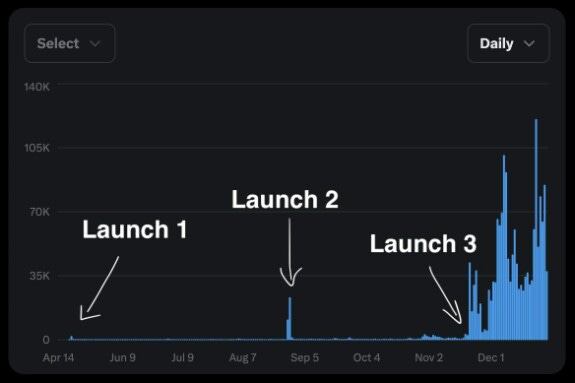
Further proof that you don't have to give up.
The situation was most likely saved by Influencer Marketing.
If you're trying to figure out how to reach your audience, here's a post with another case study and a bunch of helpful prompts:
Judging by YouTube clips, the startup purchased several partner integrations. Bloggers liked the tool, so many creators started posting reviews and comparisons with other AI coding platforms. These drove traffic to the website.

Monetization
As for monetization, the platform was initially free. All the user had to do was to use their OpenAI key. When the founders felt they could introduce monetization, they launched a subscription model. Each subscription option provides a different number of credits needed for each code generation.
Lovable now has four tiers:
- Starter – $20/mo
- Launch – $50/mo
- Scale1 – $100/mo
- Enterprise – customized
Within four weeks of the subscription becoming available, Lovable reached an annual recurring revenue (ARR) of $4M.
Sharing is caring! Refer someone who started a learning Journey in AI!
How to Use Lovable
Lovable was developed as a tool for non-technical users. According to Osika, the company wants to expand the world’s coding capabilities beyond the current 1% of the population who can program and make software more accessible as a result.
Therefore, the platform is extremely beginner-friendly. Nevertheless, everyone better be ready. Here's your quick tutorial on how to get started.
1. Creating a New Project
- Start by writing a prompt describing the app you want to create. For example, "a project management tool that helps teams track their tasks".
- Lovable will then generate the necessary files and display a preview of your app.
2. Customizing Your App
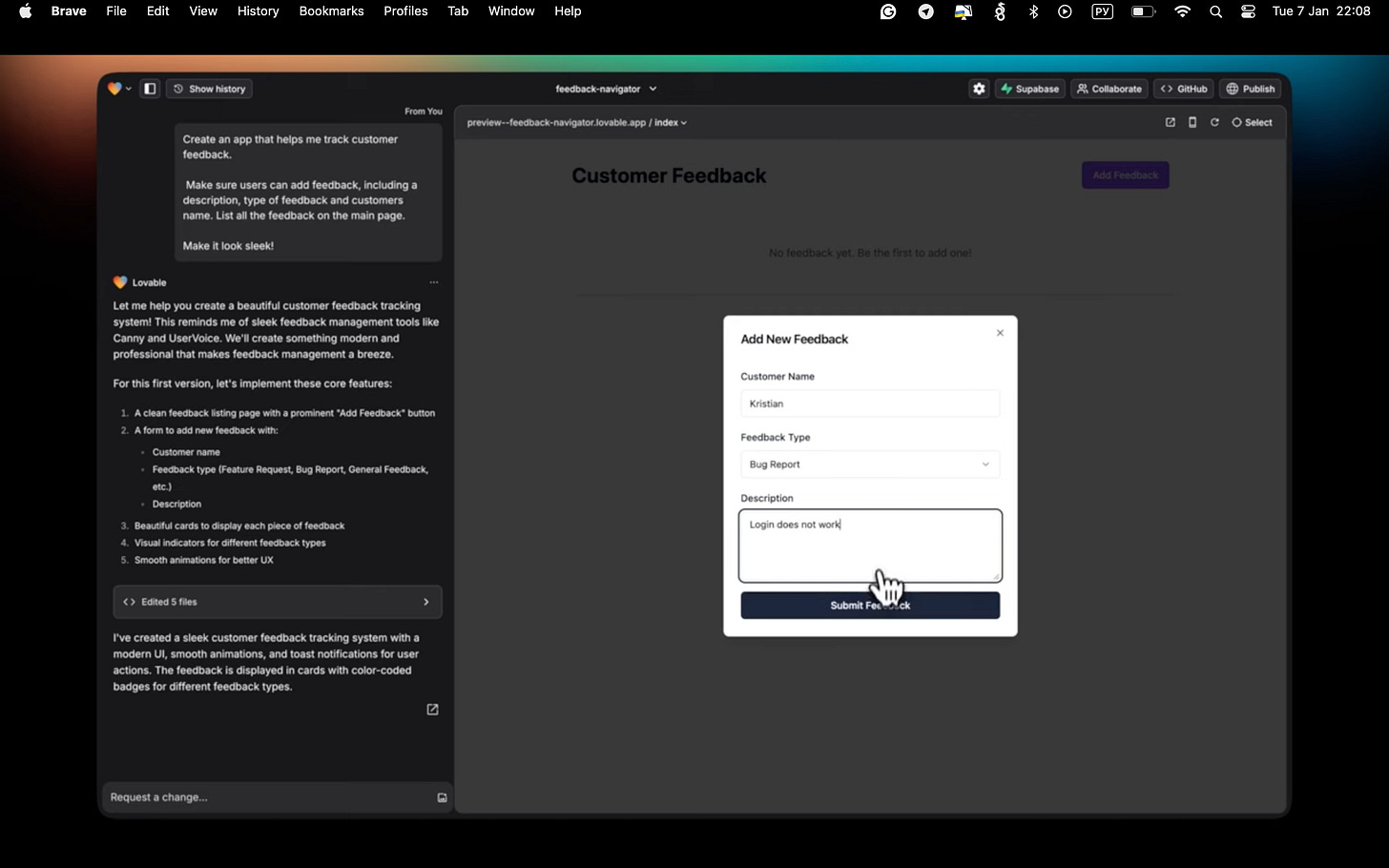
- Custom Instructions: Add guidelines for Lovable to follow when building your project. For instance, specify that the UI should be responsive and mobile-friendly.
- Adding UI Elements: Request specific UI elements, like an AB bar, via chat and Lovable will implement them.
- Reverting Changes: Lovable allows you to revert to previous edits if you're not satisfied with a change. For example, you can restore a previous state if you don't like a newly added footer.
- Select Tool: Use the select tool to isolate specific components and add them to your prompt as context.
- Image Attachments: Attach images to prompts for better visual communication. Lovable can understand the content of the images and act on them. You can also add images to the content of your application.
3. Connecting to GitHub
- Create a repository within your GitHub organization.
- Navigate to a specific file and make edits directly in GitHub.
- Lovable will show external commits and update when you refresh it.
4. Publishing Your Project
- Click on "publish" and then "deploy"
- You'll get a shareable URL.
- You can rename the subdomain and project in settings.
At this stage, you can also integrate with Supabase and other products as needed.
If you want to be inspired or see what some Lovable users are capable of, I suggest checking out the “Hall of Fame” section of the startup's website.
Current Status
A couple of months before the spike in ARR, Lovable managed to raise a seed investment of €6.8M from several European investors. The money was used to expand the startup's team, compute resources, data collection, and refinement.
Now, the startup continues to develop its product and talking about each update on X and other social media. The total audience of regular Lovable users exceeds 500K people. However, it would all be too boring if we ended it there.
A few days ago, Lovable ran into some serious problems.
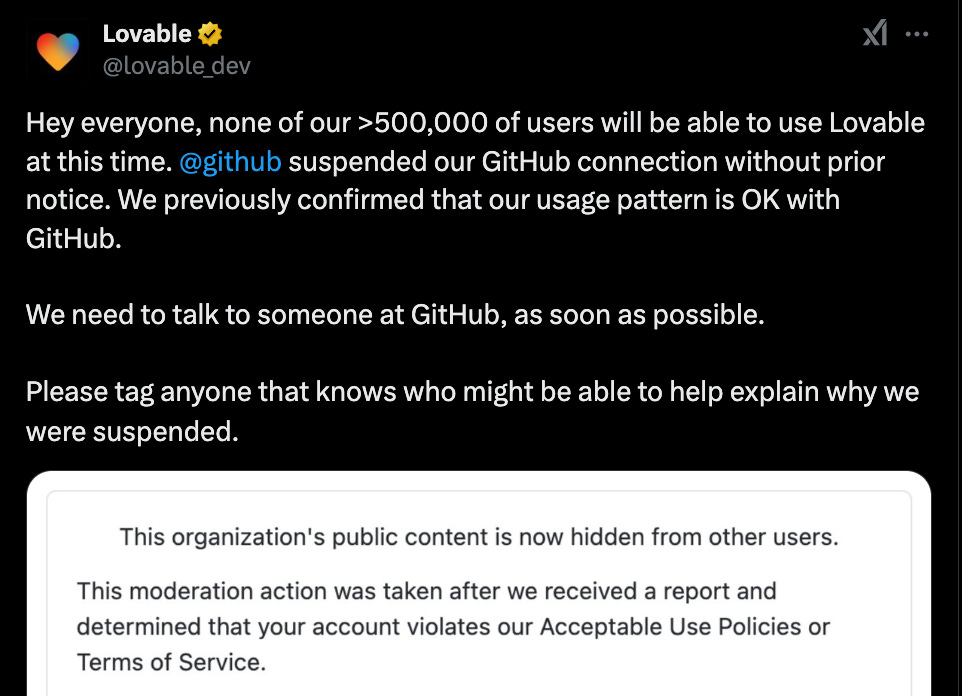
On January 3, GitHub suspended Lovable's app, which meant users could no longer create or edit projects. This was due to the startup's usage pattern, where they created a GitHub repository every two seconds for each new project initiated by a user.
Although Lovable had previously confirmed with GitHub support that their usage was acceptable, the high frequency of repository creation led to the suspension. Because the founders had no direct contact with the GitHub administration, they had to turn to the community for help.
As a result, Lovable contacted the CEO of GitHub and was able to restore access to users' projects within 24 hours.
Fortunately, no projects were deleted during this period.
Conclusion
In conclusion, I'd like to summarize what we found out through the Lovable case study. Here are a few points that seem important to me:
- Start Small: Began with an open-source project, GPT Engineer, to build a loyal developer community.
- Strategic Pivot: Rebranded to Lovable, focusing on usability, branding, and integrations.
- Smart Marketing: Combined community engagement, influencer partnerships, and proof of concept to reach a wider audience.
- Iterate Relentlessly: Learned from failed launches and kept improving until they hit success.
And, of course, the community. When launching GPT Engineer, rebranding to Lovable, promoting on YouTube and X, and regaining access to GitHub, community was key to the success. So, if you're getting ready to launch your project, give your users the attention they deserve!
Posts for those who are building startups:
Share this edition with your friends!
This article was first published in the Creators AI newsletter. View the original edition.