Manus Agent: Early Access Review
First impressions of the sensational AI agent
Hi! The other day, we got early access to Manus, and now we can't wait to share our impressions. This is the Chinese AI that made a lot of noise a couple of months ago (some even called it another “DeepSeek/Sputnik moment”).
We covered this agent, its origins, and its founders in one of our previous posts (check if you missed it!), and in this one, I suggest diving into testing Manus.
Today, we’re testing it on actual tasks, checking the developers’ promises, and determining how much we need modern agents.
At the end, we will also discuss the most worthy alternatives.
Get 20% OFF Full Access subscription!
Manus | Overview From The Inside
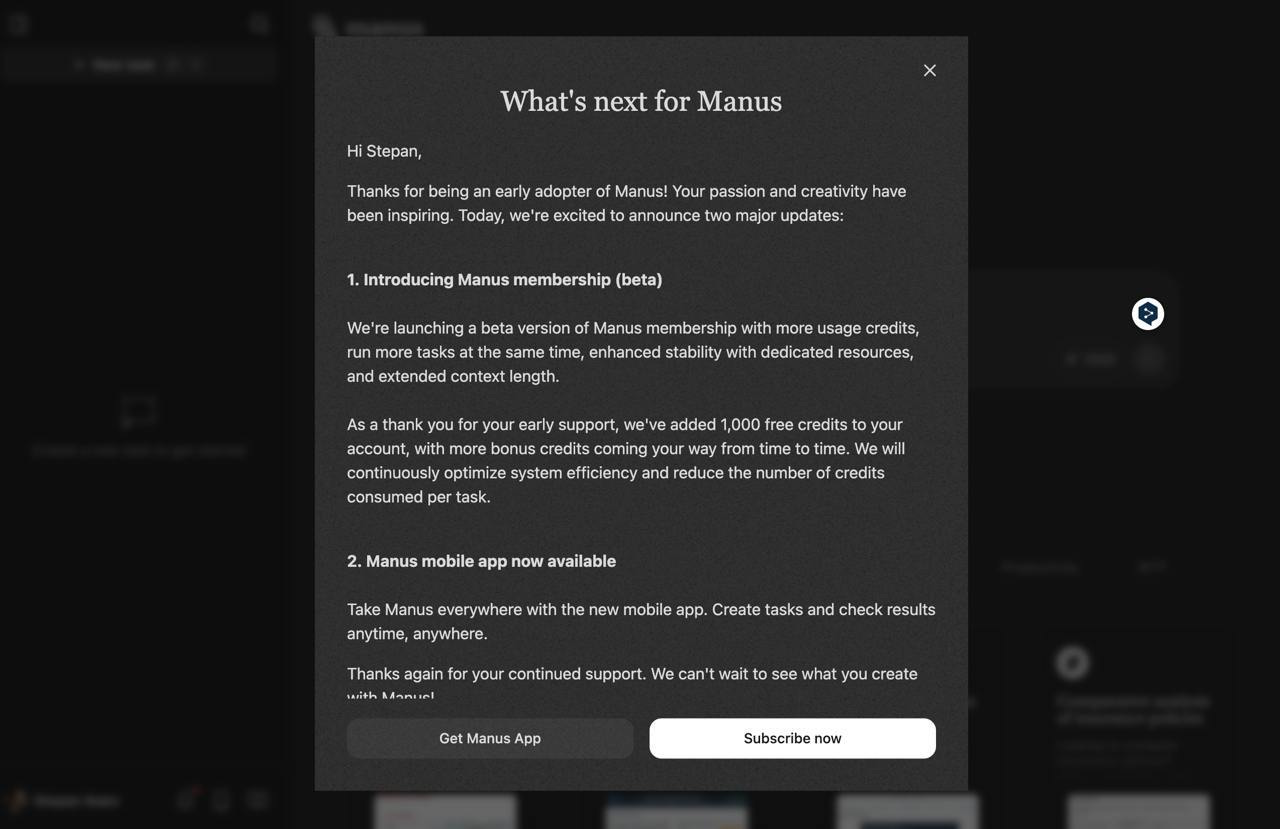
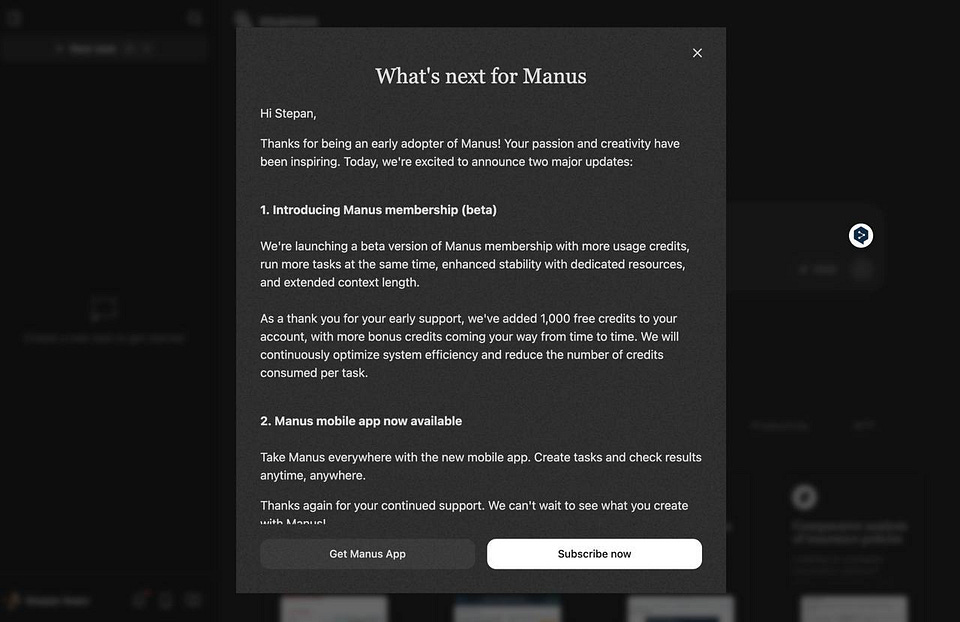
Since Manus is now in closed beta testing mode, most potential users are not yet able to log in and familiarize themselves with the platform interface. As I've noticed from posts on X, this often leads to confusion.
So first, let's go over the fundamental aspects of Manus.
What You Should Know About
The interface and interaction with the agent are similar to ChatGPT.

You have a field for entering text and attaching files and a list of tabs with previous requests. To get started, you will need to enter a prompt and wait for the AI to perform the task. And there's an important point here.
Manus performs all operations on a remote server, not on your PC or browser. So, it differs from Computer Use by Anthropic. This has both pros and cons, but more on that later.
The workflow is similar to ChatGPT's reasoning but looks more advanced. The agent also receives a request, breaks down the task into its components, and proceeds step by step.
But instead of lines of text, we see Manus using a browser, typing queries into the search bar, navigating through tabs, and much more. As a result, we can get not just a few paragraphs of text but, for example, a full-fledged website or app.
You can also view all steps. This gives a broader scope for collaboration between user and agent than usual chatbots. And, of course, it opens up space for new use cases.
Speaking of which.
Share this post with friends, especially those interested in AI Insights!
Manus doesn’t restrict users regarding scenarios (except for the $39/mo subscription). However, the developers offer several use cases for those who don't know where to start.
In addition to featured (popular queries), Manus boasts categories such as:
- Research: Use cases for entrepreneurs and creators
- Life: Solving everyday issues with the help of an agent
- Data Analysis: Structured processing of large amounts of data
- Education: Scenarios for learning and teaching
- Productivity: Common scenarios for different professions
- WTF: Fun and entertaining use cases
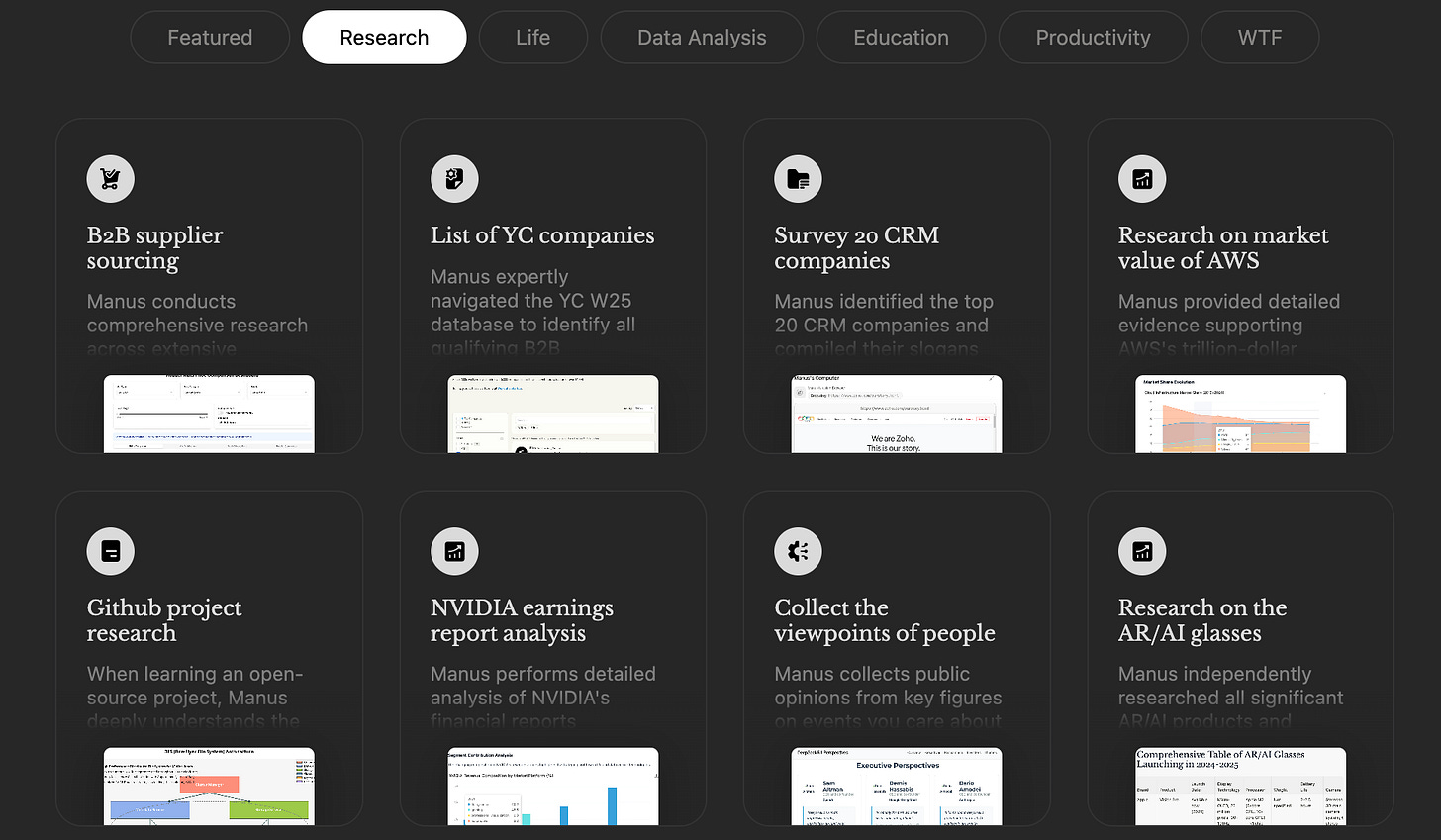
Selecting the appropriate category shows how Manus performs specific tasks, from a prompt to the finished result. And, of course, in the pre-prepared cases, Manus performs superbly.
But the state of affairs outside of promo campaigns? Let's break it down with custom prompts for entrepreneurs and creators and find out how helpful AI agents are in real tasks.
AI Agent in Real Action
Straight to the point.
We’ll give Manus different tasks that ordinary chatbots usually can't handle. Each will touch on a different aspect of a person's life connected to digital projects. Based on the results, you’ll determine whether it's worth integrating AI agents into your life.
After each generation, I’ll leave a link so you can read the complete responses.
Data Collection & Website Generation from a Single Prompt
This is the first use case and an insurmountable task for a chatbot (even the best ones like ChatGPT or Claude). Here’s a scenario: Let’s say you’re a creator or entrepreneur who wants a new channel to attract an audience but doesn't know how.
You already have a presence on social media but aren’t sure if it makes sense to launch a separate website. Gathering all the information in one place and developing your own platform is long, steamy (and sometimes expensive).
Manus promises to help with this problem: it can analyze it for you and prepare and deploy a website. Let's see how it works with our newsletter as an example.
Here’s out prompt:
Explore the Creators AI newsletter on Substack, figure out what it covers, categorize the content, and then build and deploy a website dedicated to that newsletter.The result:
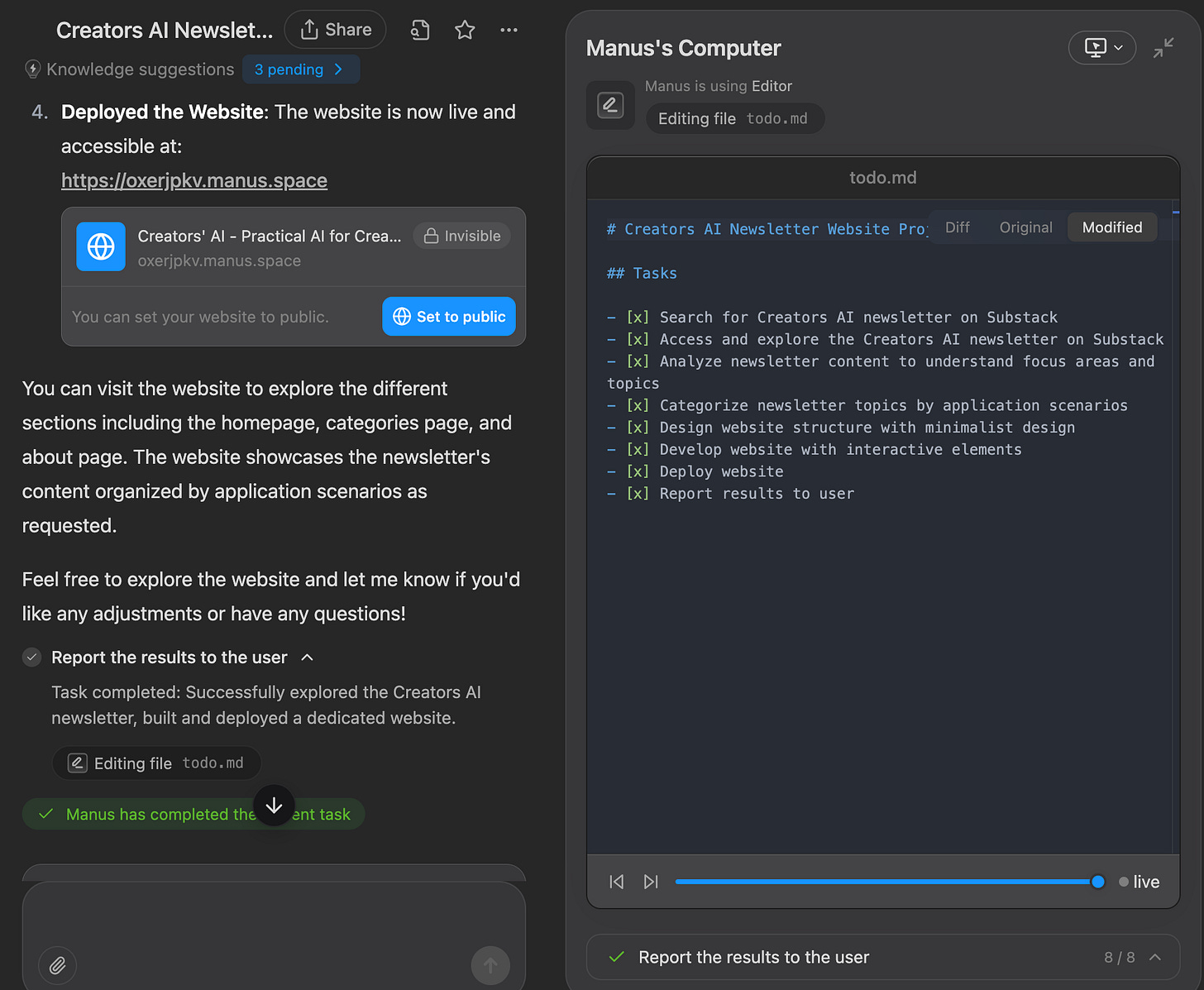
Although I am used to various AI tools and have seen hundreds of examples of models creating new games, websites, and more, it never ceases to amaze me.
In my opinion, Manus has done a pretty good job. If you look at the UI, the interface seems relatively simple and faded (to be fair, I asked to make it minimalistic). But if you pay attention to the details, you will realize how well the agent has done its job.
Without much input data, Manus gathered all the necessary information from our posts, checked the number of subscribers, and added some interesting hooks. In terms of functionality, everything is also good. A little tweaking of the UI will make a great website ready.
So, if you're a creator, entrepreneur, or freelancer, check out this use case scenario. In my opinion, it's one of the best ways to utilize the skills of AI agents.
You can see the workflow here and check the generated site at this link.
Financial Analysis with Actual Data
The following case study is more topical. If we want to include an agent in our daily routine, it's a good idea to make sure that it knows how to work with relevant info.
Let's try this prompt:
Last week, Donald Trump announced global tariffs. Explain to me what principle created them, how the leaders of other countries reacted to them, how the US stock market behaved, and what long-term prospects they may lead to.Here’s the result:
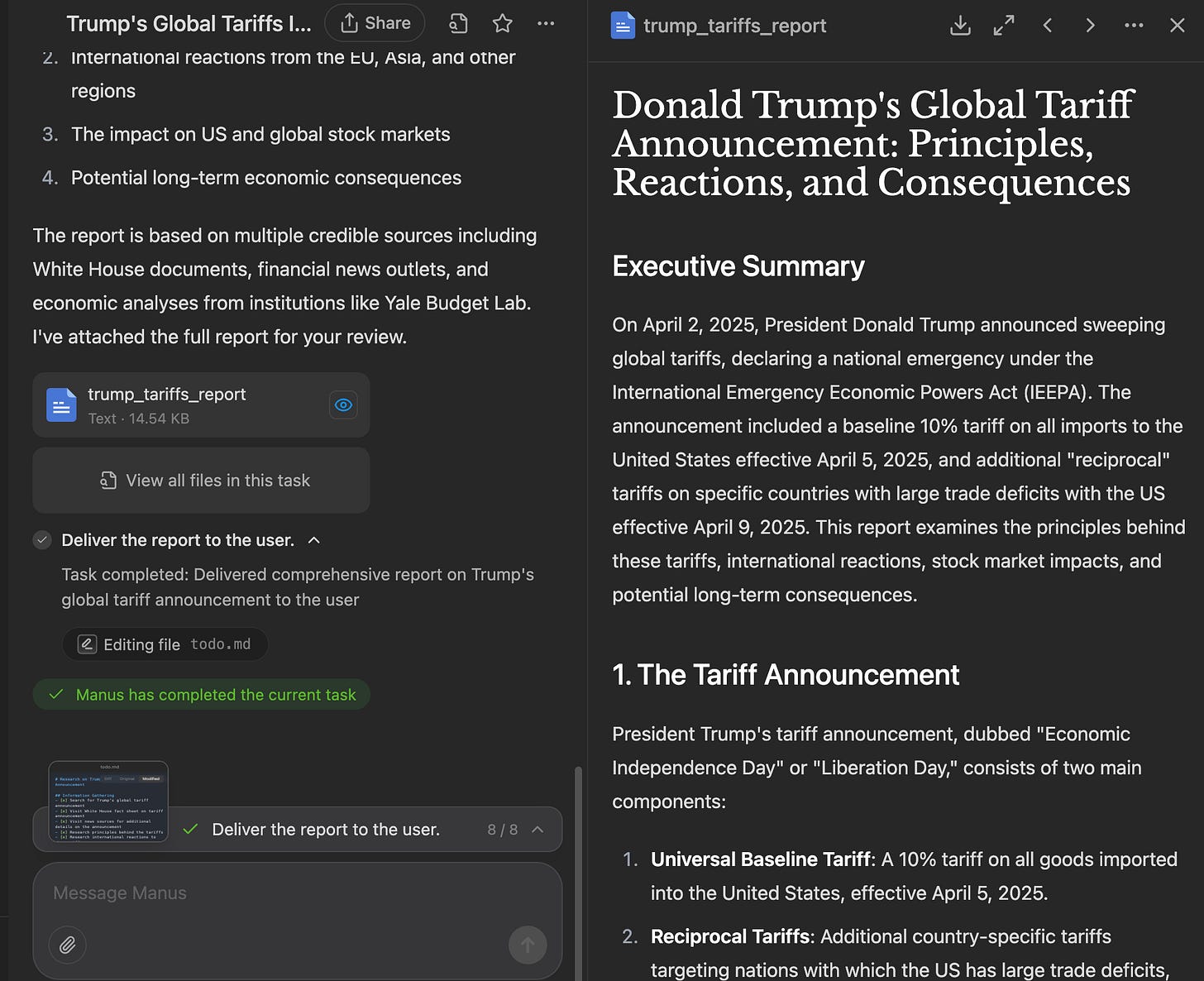
There were two critical criteria for me in this case study: relevance and objectivity. Given the number of news stories on the topic, I was curious about the dates that would appear in the final response and the sources of information that would be used.
Manus chose news from the day the global tariffs were announced, as well as those published on the same day I asked the question. The structure also matches the query: there is basic information about the tariffs, market and politicians' reactions, and a forecast for the near future.
At the same time, the agent does not explicitly assess current events.
You can give your assessment by reading the full results at this link.
Creating Courses for Specialized Industry
Manus developers promote their agent as a tool for education. So, I don't see much point in testing it on general topics like language learning or productivity.
I'm sure the AI can handle that just fine.
Instead, let's prepare a course to learn the basics of a complex profession, with a theoretical component and software. If it works here, it will work in other areas.
Here's our prompt:
Create a four-week course on the basics of motion design. The target audience is adult and technically savvy users with zero industry experience. Therefore, the course should include an introduction to the profession, the basics of working with graphics, an introduction to key software, and a series of hands-on tutorials.The result:

There is a lot to talk about.
On the one hand, Manus put together a pretty good course: it has a clear structure, a plan for each lesson, lecture topics, homework, and additional materials. On the other, the agent did not dig deep. The result is more like an outline of a course, with general points for someone who wants to implement it. But it isn’t easy to use a guide.
At first, I asked Manus to generate a website for the course and make it up, but after reading the files, I decided it wasn't necessary. Check the result here.
If you use the result as a starting point, though, it's pretty decent. After all, it's just one prompt. But I'd be lying if I said Manus creates educational content at the snap of a finger.
Creators’ AI could be a valuable gift for your friend, colleague, or family member. Gifting books is bright, but giving an AI newsletter is a superb move 😎
Disadvantages, Verdict & Alternatives
As for conclusions, given that my experience was highly positive, I'll start with the downsides. There are three in total:
- Speed of Operation
While I must admit that the agent does a tremendous amount of work after each prompt, the experience with Manus differs from what you might be used to. It is significantly slower than the chatbots we use, even reasoning models.
For example, it took more than an hour to generate an AI financial analysis and about two to create a course. This is still better than doing the work manually (it can even take days), but it's annoying when unsure of the end result.
- Pricing
All users with early access get 1000 credits for solving their tasks. However, the developers do not specify how much volume is required for a particular request.
By my calculations, it takes a little over 300 credits for one in-depth research and turning it into a website. Thus, to get the three cases above, I spent all my starting credits (some more went into the test prompts).
There's no way to refill credits. Instead, the company offers a $39/mo subscription with 3900 credits. You can also get extra credit for taking surveys and rating responses. But it turns out to be noticeably more expensive than any popular chatbot.
- Remote PC
As I mentioned above, unlike many others, Manus doesn’t take control of your PC. It is limited to its own browser and cannot use your software. So, if you were envisioning your own Jarvis that will control any apps, I have to disappoint you.
In addition, I wouldn't give Manus my logins and passwords (so far, I don't trust the startup that appeared a couple of months ago). This means that content automation on LinkedIn, Facebook, and other platforms is unavailable to this agent.
Still, Manus shows exceptional analytics and research abilities, is well-versed in current topics, and handles app generation at the level of Cursor and Bolt. Overall, the experience with this agent (and this is not just my observation) is reminiscent of interactions with Deep Research, Lovable, and Operator. Simultaneously.
That brings the agent closer to a one-size-fits-all answer to any question.
If Manus gives its users more credits (and the subscription will be cheaper) and becomes faster, it could be my daily driver. It's not perfect, but it's already much better than what we're used to.
For those who don't have access to Manus yet, I recommend trying two similar platforms I've had the opportunity to test (if you're an active reader of our newsletter, you can probably guess which ones!).
I'm talking about Computer Use and Browser Use.
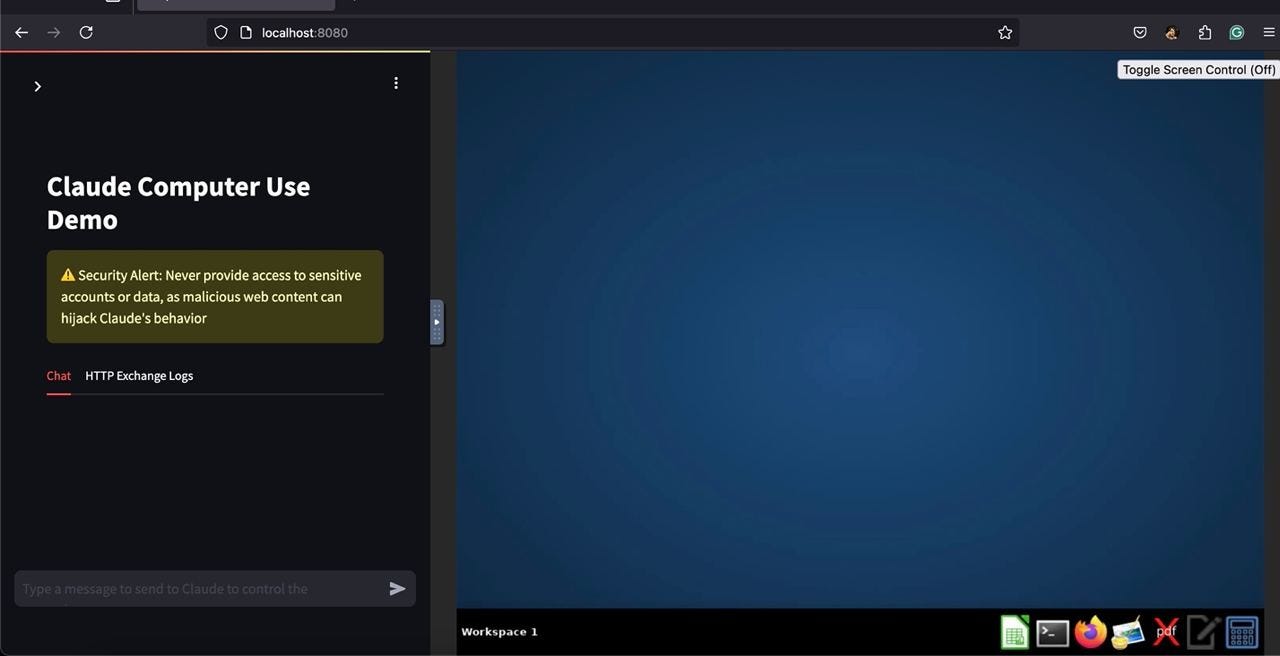
Computer Use is, in a sense, a more advanced platform. It was developed by Anthropic and is now at the beta-testing stage (strictly speaking, Anthropic pioneered the creation of such agents). Unlike Manus, Computer Use allows the AI to take control not only of the browser but of the entire computer.
We talked about Computer Use in this post:
Computer Use is not free, but it is clearly worth your attention.
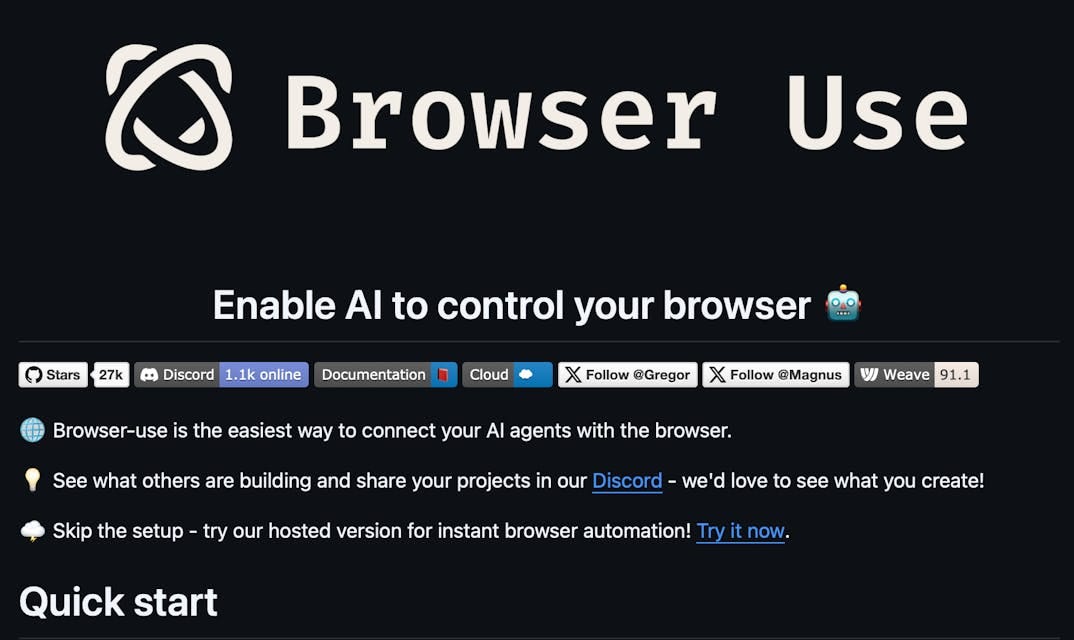
Browser Use is something between Manus and Computer Use. As the name suggests, the platform allows you to give AI control over your browser. But that's not the main thing; it's an open-source project.
You can access the agent via GitHub, plug-in APIs from OpenAI, Anthropic, Google, or DeepSeek, and use your favorite AI in a new way.
What's funny is that many people found out about Browser Use because of the hype around Manus. As a result, this agent got more than 54,000 stars on GitHub and raised $17M in seed series.
Of course, there is a huge variety of agents on the market right now. But these are the ones that have caused me the most experience. And if you want to dive more deeply into the topic, check out the posts below.
Share this edition with your friends!
This article was first published in the Creators AI newsletter. View the original edition.