Operator: The Real AI Agent by OpenAI
What are AI agents capable of in real life?
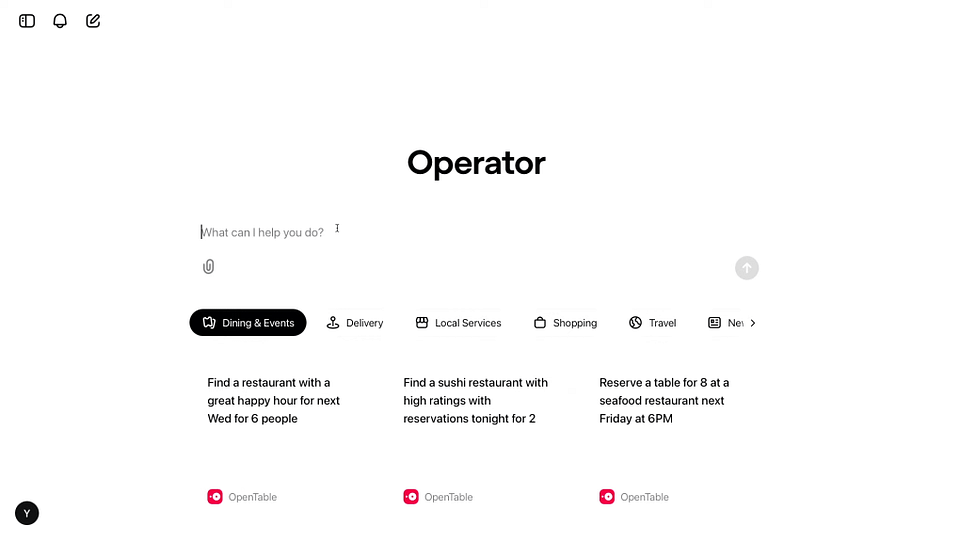
Being under the impression of DeepSeek, it seems everyone forgot (frankly speaking, me too) about another important release—ChatGPT Operator. But this is not just a new chatbot but a big step of OpenAI towards AI agents.
And there's a lot to talk about.
So, in today’s issue:
- What is ChatGPT Operator
- 5 Use Cases with Real Life Examples
- Alternatives You Can Try Right Now
Operator is only available to Pro subscribers in the US, but we have alternatives you can use anywhere. Luckily, there are already quite a few of them.
Keep your mailbox updated with practical knowledge & key news from the AI industry!
ChatGPT Operator | Quick Overview

Operator is an AI agent designed to perform tasks on the web autonomously. It emulates human interaction with computer interfaces by combining GPT-4o's vision capabilities with advanced reasoning through reinforcement learning. The agent clicks links, scrolls pages, and enters text where needed. The type of task can be almost anything—as long as your workflows don't extend beyond the browser.
According to OpenAI, Operator can “see” (through screenshots) and “interact” (using all the actions a mouse and keyboard allow) with a browser, enabling it to take action on the web without custom API integrations.
And it even generates some pretty good memes about itself!
If before you went to the ChatGPT app or website, entered the necessary prompts, and then went back to the right platform and did the work manually, it's different with Operator. All you have to do is give the AI the desired command consisting of several actions and just watch it act in your stead.
What exactly it will do depends on the user's workflows. It could be the usual shopping and travel preparation or, for example, full automation of an unloved social network. (Yes, I mean LinkedIn, but more on that later).
Here are a few of Operator’s features that I find most important:
- Personalization: Like regular ChatGPT, Operator can remember your data. Create custom instructions for specific sites in advance and tell the AI your preferences.
For example, Operator will buy certain products on Instacart or book airline tickets from pre-selected airlines on Booking.
- Multitasking: The Agent from OpenAI is not limited to single window operation. You can run multiple processes that it will execute simultaneously.
This feature has passed many users. However, it is really handy because it means we can build multi-level processes around a single bot.
- Security & Safety: Although Operator can do all the work on its own, the developer has limited some features. In particular, when using personal or payment information, the browser's control is returned to the user.
By the way, Operator will also occasionally call on you to deal with CAPTHAs. Yeah, you can't get away from that.
Limitations
As for limitations, Operator has all the same problems as regular ChatGPT, but with a few shortcomings of its own.
Speed: If you expect Operator to act like an advanced user using a bunch of hotkeys, I must disappoint you. The more complex the task, the more time it takes.
Limited autonomy: This item is both a pros and cons of the agent's AI. For now, Operator is not allowed to manage your data, even if you ask for it. It also handles captchas very poorly.
Lack of push notifications: This seems like a small thing, but given the previous limitation, it's an annoying drawback. The agent can stall at the very beginning of the process and you won't know about it until you return to the appropriate window.
But these are all pretty general points. Let's see how Operator works in real life.
Use Cases & Examples
As is traditional, it didn't take long for the creators at X and Reddit to curb the capabilities of OpenAI's first AI agent. Here are the most notable real-world examples for entrepreneurs, freelancers, and engineers.
Specifically an AI agent is able to act as:
- Content Creator
- Coding Assistant
- Sales Manager
- App Builder
But let's go in order.
Operator & Content Creation
Max Winebach decided to use an AI agent to beat LinkedIn.
He's an analyst at Creative Strategies who talks about the latest news in consumer technology in his social media. After testing the Operator, he stated that he “will never have to touch linkedin again”.
And here's why (the result is pretty impressive):
He used the following prompt:
*link to the relevant source* can you write and post me something about this rtx 5090 review on linkedin, then reply to and comments that come in trying to match my tone and style from the actual post. make sure to optimize the linkedin post text based on this research note/reviewFor my part, I will note that this case is far from the best prompt I've seen. If you tweak it a bit, teach GPT your style, and give it more data, you can totally nail running one of the social media. That's awesome.
Well, we're moving on.
Coding Assistance
From content creation, let's move on to a more technical challenge.
Software engineer Kieran Klaassen, who is building startup Cora, claims to have found the best use case for Operator. He turned to AI to test his local development environment and see if his feature worked.
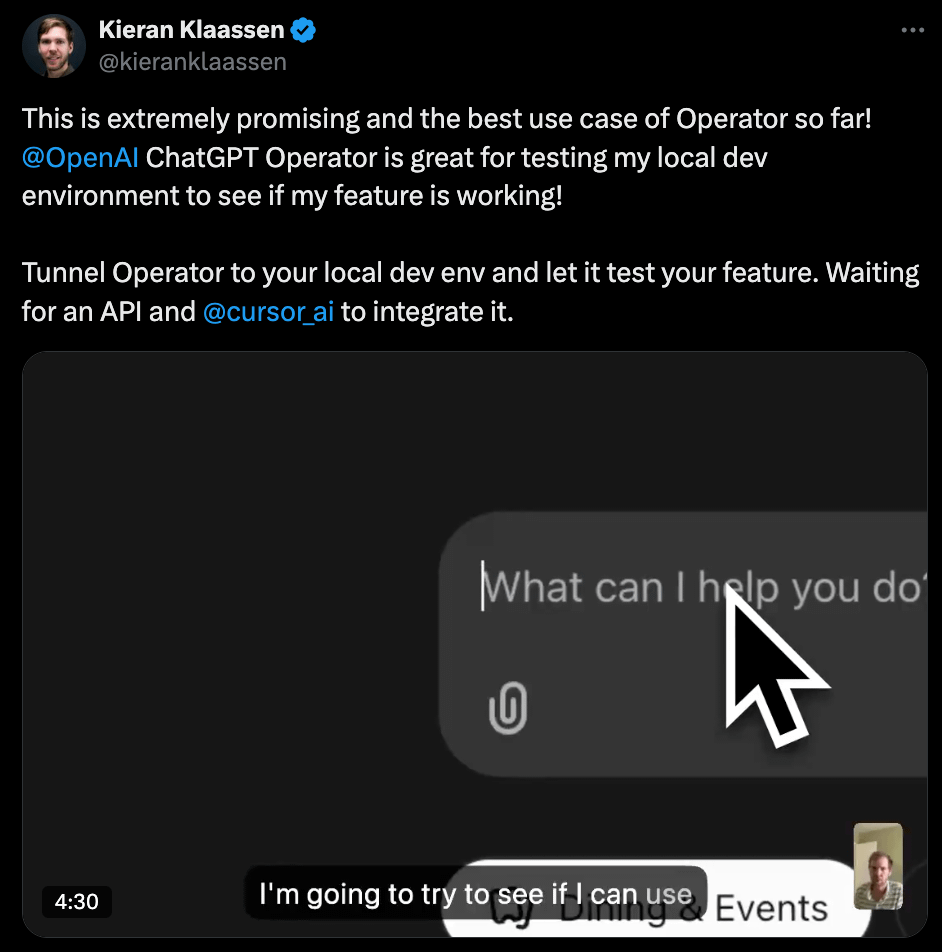
Here's the prompt that was used:
*link to the website*

I want you to browse to this website and check if a feature is working. I want you to use an example email as like example at test.com to signup for the waitlist and on the page after that I want to see if there is a confirmation if I want to sign up for every subscription and if not it fails if yes it’s good go do it.
Again, not the “cleanest” prompt, but the result is worthy of attention. If I add a full video of the process, this post will become too newsletter heavy. So here is a link where you can familiarize yourself with the completion of the task.
AI Agent Takes Sales Assistant Job
Another case with huge potential.
Helena Zhang, the founder of Pocketflow AI, decided to check how good Operator is for working as a sales assistant. And she didn't miss a beat.
She gathered a list of people her company wants to contact, asked Operator to find them and prepare personalized drafts to be agreed upon before sending them out.
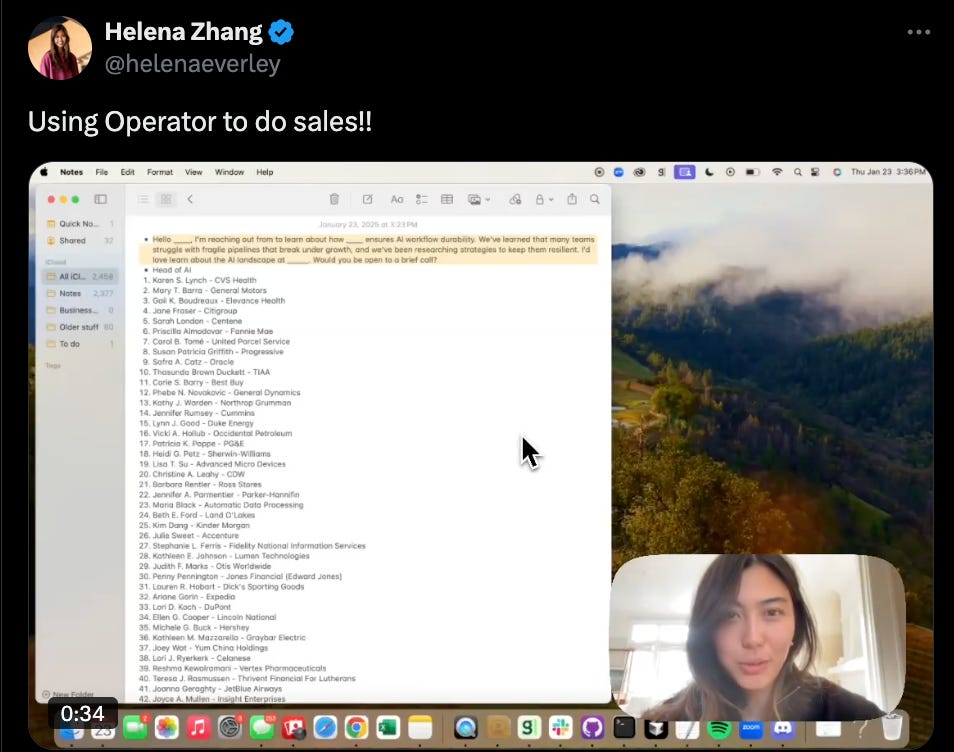
You can see what it looked like at this link.
Creators’ AI could be a valuable gift for your friend, colleague, or family member. Gifting books is bright, but giving an AI newsletter is a superb move 😎
Building & Deploying an App
And lastly the most notable example.
A user named Yohei (one of the creators of the Baby AGI agent) made Operator use Replit to build, deploy, and open source a tool. The whole process took about 30 minutes, but the author cut a video of the full process down to 8 minutes.
In the summary, he noted that Operator encountered several problems and development took longer than he would have liked. In particular, Operator didn't realize that he needed to scroll the page to see all the information and couldn't find the git function in Replit.
That said, it handled everything else just great.
Alternatives for Operator
That's all great, though Operator is available to ChatGPT Pro users only in the U.S. for $200/mo. And if you're in another country or don't want to give up $200 for a test feature, you can turn to alternative solutions.
Open Operator
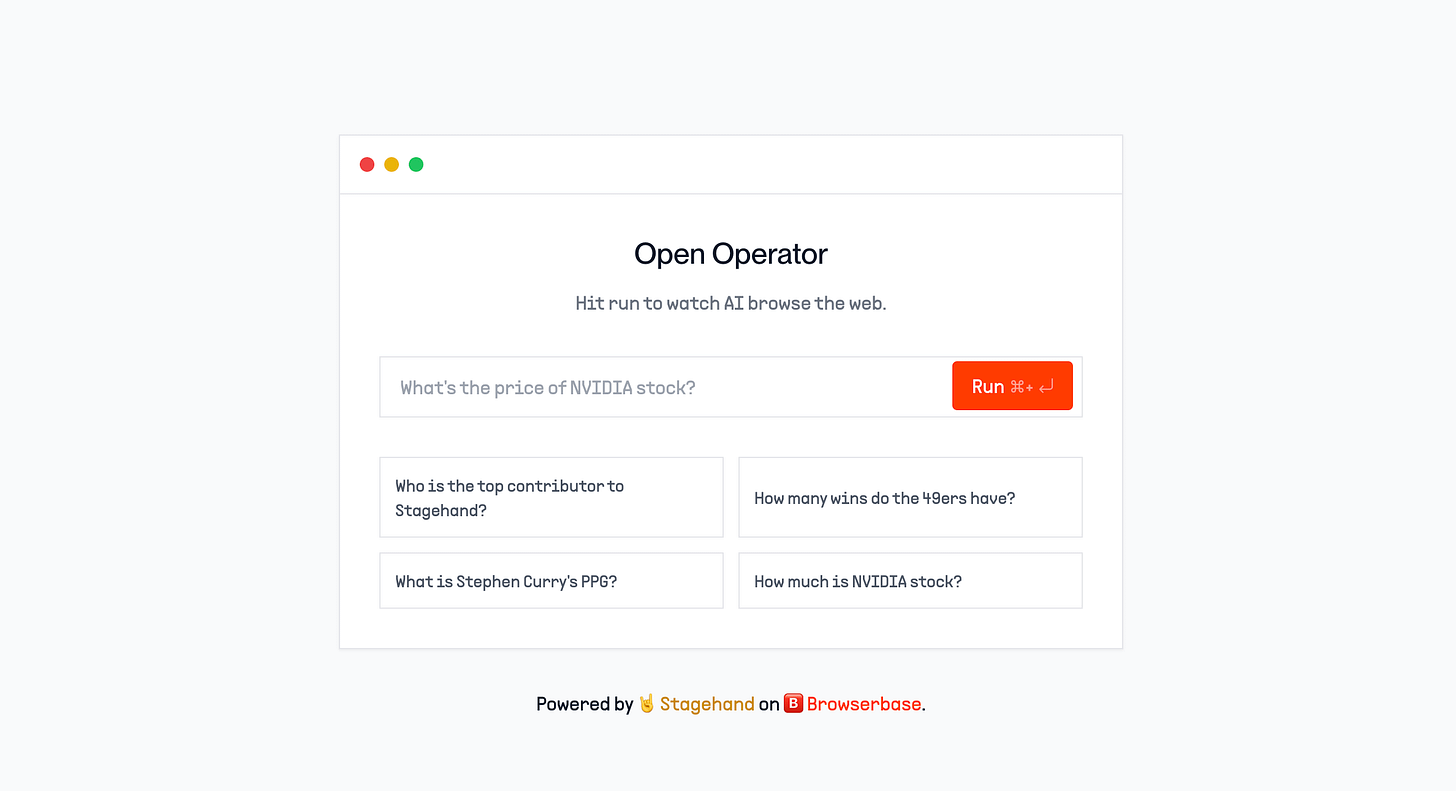
Open Operator is a platform that allows you to observe AI as it navigates and interacts with the web. Like with Operator by OpenAI, you can watch the AI browse the internet, providing insights into its web interaction capabilities.
The nicest bonus: right now you can try it for free.
Anthropic's Computer Use
Anthropic’s "Computer Use" feature in Claude 3.5 Sonnet lets AI interact with computers, mimicking human actions like clicking and typing. It can handle tasks like web browsing and form-filling, with companies like Asana and Canva testing its integration. Currently in beta.
We have to give Anthropic credit. In the case of agents, this company was pioneered among the leading AI startups.
We covered how to try it out in this post:
AutoGPT
AutoGPT is an open-source autonomous AI agent developed by Toran Bruce Richards. Utilizing OpenAI's GPT-4 or GPT-3.5 APIs, AutoGPT can autonomously achieve user-defined goals by breaking them into sub-tasks and using the internet and other tools in a continuous loop. Among open source solutions, this is one of the best.
More about the free AI agents on GitHub you will find here:
UI-Tars by ByteDance
UI-TARS is one more open-source AI agent. This one was developed by Chinise company ByteDance and Tsinghua University and also designed to interact with graphical user interfaces using visual perception and reasoning capabilities. The system enables automated task completion across computer, employing learning techniques to navigate and perform complex interactions.
UI-TARS is available on Hugging Face, where you can access a demo space and interact with the model directly online. Right now, you can try the agent as a macOS app, and ByteDance promises to release a Windows version in the future.
Midscene.js
Midscene.js is an open-source SDK for automating web pages using natural language through AI. This provides a simple setup process where you can install it from Chrome Web Store and configure it with your API key. Like other web agents the extension can be used to write content, search the web, create spreadsheets, and other daily tasks.
Final Thoughts
Operator from OpenAI is the case when you really don't want to criticize a new AI tool. The developers admit that it is not perfect, has limitations, and is still prone to errors. But that's why Operator was released in “preview” status.
And if you look at how it tries hard to fight captchas but always loses, you might even feel a little sorry for it.
Nevertheless, the first big step has been taken. And as the examples above show, AI agents can already be used in the real world. And right now, the main question I think is not what the outcome will be when agents can replace some humans.
Much more interesting: what will happen when agents learn to work with each other?
Share this edition with your friends!
This article was first published in the Creators AI newsletter. View the original edition.