Rabbit R1, AI Pin, and Apple Vision Pro vs Your Smartphone
Looking at the top AI gadgets of early 2024!
👋 Hey, I’m Daniil and welcome to a ✨ subscriber-only edition ✨ of Creators’ AI. By subscribing, you directly support Creators' AI's mission to deliver top AI insights & practical knowledge without ads or clutter. Your subscription allows us to grow our dedicated team and curate the most important AI Tools, Stories, and Tutorials in one place. - Daniil
Intro
It will soon be a year since we've been researching, reviewing, and talking about the best AI Tools, creators, and startups. But as you may have noticed, we've been focusing most of our attention on software products and services. It makes sense: right now, AI World revolves around chatbots and platforms that can be accessed from any device, as long as you have a good enough internet connection.
Call me old-fashioned, but sometimes (despite all the variety of modern neural networks and chatbots), I can't get enough of actual gadgets. Smartphones and laptops are less likely to get significant updates, and consoles have become predictable. Perhaps AI will breathe new life into physical products.
After all, machine learning has transformed our workflows, so why shouldn't it spark developers into the next generation of gadgets?

Today, we'll review three very different gadgets with a few things in common. All of them were introduced in the last year, made a sensation in the gadget world, and caught the attention of geeks. And all of them, of course, have become the top gadgets in terms of user interest in early 2024.
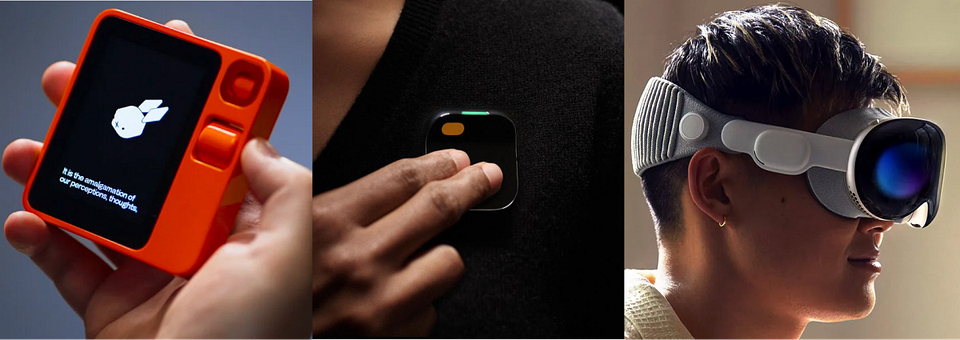
I'm talking about Rabbit R1, AI Pin by Humane, and Apple Vision Pro.
Let's take a look at each device, discuss what usage scenarios they already offer, and speculate a bit about the future of AI in the form factor of real gadgets. Who knows, maybe you don't need a smartphone anymore.
Sharing is caring! Refer someone who recently started a learning journey in AI. Make them more productive and earn rewards!
# Rabbit R1
Rabbit R1 is a unique and compact AI-based gadget unveiled at CES 2024. And since we're talking about the device (which we don't often do), let's take a quick look at its specs.
Specs
The R1 is a small square gadget reminiscent of old handheld consoles. It has a 2.88-inch touchscreen display, a rotating camera for photos and videos, a small scroll wheel, and a button to launch the voice assistant. Its technical part is relatively poor compared to modern smartphones: a 2.3GHz MediaTek processor, 4GB of RAM, and 128GB of internal storage.
AI Features
But all these characteristics aren’t so important. Much more important is what's "inside". Inside, Rabbit R1 has a unique Rabbit OS platform built on its own AI. Instead of a large language model like ChatGPT, the device relies on a "large action model". To put it in simpler terms, it's a general-purpose AI for managing apps.
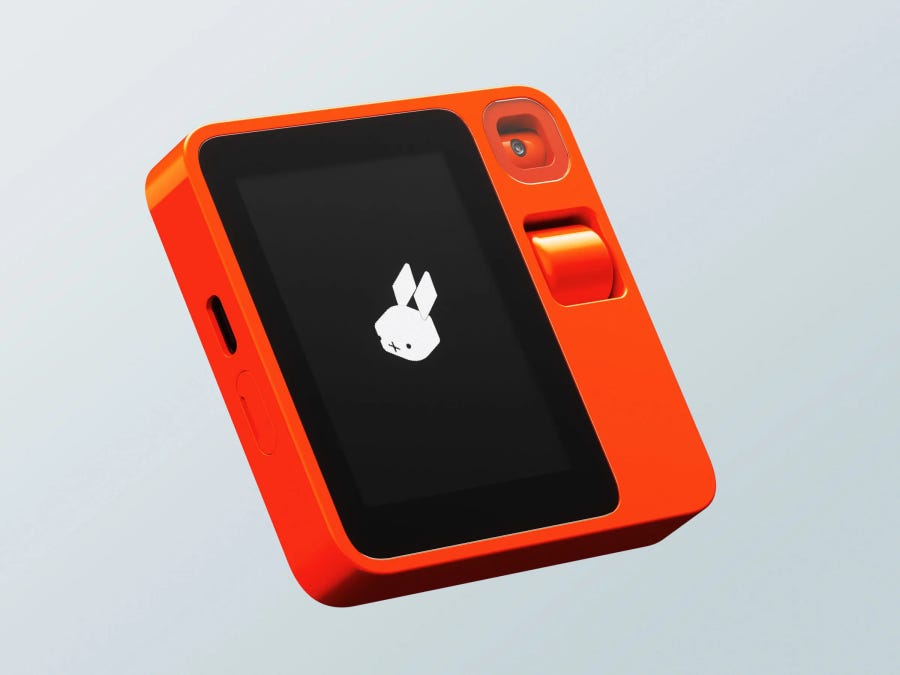
Like Google Assistant (or Alexa and Siri), Rabbit OS allows you to control mobile services. Using this gadget, you can order a taxi and grocery delivery, reply to a friend, or set an alarm. At the same time, you don’t need additional customization and use your hands. Everything can be done by voice. According to CEO Jesse Lyu, the Rabbit screen is only needed to check the data that the device processes.
The main draw of the R1 is its "flexibility." The developers don’t ask third-party developers to adapt their apps to the gadget but create a model that can handle any task. A lot of use cases will grow out of this approach. In particular, the user can teach his R1 to work in Photoshop and Microsoft Office or find any information on the Internet, make a plan for the next week, and prepare for an important event.
It's worth noting that some doubt the R1's prospects. You can find many arguments about this gadget on Reddit, but I will refer to one that seemed the most convincing:

Prices and availability
The current price of Rabbit R1 is $199, and the startup will start shipping devices to first customers in March. If you are interested in this AI gadget, keep in mind that demand is very high: the developers have already sold out the fifth batch.
# AI Pin by Humane
AI Pin is similar to Rabbit R1 in many ways in its idea, but it still has some unique features.
Specs
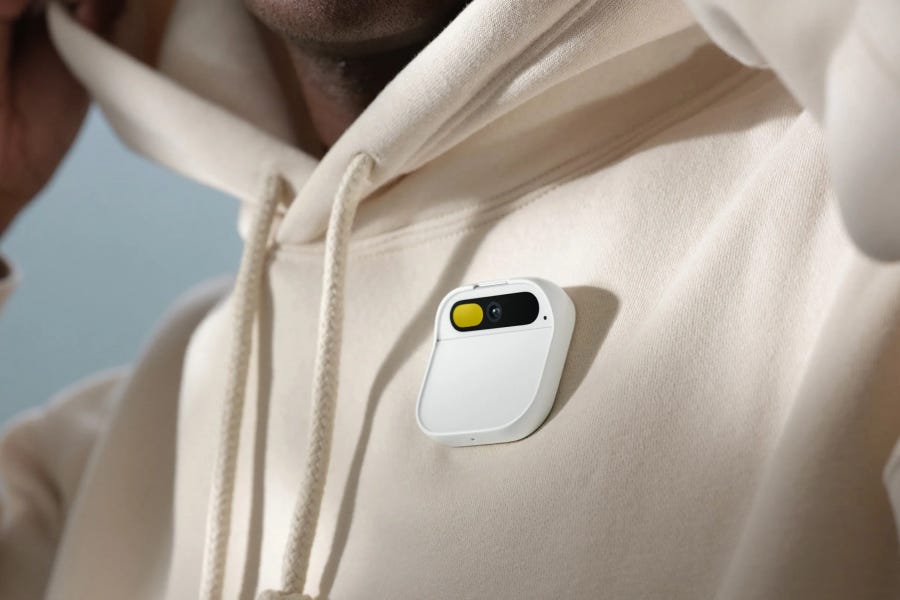
The first difference from the Rabbit R1 that catches your eye is the lack of a display. Instead of a screen, the AI Pin relies on voice commands, gestures, and a small projector to display text or tiny icons on the user's palm. Nothing is known about the specific specs except that the gadget has a Snapdragon processor, Bluetooth, and a 13MP camera. With the lens, the owner can also take photos and scan QR codes.
AI Features
As the name suggests, the AI Pin is supposed to attach to the clothes of its user. According to the developers, the owner of this gadget can leave his smartphone at home and solve any everyday tasks, communicating with the Cosmos operating system. It works in tandem with neural networks from Microsoft and OpenAI.
The way Cosmos works is similar to the plug-in system for ChatGPT. It also allows you to use standard applications via chatbot or create new services based on GPT-4. The developers promise long-term support for the device and regular updates to improve the user experience.
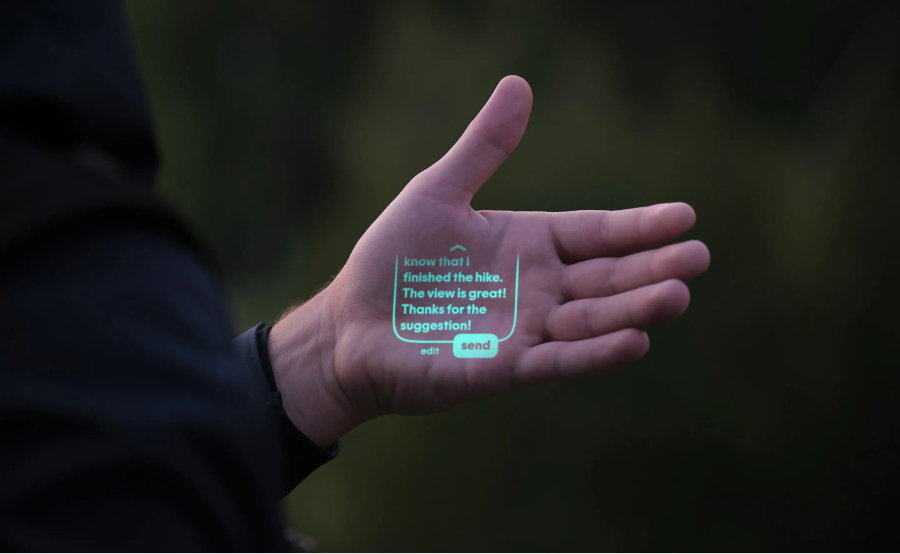
AI Pin can now write messages, handle emails, identify food to tell you about its nutritional value, and more. In addition, the device supports music streaming via Tidal. It works like an "AI DJ" that selects music based on context.
Prices and availability
The AI Pin is priced from $699 for the base version. However, you can't make a one-time payment - the device requires a subscription of $24 per month.
Subscribe to stay in tune with AI breakthroughs!
Apple Vision Pro
It may seem that the Apple Vision Pro sticks out from our list. That's partly true, but if you dig deeper, you'll realize that Apple's MR headset has much in common with previous gadgets. Let's start with the specs and then discuss the AI component.
Specs
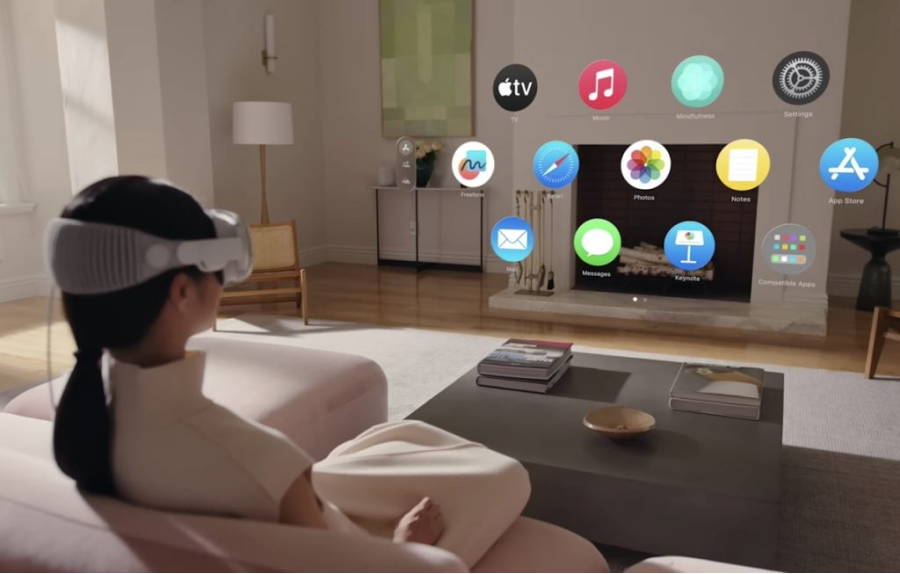
The Apple Vision Pro offers two OLED displays that contain 23 million pixels (more than 4K for each eye!), an Apple M2 processor, 12 cameras, six microphones, and five sensors. In addition, the headset works with an R1 chip that works simultaneously with the M2 chip to ensure no latency, as well as a system for personalized spatial audio. This device can work as a VR headset and as AR glasses, which together create an MR (Mixed Reality) system.
AI Features
I won't list all the gadget's features here but will focus on the user experience. Vision Pro is a new platform that supports applications familiar to iPhone owners and is gradually adding new services. And now it's all in a mixed-reality format.
The possibilities that Vision Pro offers to creators already surpasses classical platforms. You can use neural networks to create art objects and spatial content, communicate with chatbots in a more lively format, and fully immerse yourself in the worlds created by artificial intelligence. The potential of Mixed Reality (MR) technologies as the following graphical interface for AI is truly impressive.
In the meantime, just take a look at the use case by Himels Tech. Even without AI, he could turn his apartment into a digitized location with Vision Pro.
Not only we but also leading experts have high hopes for Vision Pro in the "world of AI". According to Wedbush, Vision Pro is Apple's first major push into AI, which will help drive a 30% stock gain this year. Analysts believe Vision Pro has every chance to become one of the most popular platforms for developing artificial intelligence.
And here is what Sam Altman, CEO of OpenAI, thinks about this product:

Vision Pro and AI will develop in parallel, creating new use cases for healthcare, sports, fintech, and work. If you doubt it, the first signs are already appearing: OpenAI has already released the VisionOS app (analogous to ChatGPT for MR), and Adobe has developed a new version of Firefly AI for the gadget.
Prices and availability
Apple Vision Pro sells for a hefty price, even for the base package, starting at $3,499 (which didn't stop Apple from selling over 200,00 units immediately after launch). And models with extended storage cost even more, up to $3,899.
Creators’ AI could be a valuable gift for your friend, colleague, or family member. Gifting books is bright, but giving an AI newsletter is a super move 😎
Conclusion
Well, are you ready to ditch your smartphones for a new generation of gadgets? Rabbit R1, AI Pin, and Apple Vision Pro provide a truly new user experience that we can't get with conventional devices. More to the point, in some cases, they outperform smartphones, tablets, and laptops: solving a task with a couple of voice commands or gestures sounds very tempting.
But you should look with a cold head, and it becomes clear: the future is murky. If you ask me if there is a need to buy a Rabbit R1, AI Pin, or Vision Pro, my answer is no. The reality is that despite the cool features and capabilities these gadgets offer, they don't have a severe advantage over smartphones and, at the moment, look like gimmicks for enthusiasts.
No matter how much you like the gadgets in this newsletter, some issues will have to be solved "in the old way", which means we are not ready for the new era. But... seeing the demand for these gadgets, the enthusiasm of developers, and the progress in AI, we can't deny that this new era is somewhere around the corner. Perhaps a couple of years away from us.
So let's keep an eye on this approaching future together!
What gadget do you consider the central improvement platform for artificial intelligence? Tell us in the comments!
This article was first published in the Creators AI newsletter. View the original edition.