Suna: Viral Open Source Agent
Is Manus in trouble? It seems so.

We haven't had enough of Manus yet, but just two days ago, a new general agent swirled in the AI community. This time, it was from Europe, free, open source, and not only available by invitation.
And it's already at the top of the GitHub trends!
Sounds good, but what is it in practice?
Today we figure it out. In this post:
- Suna & Its Background
- Overview of the Trending Agent
- Examples & Prompts
- Suna vs Manus
Get 20% OFF Full Access subscription!
AI Agent by 18-year-old Founder
👆 Founder & his team introducing Suna.
So, the events are developing too fast: two days ago, nobody knew about Suna, and now it is the most discussed tool among AI enthusiasts (but we are used to it, right?). Let's exhale and quickly go from the beginning to understand everything.
Suna is an AI agent developed by Kortix AI, a Marko Kraemer’s startup. This story is particularly interesting because Kraemer is now just 20 years old (he launched at 18 y.o!) and had "just left school" when founding the company.
He also ran a dev agency as a teen, managing a team of 10 and earning over $1M in revenue (according to him).
This places him among the youngest founders in the AI space.
Not much is known about Kortix AI. Last year's Sifted wrote that the company emerged from the European ecosystem. This could be confirmed by the location where Suna was developed. In the announcement video, Kraemer stated that the AI agent was built by the startup's team in Lisbon in just three weeks!
Kortix AI's long-term goal is to allow other businesses to replace 70% of their workforce with AI. And Suna exists to do just that.
Speaking of which.
The Latest Trending Agent | Overview

Suna is designed as an open-source generalist AI agent that can handle tasks through natural language conversations. If you are familiar with Manus or have read our posts about AI agents, you will immediately understand what we are talking about.
Here’s its actual feature set:
- Browser Automation: Suna can navigate web pages, click elements, fill out forms, and extract data.
- File Management: The agent supports document creation, editing, and organization, allowing you to generate reports or manage project files.
- Web Scraping & Search: Suna offers web scraping and information retrieval capabilities, including cross-platform search and data integration.
- Command-Line Execution: It can run system commands and scripts to automate local tasks such as batch file processing or server management.
- Website Deployment: Suna provides one-click website deployment functionality.
- API and Service Integration: The platform supports multiple LLMs and can connect to external services such as Supabase and GitHub.
All in all, Suna can be called the “European response to Manus”.
And this is not a reproach. On the contrary, the Chinese AI turned out to be very good, so creating an open-source analog looks like a very cool solution.
Let's look at practical examples. And then we’ll compare it with Manus.
Application Scenarios & Tutorial
Here are some of Suna's most notable use cases.
Excel Automation
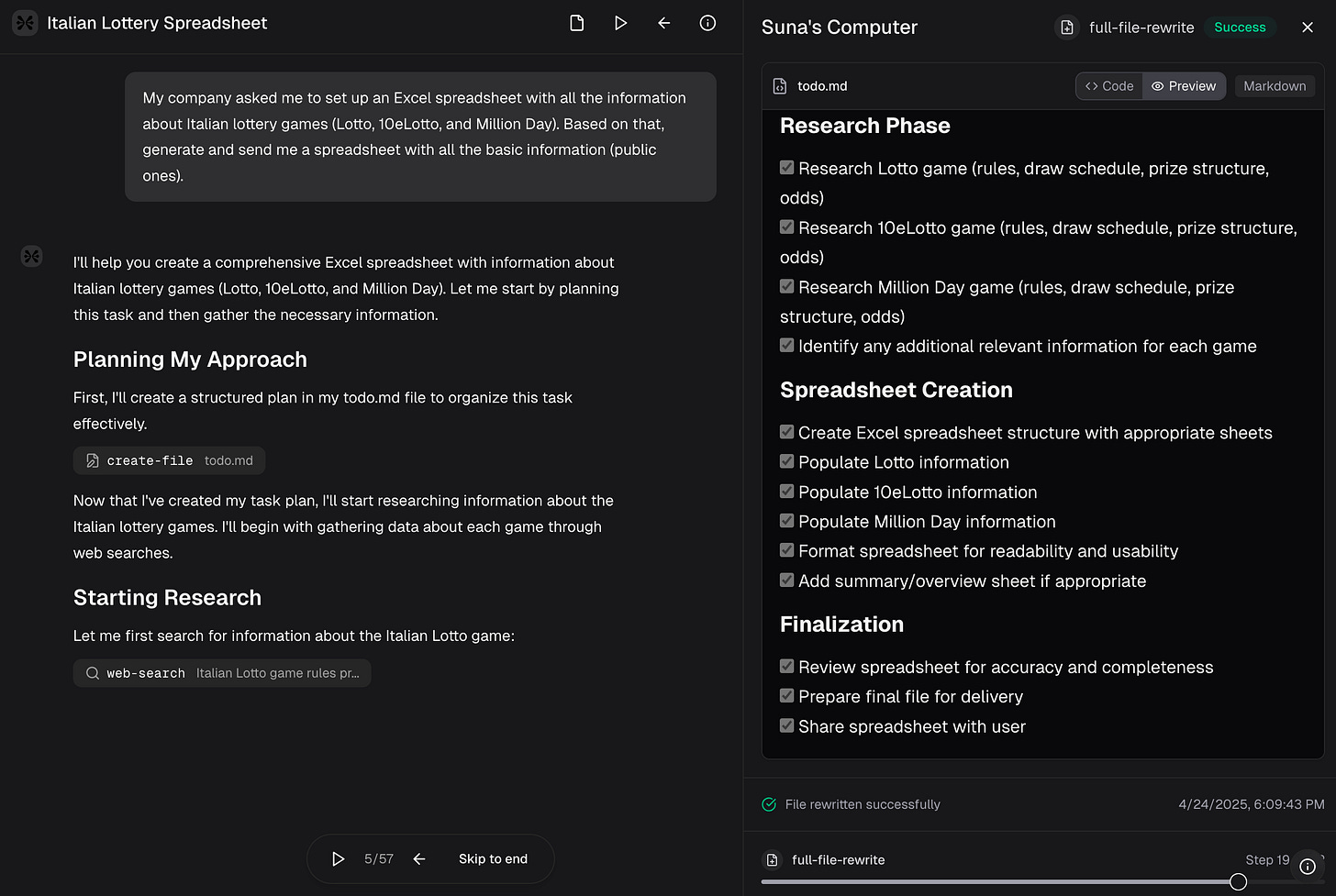
I can't stand Excel, so if I see a way to spend less time in spreadsheets, I use it.
Here’s the prompt:
My company asked me to set up an Excel spreadsheet with all the information about Italian lottery games (Lotto, 10eLotto, and Million Day). Based on that, generate and send me a spreadsheet with all the basic information (public ones).And here’s the result: Suna’s Response.
Share this post with friends, especially those interested in AI Insights!
Actual Data Web-Scrapping
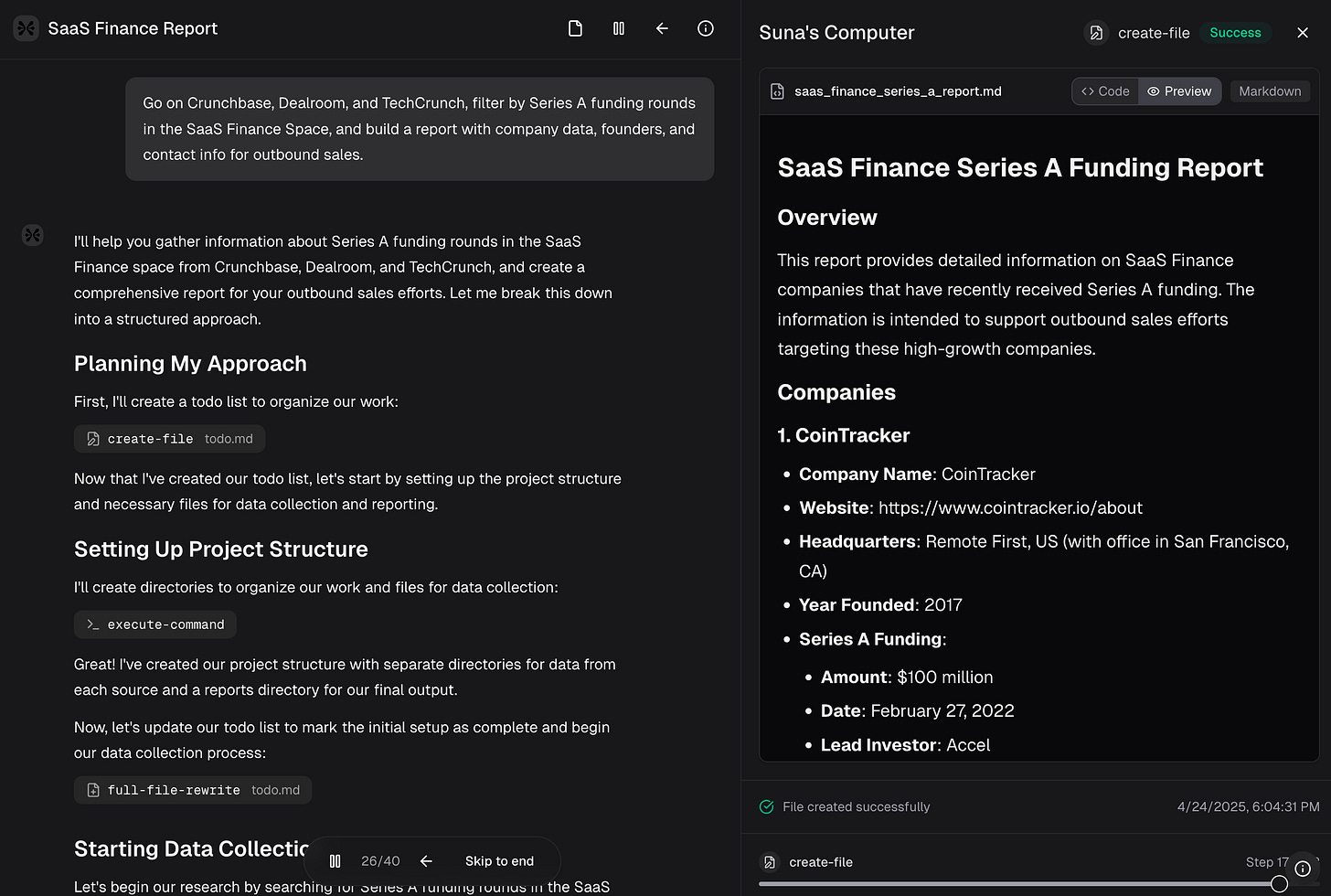
Another good example of using an agent is collecting and synthesizing data from multiple sources into one valuable report.
Here’s the prompt:
Go on Crunchbase, Dealroom, and TechCrunch, filter by Series A funding rounds in the SaaS Finance Space, and build a report with company data, founders, and contact info for outbound sales.And here’s the result: Sona’s response.
I think there is a moment in the life of any creator, analyst, entrepreneur (and many other professions) when you need to put together a report like this.
Now it is much easier to do it.
Customer Research with Ready-to-Send Emails
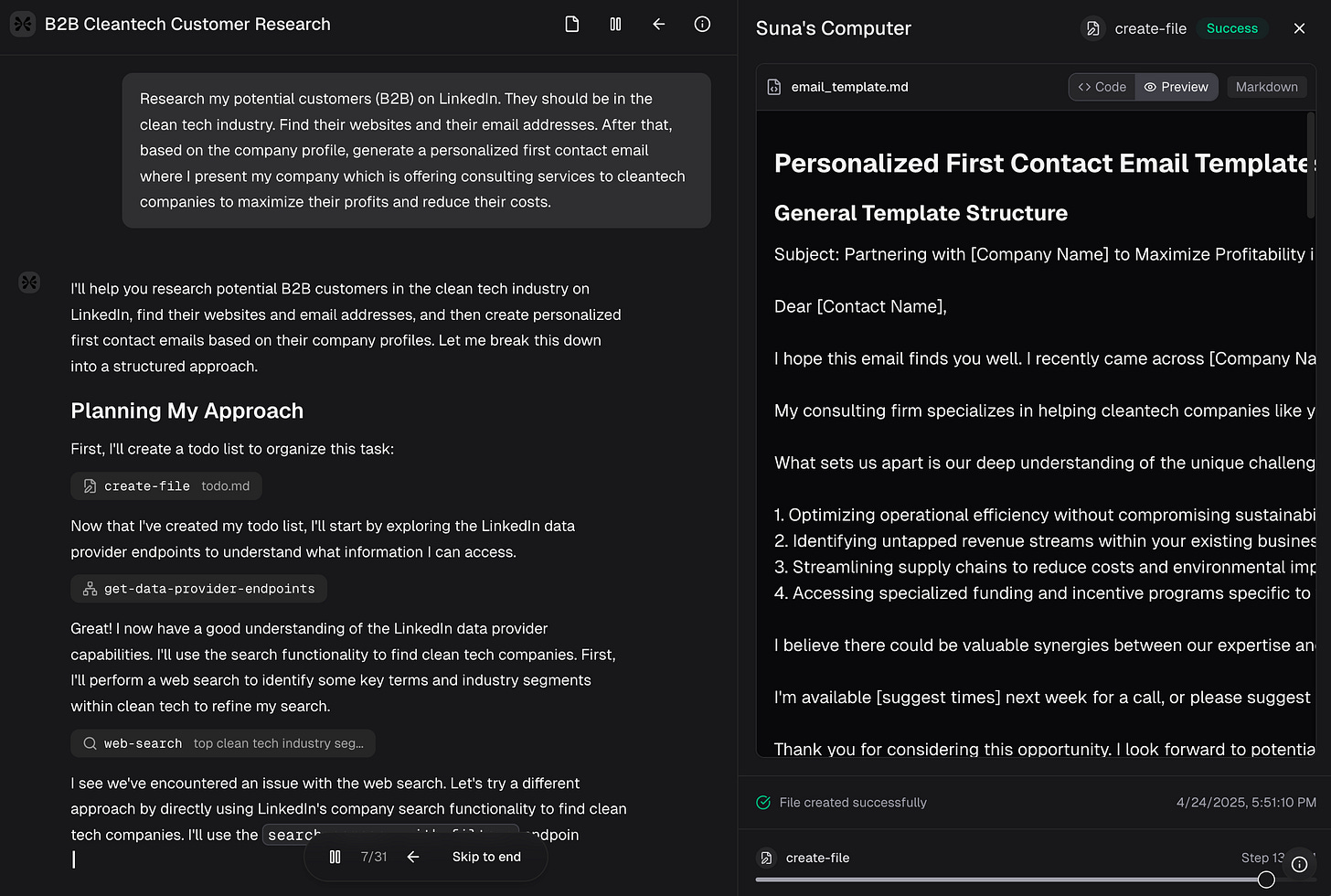
Another chore that is clearly no fun. Using one (rather simple prompt), you can automate. That said, you can also perform two tasks at once: conduct research and compose personalized emails for a dozen potential customers.
So now it is enough to give the following command:
Research my potential customers (B2B) on LinkedIn. They should be in the clean tech industry. Find their websites and their email addresses. After that, based on the company profile, generate a personalized first contact email where I present my company which is offering consulting services to cleantech companies to maximize their profits and reduce their costs.Here’s the result: Sona’s response.
Creators’ AI could be a valuable gift for your friend, colleague, or family member. Gifting books is bright, but giving an AI newsletter is a superb move 😎
Suna vs Manus | Comparison
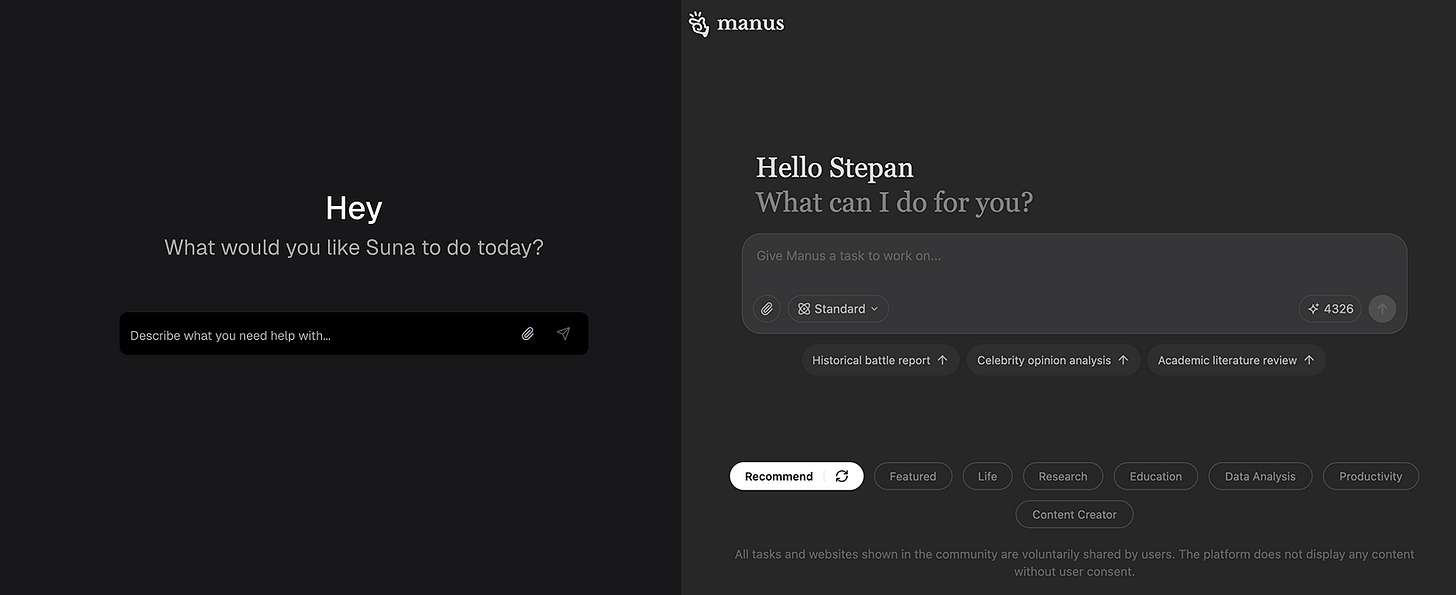
You don't have to go far to understand the difference between Suna and Manus. Let's be honest, on paper, the Chinese agent is not capable of imposing competition on a new player. Let's face it.
Manus:
- Invitation-only access
- Closed-source proprietary technology
- Limited availability, creating exclusivity
Suna:
- Open to everyone, no invitation required
- 100% open-source under Apache 2.0 license
- Self-hosting option available
Manus’s team claimed it was the “world’s first general-purpose AI agent” and even benchmarked it against OpenAI systems, emphasizing its autonomy and broad skillset.
Suna’s creators similarly tout it as the first fully open general AI agent. In practical terms, both can do things like conduct research, automate online actions, etc.
We have tried both and can say that Manus and Suna feel alike in what they can accomplish, which is also a big compliment to Suna given Manus had a head-start.
One area of difference might be in multi-modal support: Manus is said to leverage multiple models (including vision-enabled models like Qwen-VL for image understanding), whereas Suna at launch is focused on text-based tasks (though the community is discussing adding image generation and even voice control).
Over time, Suna might expand into those modalities as well. So right now I'd say it's a tie, but for the foreseeable future I'd certainly bet on an open-source project.
Getting Started with Suna
You now have two options as to how you can access Suna.
- Visit www.suna.so to access the cloud version.
Thus, use can use the chat interface to communicate with the agent. You can simply type your requests as you would explain them to a human assistant.
- Self-Hosting Option: For those who prefer to self-host, you can clone the repository from GitHub, install the required dependencies (Python 3.11+ and Node.js), configure the environment variables, and run the application locally.
This option will give you a much larger scope of possibilities, but will require an API key for AI models from OpenAI, Anthropic, or another developer.
And, of course, it is suitable for tech savvy users.
Conclusion
Kortix AI (and I'm specifically talking about the startup, not Suna) is this one case where you want to look at things in a positive way. The fact that an 18 y.o founder and a small team can release a free agent that competes with a well-funded closed product shows how well we are moving.
And I specifically want to point out a cool trend: as soon as a quality idea in the AI niche comes along, we almost immediately get its open source counterpart.
Whether Suna will make “employee AI” commonplace, though, is still a question.
On first impressions, the agent doesn't offer exceptional capabilities. We've already seen similar capabilities in one form or another from Manus, Deep Research by OpenAI, and Perplexity.
But it's a good reminder that the AI revolution isn't just happening in big labs: it's happening publicly, in real time, and sometimes led by teenagers with a GitHub account.
Share this edition with your friends!
This article was first published in the Creators AI newsletter. View the original edition.