
The Dark Side of AI Is No Longer Sci-Fi — It’s in Your Pocket
Last fall, we told you deepfakes would get weirder. Now they’re getting personal.
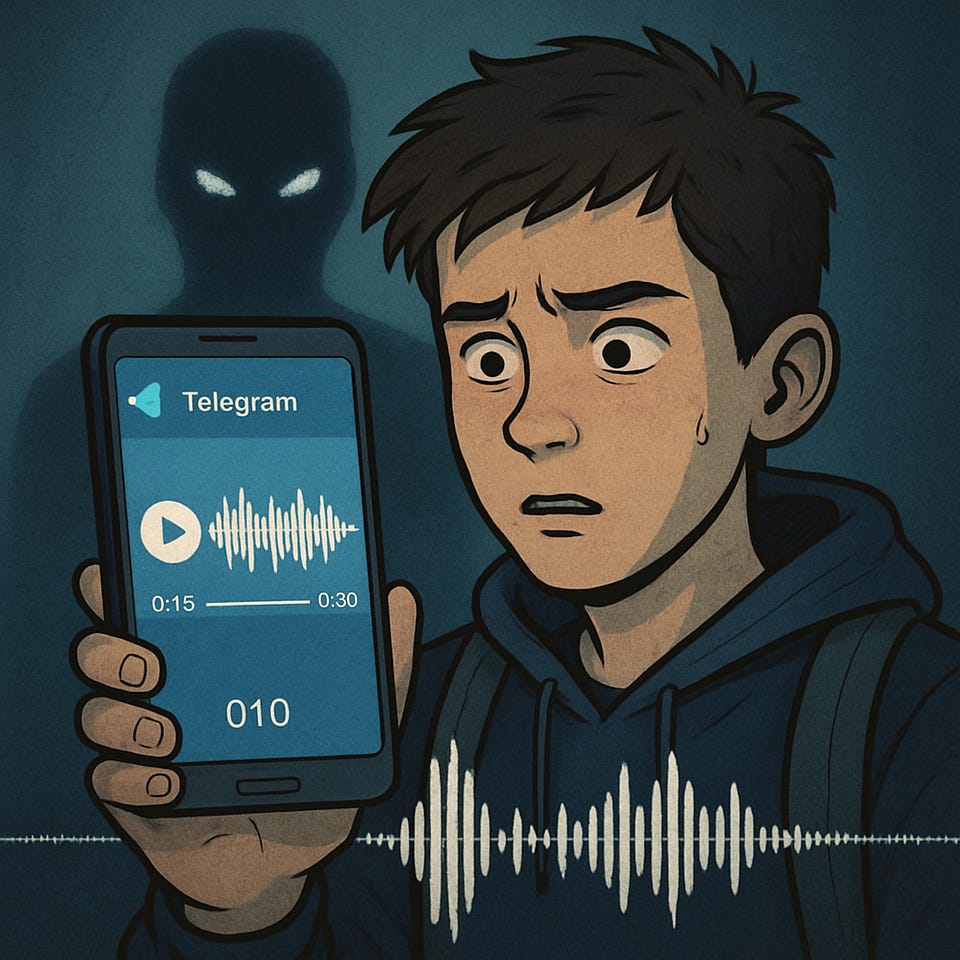
In one recent case, a teenager in Germany received a voice message from her “mom” on Telegram — panicked, urgent, asking for help. Only it wasn’t her mom. It was a perfect voice clone, generated by a scammer using less than a minute of publicly available audio. The scam failed, but the message was clear:
AI fraud isn't just coming — it's already in your inbox.
Keep your mailbox updated with key knowledge & news from the AI industry
In this issue, we explore how the dark side of AI has gone mainstream: from deepfake voice scams to new tools that dig through your personal data, impersonate loved ones, and enable social engineering at scale. We’ll show you what’s changed, what’s coming next, and how to protect yourself and your people from the inevitable.
We Told You So
Back in our November 2023 issue, we covered the rise of deepfake tools, synthetic media, and the first signs of AI voice scams creeping into the wild.
At the time, it felt like a glimpse of a strange future. Now, it’s just part of the toolkit.
What used to take hours of AI finetuning now works inside a Telegram bot. Tools that were limited to devs with GPUs are now available through simple web interfaces. And the line between “real” and “synthetic” has never been blurrier — or more dangerous.
What’s New in 2025
Let’s start with the obvious: it’s easier than ever to fake a human.
The Call Is Coming from Inside the App
Voice used to mean trust. A familiar tone, a mom's voice, a friend's panic — these were things you didn’t question. In 2025, that trust has been weaponized.
AI voice tools like ElevenLabs,Parrot AI, and Talknet don’t just sound real — they feel real. Some need only 10 seconds of audio — a podcast clip, a TikTok rant, a random interview from five years ago — and boom: instant, eerily perfect clone.
And these aren’t "what-if" hypotheticals. The scams are already here.
Telegram: The “Mom” Who Wasn’t
Location: Germany Victim: 16-year-old girl Tool used: AI voice cloning + Telegram voice note
She gets a voice message from her mother. Panicked, gasping:
“I need help. I’ve been in an accident. Please send money.”
It’s her voice. Not just similar — exact. But something feels wrong. She calls her real mom. No accident. No emergency. Turns out, a scammer cloned the mom’s voice from a 2019 podcast appearance.
WhatsApp: The Brother That Could Chat
Location: IndiaVictim: Mid-30s tech workerTool used: Real-time AI voice + chatbot
A call from his “brother”:
“I’m in jail. I need money fast.”
It sounds right. The voice, the slang. They even have a back-and-forth.But when he asks a personal childhood question, the line glitches. Then repeats. Bot error.The call was real-time text-to-speech, driven by an LLM-powered chatbot pretending to be family. This wasn’t a recording. It was an interactive deepfake.
Voicemail: The Boss in Trouble
Location: United StatesVictim: Employees at a midsize law firmTool used: AI voicemail + spoofed caller ID
Voicemail from the managing partner:
“I’m in trouble. Please wire company funds. Don’t ask questions — I’ll explain later.”
The voice? Spot on. Slight tremble. Intensity. One staffer initiates the transfer. But a second message comes — nearly identical, but slightly off. A gut check. They pause. Call his assistant. The managing partner? Relaxing on a boat in Italy.
It wasn’t malware. It wasn’t a hack. It was emotional hijacking — trust, urgency, and fear in your inbox.
Be careful with deepfakes. Share this post with your friends!
The Psychology of It
These attacks don’t rely on code. They rely on you — your fear, your instinct, your reflex to act when someone you care about is “in trouble.”
The voice sounds real. The emotion feels urgent. And that’s the whole point.
In 2025, deepfake voice scams aren’t fringe. They’re global, fast, and scalable — and they prey on one thing we all have: people we care about.
Emerging Patterns to Watch
- Elder scams with cloned voices of adult children
- Fake kidnapping calls with AI-generated screaming in the background
- Workplace fraud via fake managers requesting internal transfers
- Romance cons are powered by synthetic long-distance calls
The attack surface isn’t just your phone. It’s your memory — and your emotions.
In 2025, trust doesn’t break all at once. It gets cloned and sold back to you at a cost.

Deep Search + Personal Data = Perfect Social Engineering
Meet the new generation of open-source “deep search” tools — like Skiptracer, Photon, and commercial-grade alternatives that make Maltego look primitive. They can:
- Cross-reference usernames and emails across platforms
- Scrape phone numbers, addresses, IPs, and leaked credentials
- Build complete profiles with psychographic insight (thanks, data brokers)
And they’re not just powerful — they’re dangerously accessible. With a few clicks and no technical background, anyone can build a full psychological profile of a stranger. Imagine this data in the hands of a scammer: They know where you live, who you talk to, what you post, what scares you, and what makes you click. Combine that with AI-generated voice or video, and suddenly, social engineering isn't a guessing game. It's a precision strike. Welcome to the age of weaponized intimacy.
What these attacks look like today
1. AI-enhanced romance and investment scams
- According to CanIPhish, the top six AI scam types in 2025 include romance scams, AI-driven phishing, deepfake calls, and investment fraud, all scoring high on believability and scale
- 2025 “pig-butchering” scams, which foster trust and financial dependency, reportedly cost over $521 million between March and October 2024.
2. Voice deepfakes and robocalls
- Truecaller estimates voice-based fraud causes around $25 billion in annual losses. Microsoft warns that 37% of organizations worldwide have encountered voice deepfake scams.
- In Q4 2024, deepfake voice frauds led to far higher average victim losses—many were over $6,000, far beyond typical scam call damage.
Scams in 2025 aren't just more convincing — they're more diverse, automated, and scalable than ever.

3. Business email compromise (BEC) 2.0 Attackers now use LLMs to craft context-aware emails based on scraped company data — org charts, meeting notes, even Slack leaks. Some campaigns involve AI agents running multi-day conversations with finance teams to authorize fake wire transfers. The FBI reports BEC losses have surpassed $3.1 billion annually, with AI deepening the deception layer.
4. Synthetic identity fraud. Thanks to open-source face generators and breached datasets, attackers now create entirely fake humans, complete with LinkedIn profiles, photo histories, and AI-generated interview responses. These identities are used to apply for loans, onboard as employees, or operate shell companies. In the U.S. alone, synthetic identity fraud caused $2.7 billion in losses in 2024, and is projected to grow by 22% YoY.
5. “Hyper-personalized phishing” via Telegram bots. Fraud-as-a-service providers now offer pre-built phishing kits that auto-customize messages using scraped OSINT data — birthday mentions from Facebook, Spotify listening habits, and Amazon wishlists. One click, and the bot generates a tailored email or SMS designed to bypass both filters and suspicion. No more “Dear Sir/Madam” — just, “Hey, thought you might like this new synth plugin — it's similar to what you saved last week.”
This is no longer about “falling for it.” It’s about being targeted algorithmically, with tools built to make you say yes.
And it all starts with data. You didn’t even know it was out there.
You are not the weakest link. But you are the most predictable one.
What’s Coming Next
If 2025 already feels surreal, what’s coming next borders on science fiction — except it’s already in stealth-mode development.
- Real-time deepfake video calls with facial microexpression sync. Right now, real-time video puppets are clunky, with visible lag and uncanny glitches. But startups in China and the U.S. are already testing emotionally responsive avatars. Think Zoom calls where “Your CEO” not only looks right, but smiles at the right moment, frowns, and hesitates. The goal? Make you feel like you’re talking to a real person, and override your skepticism.
- Voice-to-voice AI translators that mimic identity. The next generation of live translation tools won’t just convert languages — they’ll preserve the original speaker’s voiceprint, tone, and even cadence. Use case? Seamless international communication. Misuse case? A scammer pretending to be your French investor, your Ukrainian contractor, your Mandarin-speaking partner — and you’ll never know it was fake.
- Scam-as-a-Service APIs with real-time adaptation. Forget copy-paste scripts. We’re seeing the early rise of plug-and-play APIs where scammers upload a target’s name, platform (Telegram, WhatsApp, Zoom), and emotional angle (“urgent”, “family emergency”, “business deal”) — and the API generates a custom, real-time voice or video script with deep context awareness. These APIs are modular — voice cloning, chatbot logic, even personalized backstory generators, all stitched together.
- Generative ID Theft: full synthetic humans built to pass KYC. We're approaching the point where scammers can generate full fake identities — complete with realistic passports, voice samples, credit histories, and social media presence — that pass Know Your Customer (KYC) checks. Think deepfake influencers, job applicants, or even bank customers who don’t exist, but can still open accounts and sign contracts.
- Hijacked notification ecosystems Scammers are experimenting with malware that mimics app behavior: sending “legit-looking” system notifications, spoofed 2FA alerts, or fake biometric prompts. The next frontier? Attacks that feel native to your OS — because they are.
These aren’t hypothetical moonshots. We’ve already seen beta versions in underground forums, research labs, and leaked demos. And as models get smaller, faster, and cheaper, the threat surface expands from state actors… to anyone with $200 and a Wi-Fi connection.
The AI arms race isn’t coming. It’s already prototyping its next move.
This is more than a scam toolset—it’s a full-fledged criminal financial ecosystem. And this isn’t science fiction. It’s live. If you want a full breakdown of how these tools are built, sold, and used — say the word.
🫱 Read a deep dive on the underground market for AI scam tools

What You Can Do (Right Now)
This isn’t a fear piece. It’s a toolkit. Here are some quick, real-world actions you can take today:
Teach the Pause
Scammers rely on urgency and panic. Train your team, your family, and yourself to pause before reacting.
If a message feels emotional or rushed —
“I lost my phone”, “I’m in trouble”, “Please send money” — pause, verify through a trusted channel, and call back.
Check Your Digital Footprint
Before AI scammers do it for you, audit what’s already out there.
Check for leaked passwords:
- UseGoogle Password Checkup or Apple Security Recommendations. They alert you if your credentials were found in known data breaches — and advise you to change them ASAP.
See if you’ve been in breach:
- TryHave I Been Pwned — just enter your email to see if it’s part of known leaks.
Reverse-search your photos:
- Use tools like PimEyes or FaceCheck.ID to track where your face appears online. Yes, it’s unsettling — but scammers and fraudsters use these tools too, often to create fake profiles or steal identities.
Pro tip: For easier monitoring, try SnapScout. We at the editorial team personally use this service — it automatically scans the web for matches to your photos and sends alerts when new ones pop up.
(Disclosure: This is an affiliate link. We recommend it because we’ve tested it ourselves and trust its effectiveness.)
Why it matters: Even if you avoid posting photos publicly, they might surface online via friends, social media tags, or public events. Regular reverse searches help you spot leaks early and protect your digital identity. Stay proactive!
Use Secondary Channels
When something feels off, don’t reply in the same app. Switch to email, Signal, or even a phone call to verify.
Set up codewords for real emergencies. Your grandma might laugh—until she needs it.
Try Detection Tools
AI-detection tech isn’t perfect — but it’s a start.
Upload suspicious audio. Look for telltale synthetic markers.
Share this post with friends, especially those interested in AI Insights!
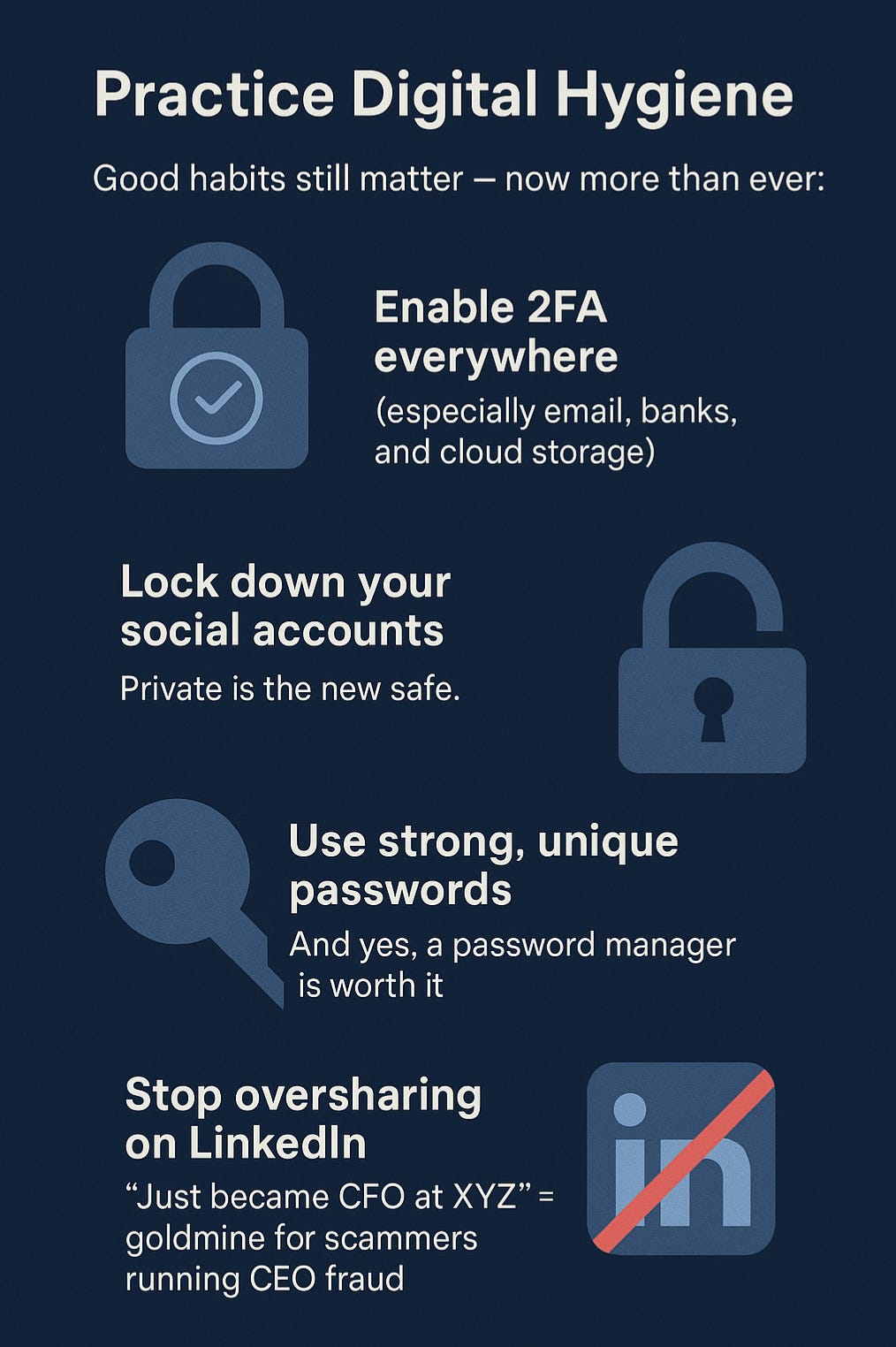
Practice Digital Hygiene
Good habits still matter — now more than ever:
- Enable 2FA everywhere (especially email, banks, and cloud storage)
- Lock down your social accounts. Private is the new safe.
- Use strong, unique passwords, and yes, a password manager is worth it.
- Stop oversharing on LinkedIn “Just became CFO at XYZ” = goldmine for scammers running CEO fraud.
Can Good Guys Use Dark Tools?
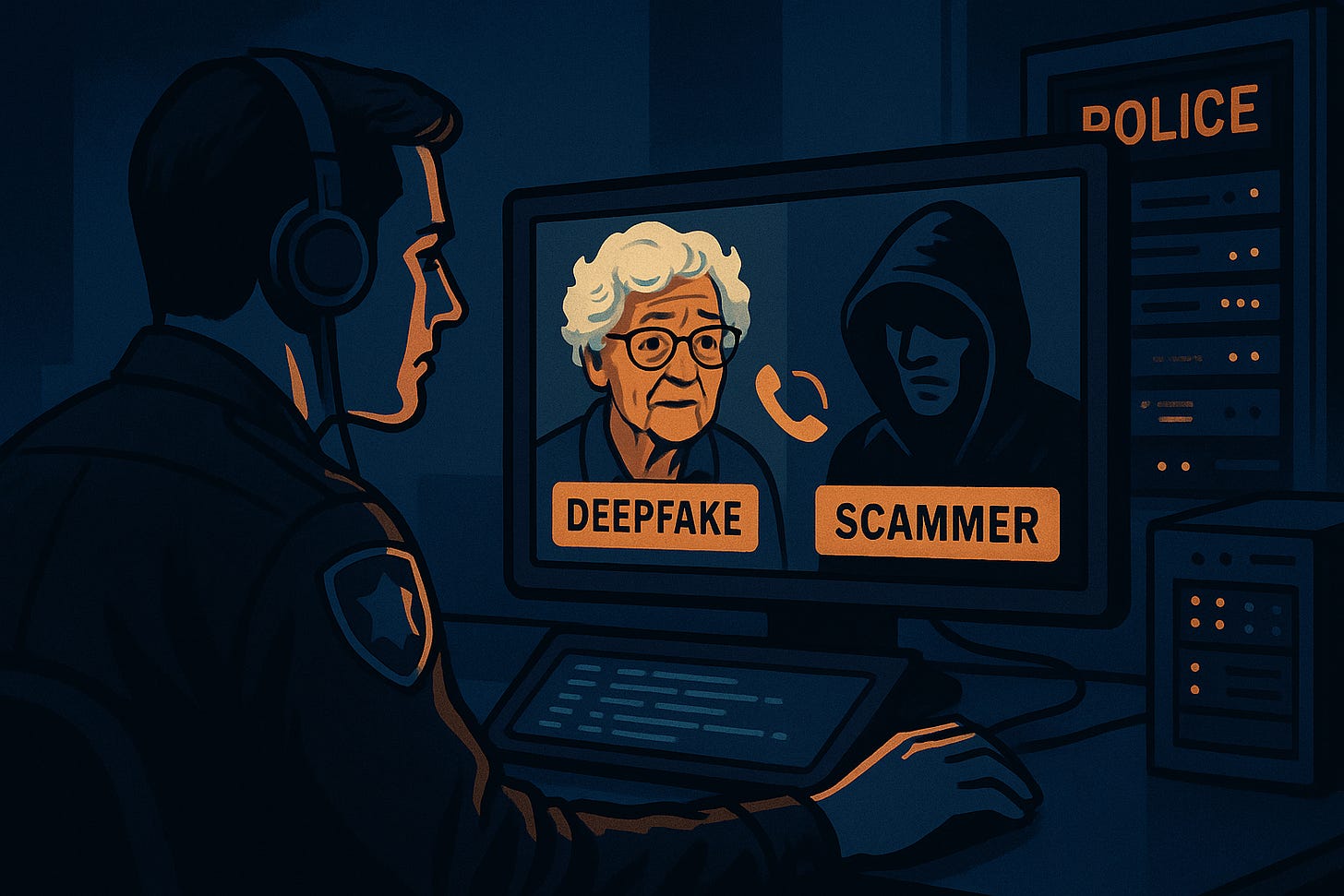
Law enforcement is starting to turn the tables — using the same tools that scammers rely on to fight back.
Some agencies are experimenting with counter-scam deepfakes: fake elderly voices, AI-generated personas, and decoy calls designed to lure fraudsters into exposing themselves. Think: a scammer tries to trick a “grandma” over the phone — only to find out she’s a deepfake running on a police server.
One UK task force used deepfaked robocalls of fake tax agents to bait overseas call centers. In the U.S., undercover agents built a fully synthetic victim — complete with social media presence, voicemail recordings, and even AI-powered chat responses — to infiltrate romance scam networks and trace the money trail. These ops work. Arrests follow. But they raise hard questions.
When Good Tools Get Dirty
If deception becomes a legitimate tool of justice, where’s the line?
- Can law enforcement impersonate real people without consent?
- What happens when an AI trap misfires and pulls in the wrong target?
- Will deepfake-powered stings be admissible in court or dismissed as tampered evidence?
- And perhaps most important: what does this do to public trust when even the “good guys” start faking voices and identities?
In a world where anyone can create a synthetic reality, truth is no longer in the tape — it’s in the intent behind it.
Trust Is Now the Most Fragile Asset
Weaponizing deception — even for justice — risks fueling the very chaos it tries to control. If both sides fake voices, forge videos, and simulate reality, who do we believe?
In 2025, trust is infrastructure. And once it’s broken, no deepfake — no matter how good — can patch it.
Final Thought
The most dangerous scams of 2025 aren’t coming from hoodie-wearing hackers in basements. They’re run by well-organized fraud networks — many operating from scam centers in Southeast Asia (like Cambodia and Myanmar), using AI voice clones, Telegram bots, and data leaked from global breaches.
Behind them are: – human trafficking rings forcing victims to work in scam call centers – cybercrime groups connected to Chinese gray-market platforms like Huione Guarantee – Telegram-based “fraud-as-a-service” vendors selling deepfake voices, phishing kits, and scam scripts for less than $200
But what truly accelerates this wave is the explosive growth of Large Language Models (LLMs) and generative AI technologies.
- These AI advancements open new doors for scams and online crimes that were unimaginable just a few years ago.
- We are constantly playing catch-up — the pace of AI development outstrips our ability to prepare and defend against evolving threats.
- Even experts — and criminals themselves — often don’t fully grasp the current capabilities of these AI systems.
- AI agents that can autonomously perform tasks and coordinate attacks are already being adapted for cybercrime, promising an even greater surge in online fraud.
These AI tools don’t scam you on their own. Real people with real intent are driving them, and they’re betting you won’t pause to think.
That’s not a prediction.
Let’s stay sharp. Stay human.
Subscribe to The Creators AI for weekly briefings
This article was first published in the Creators AI newsletter. View the original edition.