Top AI Tools of Summer 2024
Summarizing the summer with the best AIs for creators and entrepreneurs.
This summer turned out to be surprisingly (or not?) full of releases of AI platforms and tools: new image generators, assistants for coders, updates to popular solutions, and so on. We at The Creators’ AI cover all the significant announcements and releases, but sometimes, it seems almost impossible.
So today, I offer a little recap and discuss the ten most notable products and updates from that summer you can take advantage of right now.
Let’s get started.
Top AI Tools of Summer by The Creators’ AI
№10. Codestral Coding Assistant | Mistral
Release Date: May 29
Yes, given the release date, it could be called cheating, but I couldn't ignore Codestral.
AI-assisted coding is one of the trends most talked about in the industry this year. Some believe that at the rate machine learning is advancing, many coders will soon be out of work. Others say that AI will never replace talented developers. Either way, the release of Codestral has become one of the main reasons for discussing this topic.
Here's what you need to know about this platform:
- Codestral is an open-weight generative AI model by Mistral that is explicitly designed for code generation tasks.
- A model fluent in 80+ programming languages: Codestral is not limited to Python, C++, and JavaScipt. It also works in languages like Swift and Fortran, so it is suitable for a very wide range of tasks.
- Codestral's context length is 32k. The large context helps Codestral generate code structures, providing more detailed and complete solutions to complex coding problems.
You'll learn even more about this solution and be able to test it here.
To dive even further into programming prompt engineering, you can use this post:
№9. Dream Machine | Luma AI
Release Date: June 12
The discussion of AI coding has made a lot of noise, but it has only touched a fraction of the internet. But video generation (thanks largely to Sora) seems to be all over the place. This year, which is far from over, we've gone from generating static images to animating old photos to generating full-fledged videos. And, most importantly, it's now available to everyone.
While the hype around OpenAI's announcement Sora was still going strong, startup Luma AI took the opportunity and released Dream Machine. It's a platform that generates short videos based on text cues and images. The developer has staked on the accurate and smooth display of objects, characters, and actions. Therefore, you will quite rarely encounter unrealistic movements and frightening scenes.
You can create animations for your social networks, animate your favorite meme, or “animate a photo” on the Luma Labs website.
Keep your mailbox updated with practical knowledge & key news from the AI industry!
№8. Claude 3.5 | Anthropic
Release Date: June 20
There are not many companies in the world that can be put on par with OpenAI. But Anthropic is clearly one of them. With a slight delay from the release of GPT-4o in June, the company presented Claude 3.5 Sonnet, the first model from the Claude 3.5 family (yes, the naming is strange but easy to remember). Tests with this AI showed that the Sonnet was as good as, and sometimes even better than, the GPT-4o and Gemini.

Sonnet 3.5's main killer feature is Artifacts, which adds text editor functionality to the chatbot. If you want an aesthetically pleasing and user-friendly solution, you should clearly test this feature. You can do it here.
And to learn more about the Sonnet 3.5 release, read our weekly roundup.
It comes out every Friday!
№7. Gen-3 Alpha | Runway
Release Date: July 1
For anyone who couldn't get enough of Dream Machine in June this year, a few weeks later, RunwayLM introduced Gen-3 Alpha. It's another image generation platform but with a more professional set of features. Gen-3 Alpha supports text-to-video, image-to-video, and text-to-image, as well as existing tools such as Motion Brush, Advanced Camera Controls, and Director Mode.
This AI is especially good when you need to generate hyper-realistic images.
Even more examples and access to Gen-3 Alpha can be found on the Runway website.
Sharing is caring! Refer someone who started a learning Journey in AI!
№6. AI Video Generator | Kling AI

Release Date: July 25
And the latest (for today) is a platform for generating images and videos with AI. It's a solution from Chinese startup Kling AI, which can create videos from text prompts or pictures up to 10 seconds long at 1080p resolution and 30 frames per second. Kling AI uses a diffusion transformer architecture and 3D facial and body reconstruction, which allows the AI to create highly realistic videos that sometimes surpass those made by other models like OpenAI's Sora.
Trying out Kling AI is free: the platform allows you to generate videos daily using virtual credits. If you like the result, you can expand access by paying for a subscription.
More examples and access to the model can be found at Kling AI.
№5. AI Studio | Meta
Release Date: July 29
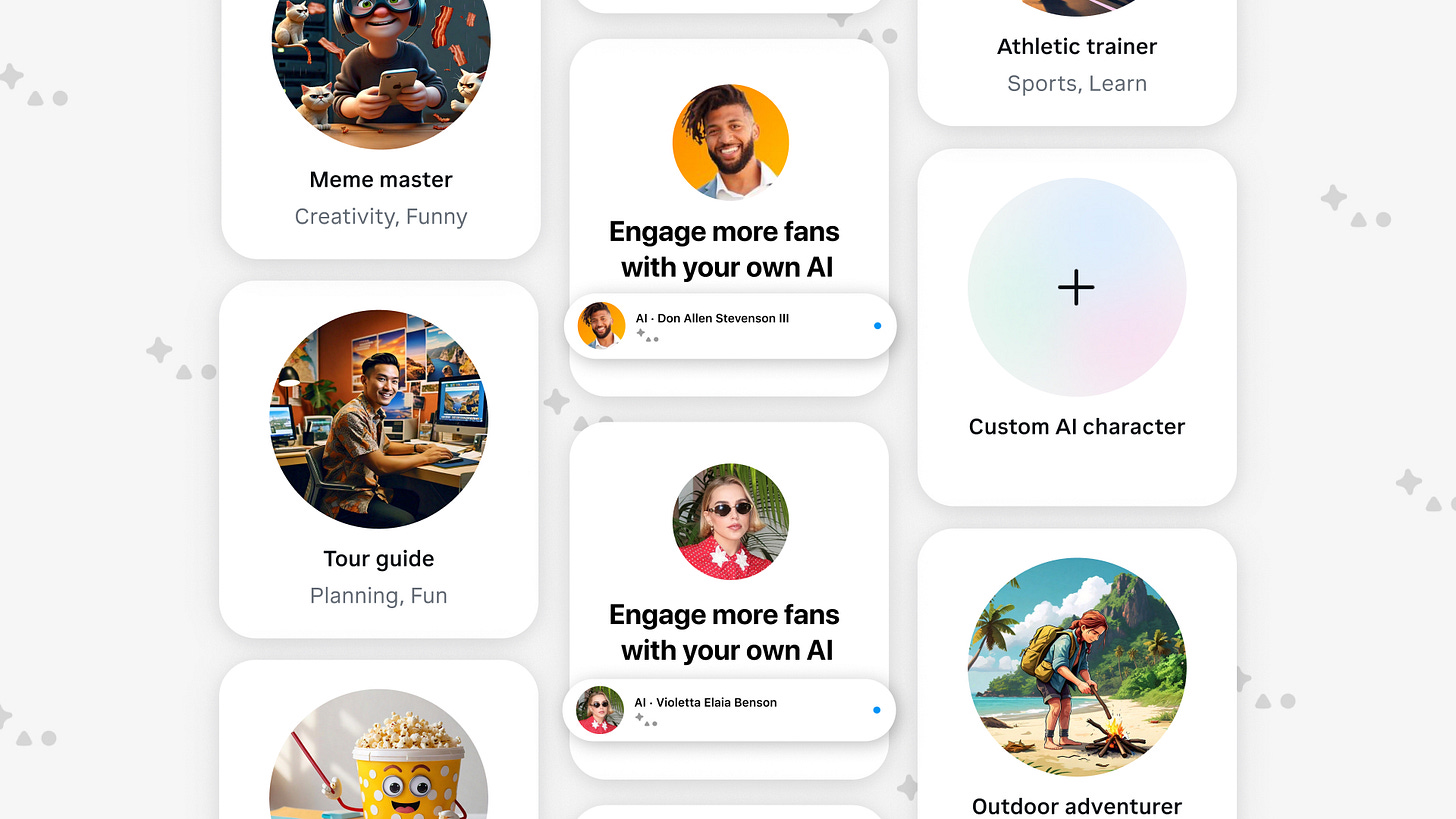
A year after its announcement, Meta has finally opened access to AI Studio for US users. This is a creation service where each user can create their own chatbot using the most recent Llama 3.1 model as a base. When the bot is made, it can be used within AI Studio or ported to other Meta platforms, including Instagram and WhatsApp.
If you're an Influencer or entrepreneur (or planning to be one), I recommend familiarizing yourself with the capabilities of this platform. Many creators have already found uses for custom chatbots.
AI Studio can be accessed here.
№4. Grok-2 Beta | xAI
Release Date: August 14
Every class should have its own bully. In general terms, Grok 2 Beta is the latest iteration of Grok, an AI developed by xAI, a company founded by Elon Musk. This release builds upon the initial version of Grok, which was designed as a sophisticated chatbot integrated into X (ex-Twitter). As usual, the new model introduces significant improvements in functionality, user interaction, and AI capabilities.
But the most interesting thing about Grok-2 is the noise caused by its limitations on image generation—more precisely, their absence. It practically does not limit the user's flight of fancy (especially when it comes to violent and bloody scenes) and allows you to create very high-quality images.
We wrote about Grok-2 release and its features in this post:
No matter how you feel about Elon Musk, his platform is worthy of attention.;
# Updates
New stuff is cool, but that doesn't mean we should forget about updating existing solutions. Below, let's break down a few significant updates that make you want to check out previously available platforms.
№3. Figma AI Updates
Release Date: June 26
A couple of months ago, Figma announced the biggest update in years. In addition to the redesign (because of which I now regularly can't find the most basic functions), the developers have integrated native support for generative AI into the service. The authors say this update is “the foundation for the next decade.”
The main features include:
- Design Generation: Users can create UI mockups for web and mobile using text prompts, enabling rapid ideation and prototyping
- AI-based Prototypes: Static mockups can be transformed into interactive prototypes automatically, streamlining the prototyping process
- Visual Search: Designers can search through team projects using images, screenshots, or frames to find specific designs or inspiration
- Automatic Layer Renaming: With one click, Figma AI can contextually rename and organize all layers in a file
- Task Automation: The AI can handle repetitive tasks like adding realistic text, translating content, adjusting tone, creating images, and removing image backgrounds
So, as you can see, Figma deserves a mention on our list. You can try out a significant part of these features (some are still being tested) at Figma.com.
№2. GitHub Models
Release Date: August 1
And we're back to coding again. Early last month, GitHub introduced Models, a new offering that gives developers access to industry-leading AI models directly through its platform. This service includes popular models such as Llama 3.1, GPT-4o, GPT-4o mini, Phi 3, and Mistral Large 2, all available in the GitHub Marketplace.
Developers can test these machine learning models using the built-in playground, allowing them to create AI-based code and quickly integrate them into their projects. In this way, GitHub wants to minimize developers' difficulty learning and experimenting with AI.
I would say this is one of the most important updates of this year.
You can already access Models via GitHub.
№1. Gemini Gems | Google
Release Date: August 28
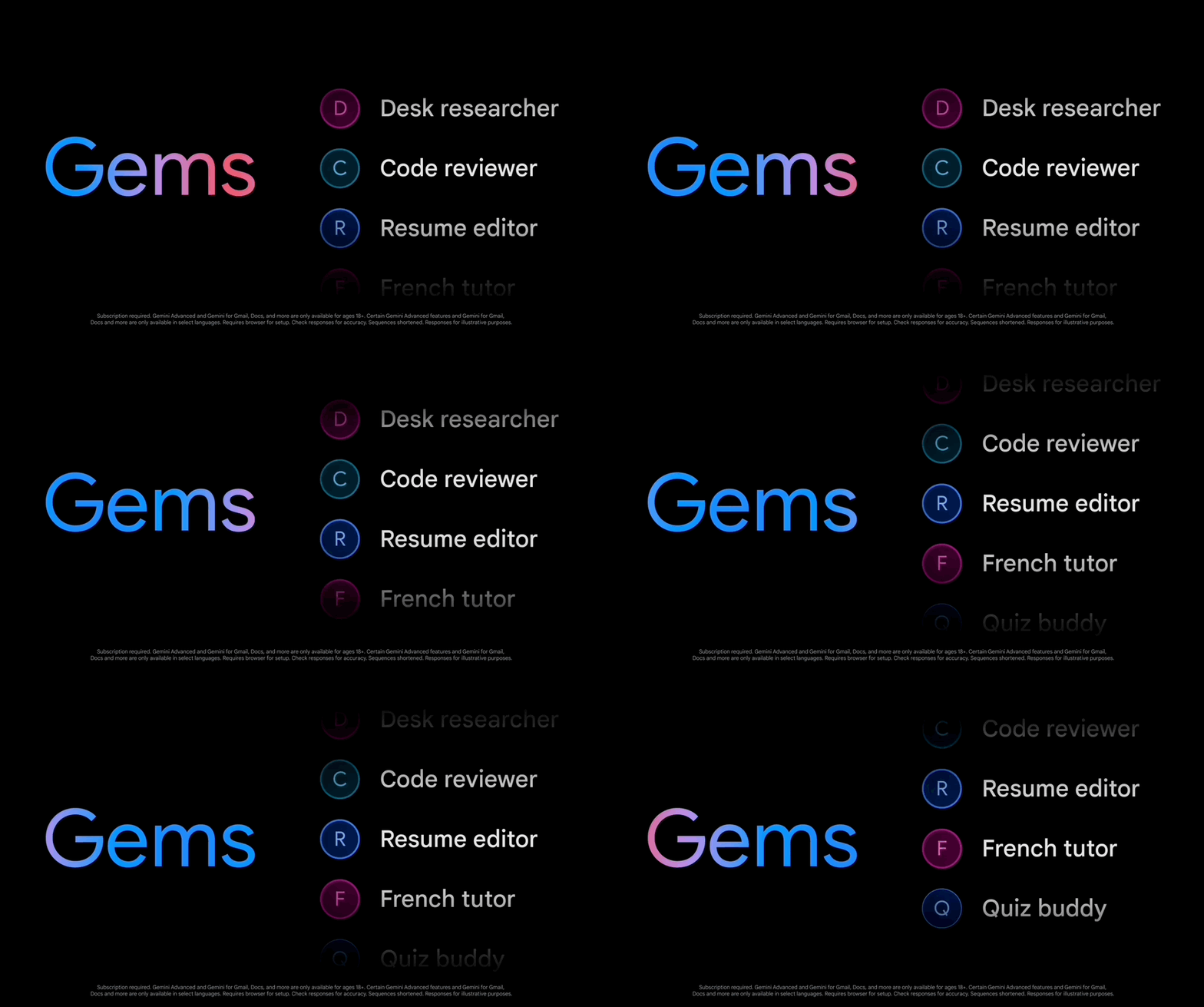
Despite Google's many AI failures this year, I'm glad we're closing out the summer of 2024 with just an update to its product. Last week, the company released Gems, its answer to Custom GPT, built on top of the Gemini chatbot. Users with an Advanced subscription can now build their own chatbots customized for specific tasks. For example, create a tutor, career counselor, and coding partner.
With Google targeting the broadest possible audience, the customization process is pretty straightforward. You can customize the range of topics and tone of your assistant's communication. But unlike Custom GPTs, you can't monetize and share your chatbot with other users, at least for now.
Google is gradually rolling out Gems to its users.
You can subscribe to Gemini Advanced here.
Final Thoughts
Yeah, it's been a hot and busy summer. It's quite interesting that even in the space of three months, we got big updates in almost all product categories from a wide variety of players and for a wide variety of tasks. And it is possible to find an application for all of them. I would like to believe that the developers will not slow down shortly.
What was your most notable release?
Share this edition with your friends!
This article was first published in the Creators AI newsletter. View the original edition.