5 AI Agents Every Solopreneur, Manager, and Executive Should Hire
The wrong question is "which AI tool?" — the right question is "which role should I hire?"
Meet Jose Parreño Garcia — Data Science leader at Skyscanner, managing 3 teams and 25 people, and the author behind one of Substack’s sharpest takes on AI in the workplace. His newsletter cuts through the hype with real systems built by someone who actually runs them. This post gives you a practical org chart for deploying AI agents — not as tools, but as roles.
At a Glance
In this piece, you will learn:
- Why thinking about AI as tools is the wrong frame — and what to think about instead
- The 5 agent roles that deliver the most value for solopreneurs, managers, and executives
- How to write a job description for an AI agent before you build anything
This post is prepared with Guest Author — Jose Parreño Garcia, Data Science leader at Skyscanner and writer of Senior Data Science Lead, a newsletter on AI systems and the future of work. If you also want to write for Creators AI — send us email here
A few months ago, I was talking to a friend who runs a small consultancy. She had spent a significant amount of time with ChatGPT, Claude, Gemini, and the rest. I asked her what had actually changed about how she works.
The answer was as disappointing as it was unsurprising. Her work quality had improved — better research, better brainstorming, better storytelling. But her throughput hadn’t moved. She was using these tools as advanced prompting machines, not scaling her work through AI systems.
I see this everywhere. The conversation about AI at work has been dominated by tools — which model, which app, which subscription. But that is the wrong frame.
Tools do not change how work gets done. Roles do.
This means that most of us — especially those running teams or businesses — should really ask ourselves: What roles should AI play in my work?
This post is about the roles worth hiring. Not the ones with the most impressive titles. The roles worth hiring are the ones that handle the repeatable blocking work: the research you defer, the draft you procrastinate, the brief that never gets written because you are already in the next meeting.
When you staff them correctly, they do not replace your expertise. They extend what you can do with it.
What Is the AI Org Chart?
Every business, team, and solopreneur has multiple functions to run — and all of them are difficult to scale without hiring more people or working longer hours.
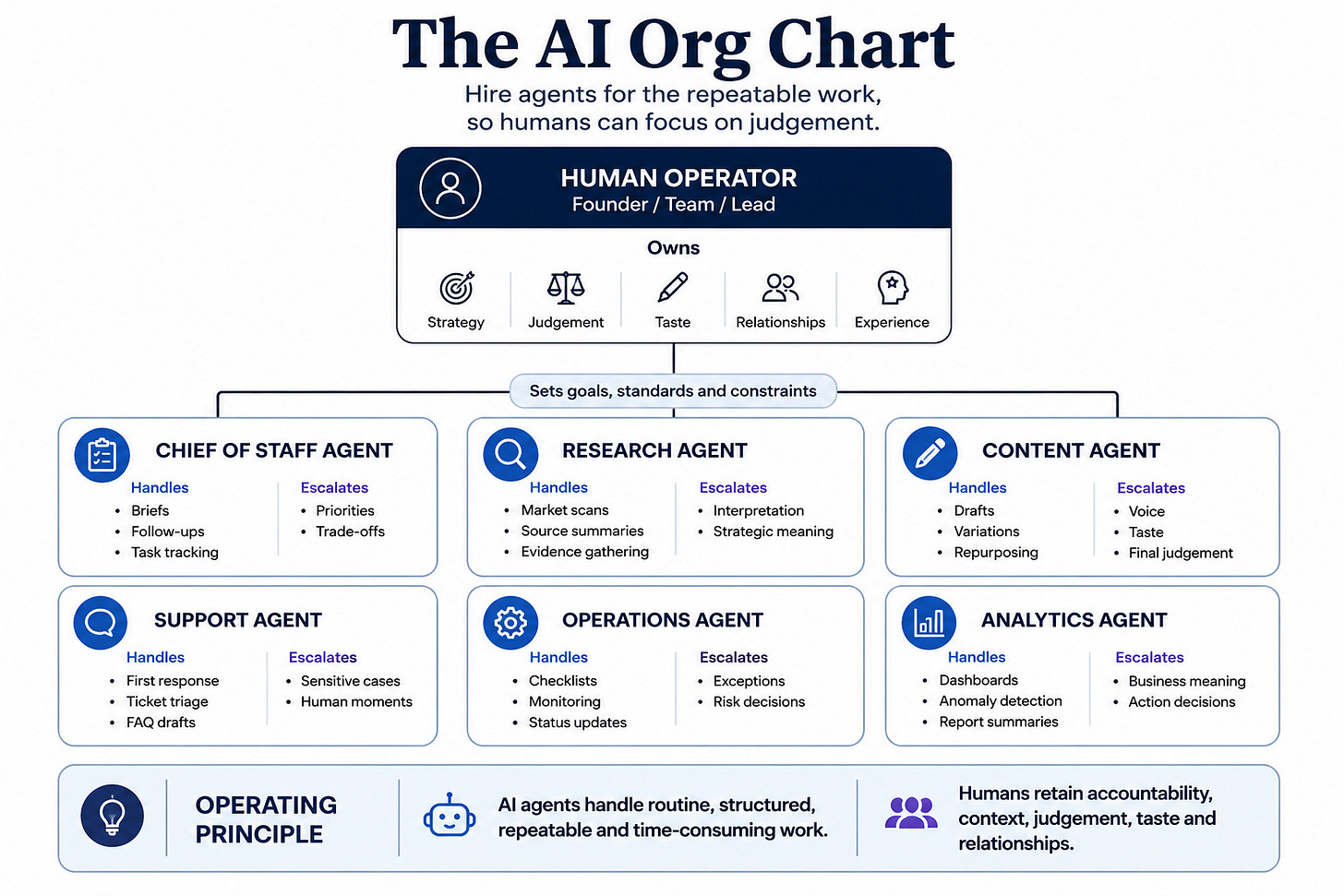
The AI org chart is a mindset shift: each of us can think about these functions as areas where we can “hire” new employees to do exactly what we want, without our full oversight. These new hires are our own AI agents.
The goal is not to replace human expertise. It is the opposite. AI agents fill the gaps — they handle the routine, structured, repeatable parts of each function so the human can spend more time on the parts that require judgment, taste, relationships, and experience
.
My own example with 3 agents
I lead 3 Data Science teams (around 25 people and 12 projects) and oversee the people side for the wider Data Science discipline at Skyscanner (around 60 people).
Before AI agents, I spent significant time reading Slack messages, Confluence docs, and technical blogs just to stay current. My work couldn’t scale because the day has 24 hours and I have the habit of sleeping 8 of them.
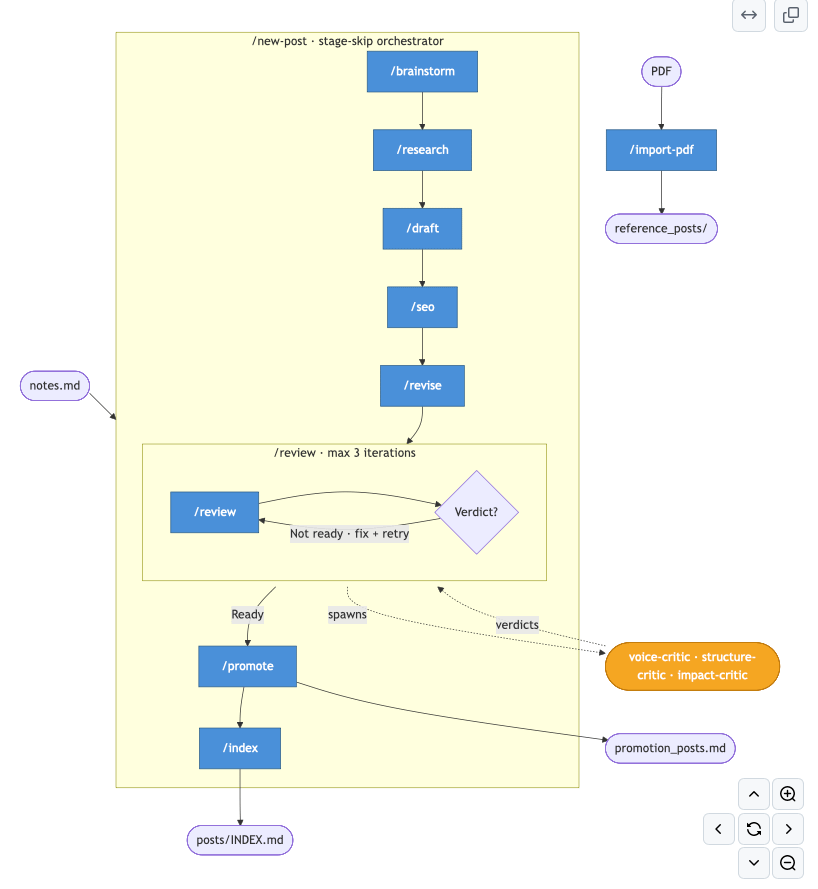
After building 3 agents, I have a much richer and deeper signal on everything happening — without working more hours.
These 3 agents enhanced my work in ways I couldn’t have achieved otherwise. Crucially, I do not have agents for the people side of my work — calibrations, promotions, relationships. I fully retain those workflows. The AI org chart should be bespoke to you. Think about the areas taking significant time that are repeatable and well-structured. Those are the areas to build around.
We’ve written about how solopreneurs are already running full agent stacks — the patterns are clearer than you’d think: How Solopreneurs Are Using Full AI Agents
This and many other practical posts on building with AI are available exclusively to our subscribers.
Subscribe now
The 5 Roles Worth Hiring
1. The Intelligence Analyst
The Intelligence Analyst is your research function. It handles market research, competitor tracking, and customer insight synthesis on a regular cadence. It takes structured inputs — competitor URLs, customer transcripts, support tickets — and produces a recurring brief. The agent surfaces evidence; you interpret what it means.
In most small teams, research happens in one of two ways: an intensive sprint before a big decision, or never. Neither is good. The Intelligence Analyst turns this into a rhythm — a weekly memo, or something generated on demand.
What it does well: tracks competitor websites and pricing pages, summarises customer interview recordings, clusters support tickets by theme, maps market categories, answers specific questions against defined inputs.
What it needs: a product description, competitor URLs, customer transcripts or support ticket exports, and clear questions — not open-ended “research everything.”
Where human judgment stays essential: the analyst finds the answers. You frame the questions and decide what they mean. Market strategy — which segment to target, which trend to act on — remains a human call.
2. The Growth Operator
The Growth Operator covers two jobs that share a common purpose: bringing in customers and keeping them. Sales research and qualification on one side; support triage on the other.
The better pattern is always: analyse-first, draft-second, human-approved-before-send.
For sales, that means researching inbound leads, scoring them against your ideal customer profile, producing a short account brief, and drafting a personalised first message. For support, it means classifying incoming requests, drafting responses for routine queries, and escalating anything sensitive.
What it needs: a clear ideal customer profile, a lead list or inbound source, examples of good outreach in your voice, a support knowledge base, and — crucially — a human approval step before any external message is sent.
Where human judgment stays essential: the agent can research, classify, score, and draft. Whether a lead is worth pursuing, whether the timing is right, whether the message feels appropriate — those remain human calls. The gate is not the problem. Unclear qualification criteria are.
3. The Voice Operator
The Voice Operator is a governed content function. It takes rough notes, voice memos, or briefs and turns them into first drafts against a written voice guide.
Most solopreneurs already use AI for writing. The difference between that habit and a Voice Operator is governance. Inputs, voice guide, style constraints, output format, and a clear human review step before anything publishes.
The key inputs are your best previous writing as calibration and a voice guide that specifies your register, banned phrases, and what good looks like. Without those inputs, the output sounds like every other AI-assisted content on the internet. With them, it sounds like you.
What it needs: your best previous writing, a voice guide (even a short one: register, banned phrases, examples of good and bad), the intended audience and channel, and a clear output format.
Where human judgment stays essential: the voice is yours. The claims are yours. The final editorial call is yours. The operator can produce a draft that sounds like you. It cannot decide what you actually believe.
4. The Builder Partner
Coding agents are the most mature AI role in production today. But the Builder Partner is not just for technical people. There are two distinct paths.
The non-technical path: product spec writing. Turn a rough idea into a PRD. Define user stories and acceptance criteria. Break a product concept into implementation tasks. Identify the risks and non-goals before a line of code is written. A well-written spec brief saves hours of back-and-forth with developers.
The technical path: implementation partner. For technical builders, the Builder Partner implements bounded tasks, writes and runs tests, reviews diffs, flags security or edge-case risks, and opens a PR for human review. The operating rule is simple: it produces work, humans review and approve it.
What it needs: a repo with context (a CLAUDE.md or AGENTS.md file explaining conventions and constraints), examples of good PRs, acceptance criteria written before implementation starts, and tests that define what “correct” means.
Where human judgment stays essential: architecture, design decisions, what ships and what does not. The builder owns the implementation; the human owns the design.
The architecture question matters more than people realise — here’s how to structure your agent stack so it doesn’t collapse under its own weight: Your AI Agent Stack Is Spaghetti — It Needs Architecture
5. The Operating Chief of Staff
The Operating Chief of Staff is the most overhyped and underbuilt role in the current AI conversation.
Overhyped because every demo of a “fully autonomous AI chief of staff” glosses over the fact that real chiefs of staff manage stakeholder politics, institutional memory, and judgment calls that are impossible to encode in a system prompt.
Underbuilt because the narrower, more down-to-earth version is genuinely useful. Meeting prep, inbox summary, project tracking, follow-up drafts.
Start with the morning brief. Every morning: review today’s calendar and flag meetings that need prep; pull prior notes and decisions relevant to those meetings; identify follow-ups due today; draft a suggested priority order; flag anything that has changed since yesterday.
This is not glamorous. It is also the work that most managers and executives do poorly or skip entirely because it requires focused attention at the start of the day — exactly when the inbox has already taken over.
What it needs: calendar access, notes from prior meetings, a task or project tracker, and explicit escalation rules. Build it gradually: meeting prep first, inbox triage second, follow-up drafts third.
Where human judgment stays essential: the human still runs the meeting. Still manages the relationship. Still decides what is worth escalating. The politics, the history, the understanding of why a stakeholder behaves the way they do — none of that lives in a calendar invite.
Share this with a founder or builder who’s still thinking about AI as a tool, not a team member.
Share
How to Write an AI Role’s Job Description
If you cannot describe exactly what you want from an AI agent, you are not ready to build one.
Treat it as if you were hiring a contractor. You would not say “help out with the business.” You would tell them exactly what you need, what good looks like, what is out of scope, and who to escalate to when something goes wrong.
Before building any of the five roles above, write a job description. It needs to cover: the goal, the inputs, allowed sources, allowed tools, forbidden actions, output format, escalation triggers, the human owner, and the quality bar.
Here is what this looks like for the Intelligence Analyst:
Goal: Produce a weekly market brief covering competitor moves, customer language, and emerging themes relevant to [product/service]
Inputs: Competitor website URLs, recent customer interview transcripts, support ticket summaries from the past 7 days
Forbidden actions: Do not state conclusions about market strategy. Do not assert trends without citing a source. Do not send output to anyone.
Output format: A structured brief with four sections: What changed, What customers said, What assumptions to revisit, What sources support this
Quality bar: A good brief cites its sources, distinguishes strong signals from weak ones, and includes at least one thing that surprised me.
Write this before you build anything. It becomes the system prompt or workflow configuration for that role.
Where to Start, by Audience Type
Solopreneurs: Start with the Voice Operator and the Intelligence Analyst. Content is where solopreneurs have the most work pending and the least time. A weekly market brief costs thirty minutes to set up and gives you thirty minutes back every week, indefinitely.
Managers: Start with the Operating Chief of Staff and the Growth Operator. The friction in most management roles is not the decisions — it is the preparation required to make them well.
Executives: Start with the Intelligence Analyst and the Builder Partner. Strategic decisions made without current market intelligence are just expensive guesses.
Once your agents are running, the next question is how to turn that leverage into revenue: 4 Ways to Monetize AI Agents in 2026
Which of these 5 roles feels most immediately applicable to how you work right now? And when you imagine them running well — what is the work you would finally have time for? Drop it in the comments.
Jose Parreño Garcia leads Data Science at Skyscanner and writes Senior Data Science Lead*— a newsletter on AI systems, data leadership, and the future of work.*
This article was first published in the Creators AI newsletter. View the original edition.