Claude AI Watermark Explained & How to Bypass It
Catch Me If You Claude
Hey!
Today we’re digging into something that changes how we work with LLMs and the content they help us produce
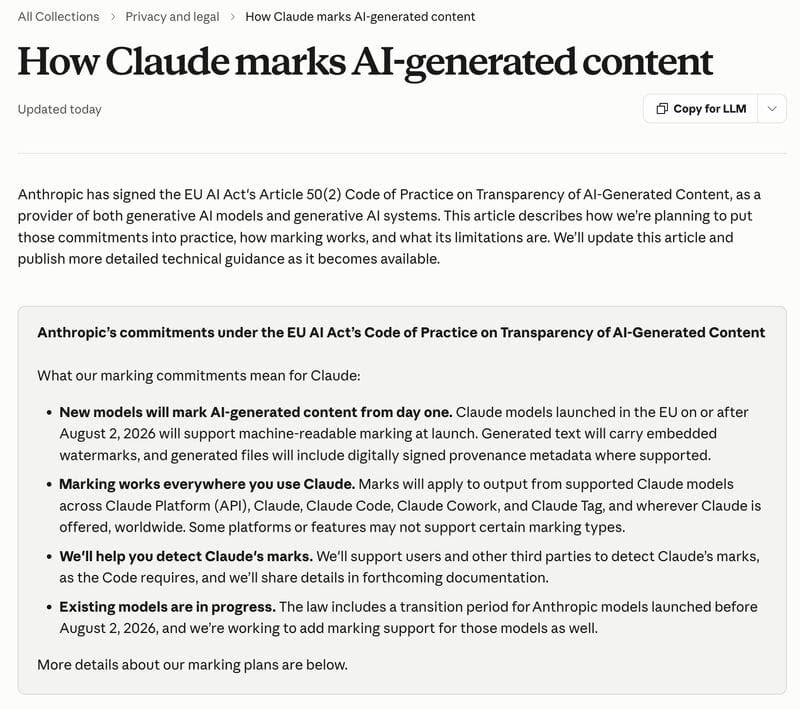
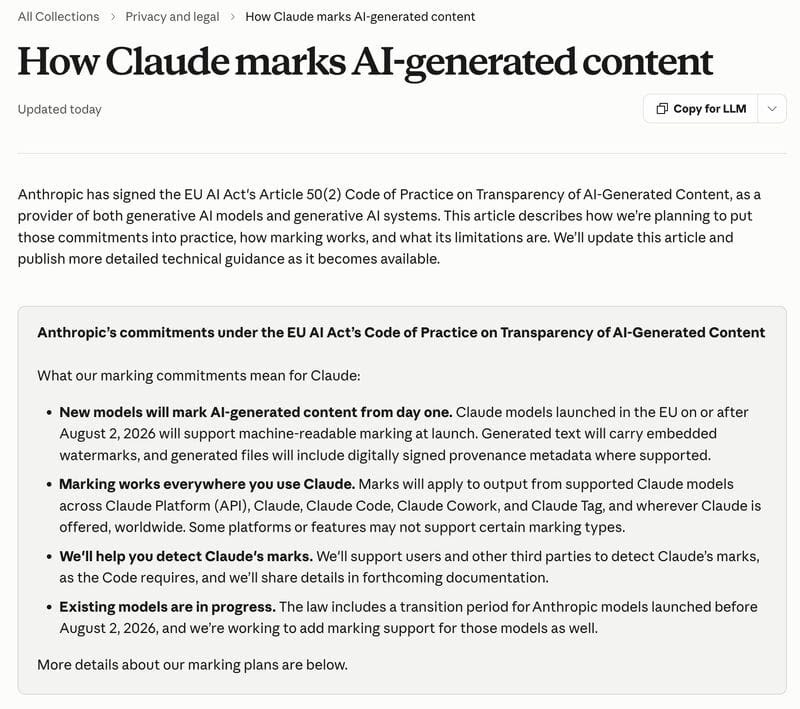
On August 2, Anthropic started adding an invisible AI watermark to content generated by its models. Quietly, without much fanfare, the company flipped a switch that affects every Claude user.
The internet’s reaction was entirely predictable.
“Can clients detect my writing now?”
“What if I paste it through Notion first?”
“Which humanizer removes it?”
Fair questions, all of them. But they’re slightly missing the point.
Anthropic is embedding invisible marks into supported Claude outputs as part of its EU AI Act commitments. Text can carry a model-level watermark that survives copy and paste. Supported image files can carry signed C2PA provenance metadata.
Here’s the catch: the mark is not a reliable authorship detector. Claude could have written the entire article, or it could have fixed three commas in a piece you drafted yourself. And right now, Anthropic hasn’t released the public detector you’d need to check the text watermark on your own.
So this is not the arrival of an AI lie detector.
It’s the arrival of a new kind of workflow risk.
For creators, agencies, ghostwriters, newsletter operators, and anyone selling AI-assisted work, the real question is this: what happens between Claude’s first draft and the file you actually publish?
Let’s break down what changed, why creators should care, and which removal methods people are already kicking around, from humanizers and translation loops to second-model rewrites and metadata-stripping exports.
At a Glance
- Claude now marks supported outputs using an invisible text watermark or C2PA metadata for supported image files.
- The rollout applies to new models launched in the EU on or after August 2, 2026; older models are being updated over time.
- A positive result means Claude may have processed the content. It does not prove Claude authored it.
- A negative result does not prove the content is human. Heavy editing, paraphrasing, translation, mixing, short passages, and file conversion can weaken detection.
- Anthropic’s public text detector is still forthcoming, so no “AI humanizer” can credibly prove that it removes Claude’s specific mark today.
- Research suggests that neural paraphrasing, cross-model rewriting, and translation can break several published text-watermarking schemes.
- Dedicated humanizers mostly optimize against GPTZero-style classifiers. That is not the same thing as removing Claude’s watermark.
- C2PA file metadata is much easier to lose through re-exporting, screenshots, and incompatible tools, but a missing manifest does not make an asset human-made.
What Anthropic Actually Announced
Anthropic signed the EU’s voluntary Code of Practice for marking and labeling AI-generated content. The transparency obligations in Article 50 of the EU AI Act started applying on August 2, 2026.
Claude’s implementation runs on two separate systems.
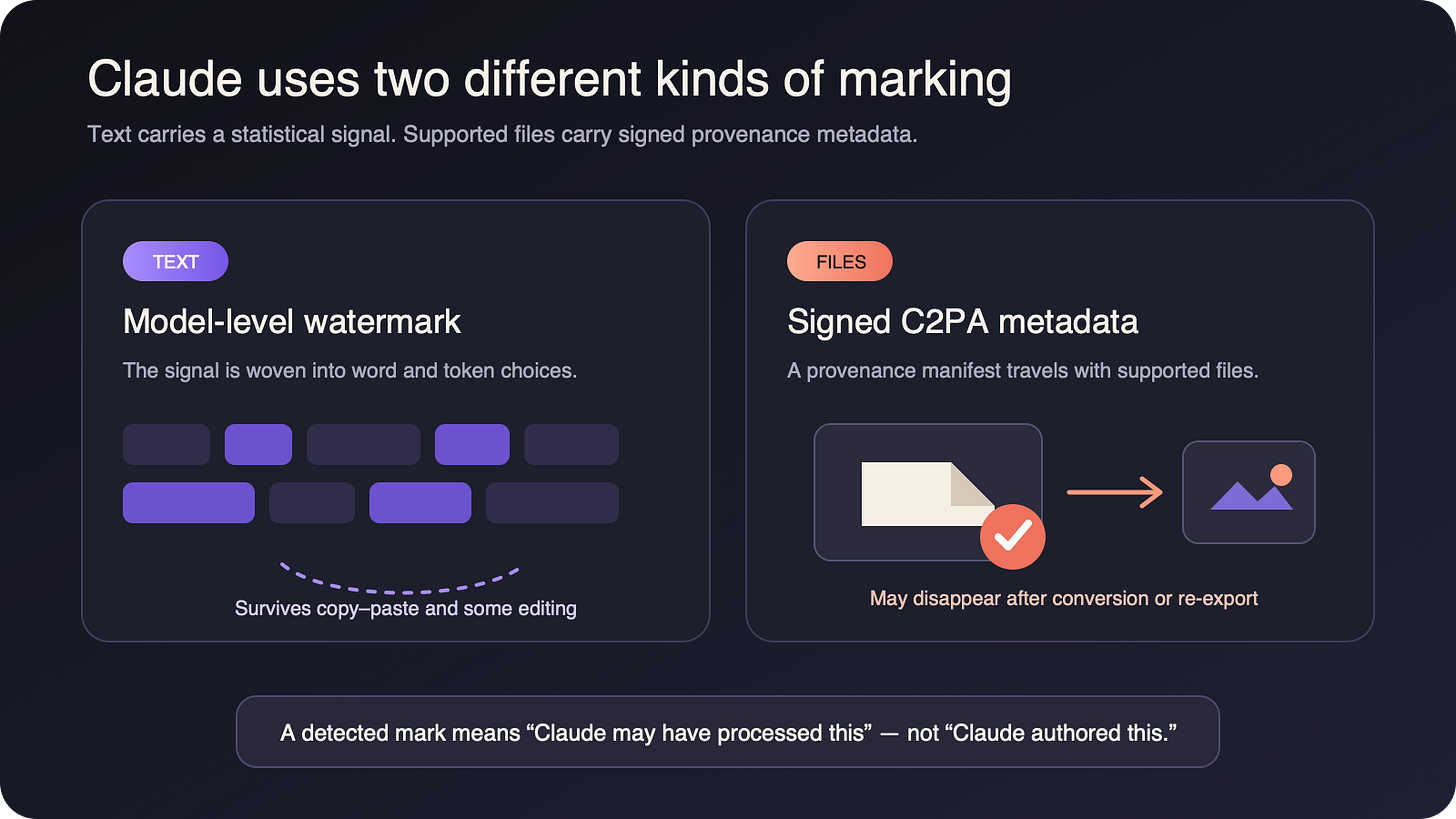
The key distinction: text carries a statistical signal; supported files carry a signed provenance record.
1. An invisible watermark inside text
Anthropic says the watermark lives in the text itself at the model level. It’s not a hidden HTML tag or a piece of metadata that vanishes the moment you paste into Google Docs.
It travels with copied text and may survive some editing.
Anthropic hasn’t publicly described the exact mechanism. So if someone tells you it’s “just zero-width characters,” or promises that saving the text as plain text will strip it out, they’re guessing.
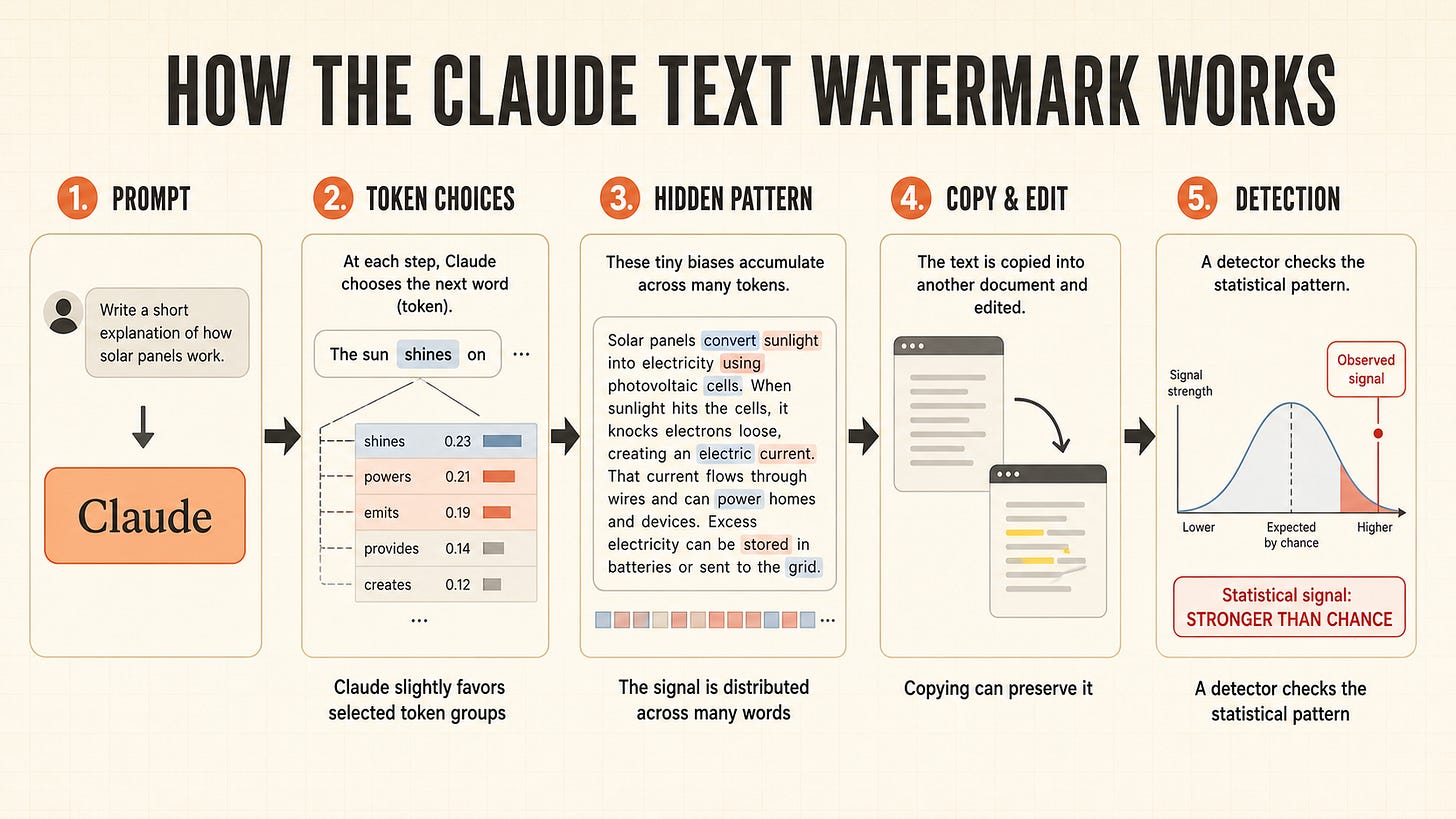
A conceptual model based on published text-watermarking research. Anthropic has not disclosed Claude’s exact implementation.
The rollout covers Anthropic’s own products, including Claude, Claude Code, Claude Cowork, Claude Tag, and the Claude API, as supported models are updated. Anthropic also says embedded text watermarks travel through model access on AWS, Google Cloud, and Microsoft Foundry.
The nuance matters: this does not mean every answer from every Claude model has been marked since day one. New models launched in the EU on or after the deadline are marked at launch; the transition for older models is still in progress. Anthropic says it is applying the marks worldwide wherever the technique is supported, not only to users in Europe.
2. C2PA provenance metadata in supported image files
For supported .png, .jpg, and .svg files, Claude can add signed C2PA metadata.
Think of this as a tamper-evident provenance record. A compatible verifier can show that the asset was processed by Claude and whether the signed file has changed since.
This is far more inspectable than the text watermark. You can already check C2PA-enabled files with the official Content Credentials verifier or the open-source c2patool command-line utility.
But file metadata has an obvious weakness: it can disappear during ordinary processing. Exporting into another format, re-saving through unsupported software, optimizing an image, or taking a screenshot may strip it.
That does not retroactively make the image human-made. It only means the provenance record is no longer attached.
A Claude mark can tell you that Claude touched the content. It cannot tell you who had the idea, who did the research, or who accepted responsibility for the final result.
This distinction is going to cause a lot of confusion.
Imagine you write a 2,000-word essay yourself, then ask Claude to tighten the introduction. The final draft may test positive.
Now imagine someone generates an entire article, heavily rewrites it with another model, and mixes in a few human paragraphs. The watermark may no longer be detectable.
The first person did more original work, yet the second may be harder to flag.
That is why this technology is useful for provenance, but weak as a verdict on authorship, effort, or integrity.
What It Means for Creators
Creators rarely use AI in a clean binary way.
A newsletter might combine an original interview, Claude-assisted research, a rewritten paragraph, human editing, and an AI-generated illustration. A YouTube script might begin as a voice note, pass through transcription, get organized by Claude, and then be rewritten during recording.
The watermark collapses all of that into one crude signal: Claude may have touched this. A client or platform may then interpret “AI detected” as “fully AI-generated,” even though Anthropic says the mark cannot establish authorship.
That is why creators will look for removal tools first. The issue is not only disclosure. It is the risk that minor editing assistance receives the same label as a copy-pasted first draft.
I wrote before about using Claude as an active teammate in How Claude Code Can Be Your AI Teammate and Claude Cowork: Complete Guide & Practical Use Cases. The important word is teammate. You want Claude contributing to a process, not impersonating the final owner of the work.
The obvious next question is whether the mark can be removed, and which tools might actually help.
I went through Anthropic’s disclosures, the current humanizer tools, watermark-removal research, and the largest Reddit discussions. Below is the practical map.
How People Are Already Trying to Remove the Claude AI Watermark
Before we get to the tools, one distinction matters more than any product page will admit: AI detection and watermark detection are different systems.
GPTZero, Originality.ai, Pangram, Copyleaks, and similar products are mostly classifiers. They inspect writing patterns and estimate whether text looks machine-generated.
Claude’s new system is different. Anthropic says it embeds a deliberate signal during generation, then uses a dedicated mechanism to detect that signal.
A tool can make GPTZero report “human” while leaving Claude’s watermark intact. It can also disrupt Claude’s watermark while another classifier still decides the prose looks like AI.
Many humanizer companies blur this distinction because “watermark remover” is a better landing-page headline than “probabilistic paraphraser.”
Until Anthropic releases its detector, none of these companies can run the one test that actually matters.
Passing five generic AI detectors does not prove that Claude’s embedded signal is gone.
The Claude Watermark Removal Toolkit
Here is the landscape I would watch.
Dedicated humanizer Tools: Rephrasy, Phrasly, Walter Writes, Undetectable AI, StealthWriter What it changes: Vocabulary, syntax, rhythm, sometimes structure Claude-specific confidence: Plausible, but currently unverified
Cross-model rewrite Tools: ChatGPT, Gemini, DeepSeek, Grok, local Llama or Qwen models What it changes: Regenerates the token sequence with another model Claude-specific confidence: Plausible, but currently unverified
Translation loop Tools: DeepL, Google Translate, another multilingual LLM What it changes: Reconstructs text through another language Claude-specific confidence: Strong evidence against several published schemes; Claude unknown
Conventional paraphraser Tools: QuillBot, Grammarly, Wordtune What it changes: Mostly sentence-level substitutions and restructuring Claude-specific confidence: Less disruptive; likely less reliable
Metadata-dropping export Tools: Canva, Figma, Preview, ImageMagick, social platforms What it changes: Re-encodes the file and may discard C2PA data Claude-specific confidence: Often effective at losing metadata, not proving human origin
Screenshot or rasterization Tools: OS screenshot tools, browser capture, PDF/image conversion What it changes: Creates a new file without the original manifest Claude-specific confidence: Very likely to sever the original C2PA chain
Visual paraphrase Tools: ComfyUI with FLUX or Stable Diffusion, other image-to-image tools What it changes: Generates new pixels from the visible content Claude-specific confidence: Strong against some image watermarks; Claude/C2PA question is different
Read this as a menu, not a ranking. The right route depends entirely on what you are up against: a statistical text watermark, a generic AI classifier, or signed file metadata.
Method 1: Dedicated humanizers
The obvious tools have outgrown their synonym-spinner reputation.
Rephrasy, Phrasly, Walter Writes, Undetectable AI, and StealthWriter all claim to rebuild cadence, vary structure, and optimize against multiple detectors. Several now ship a feedback loop: you rewrite the text, check it against a detector, crank up the “humanization” strength, and run the whole thing again.
Phrasly positions itself as a broad writing and humanization platform rather than a Claude-specific watermark verifier.
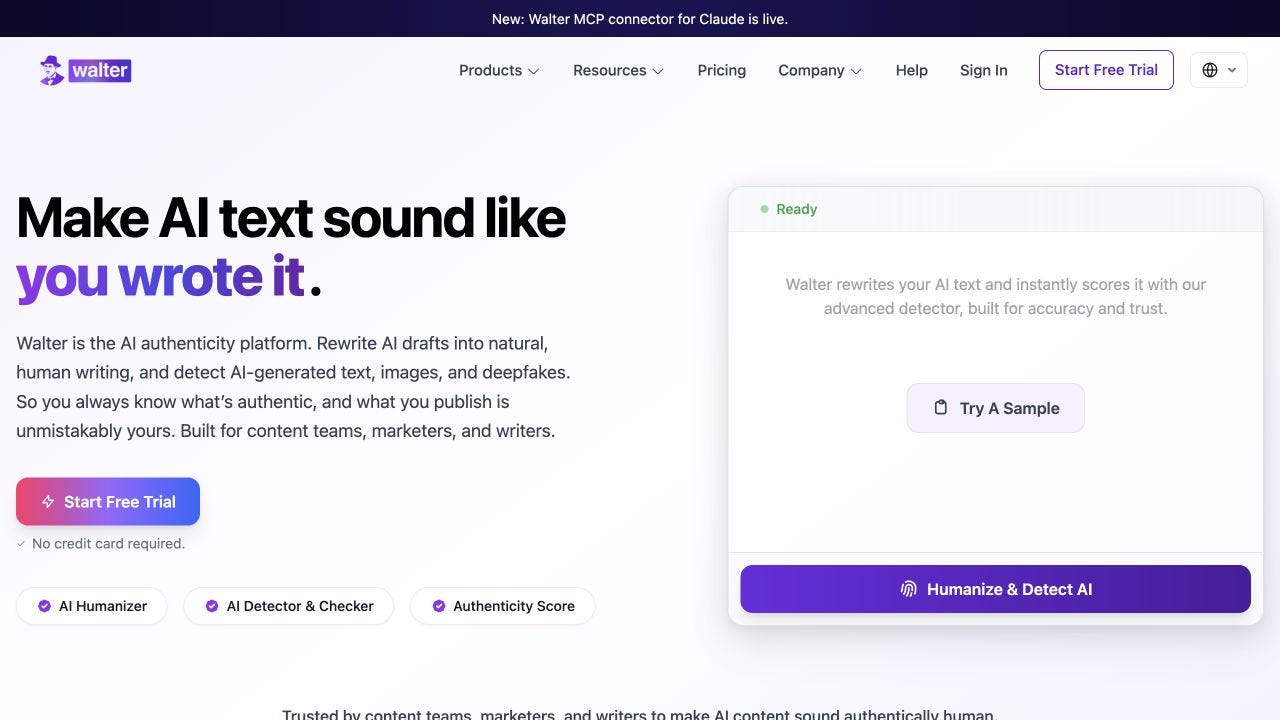
Walter combines rewriting and generic AI detection in one interface. That is useful for classifier testing, but it still cannot validate Claude’s private watermark.
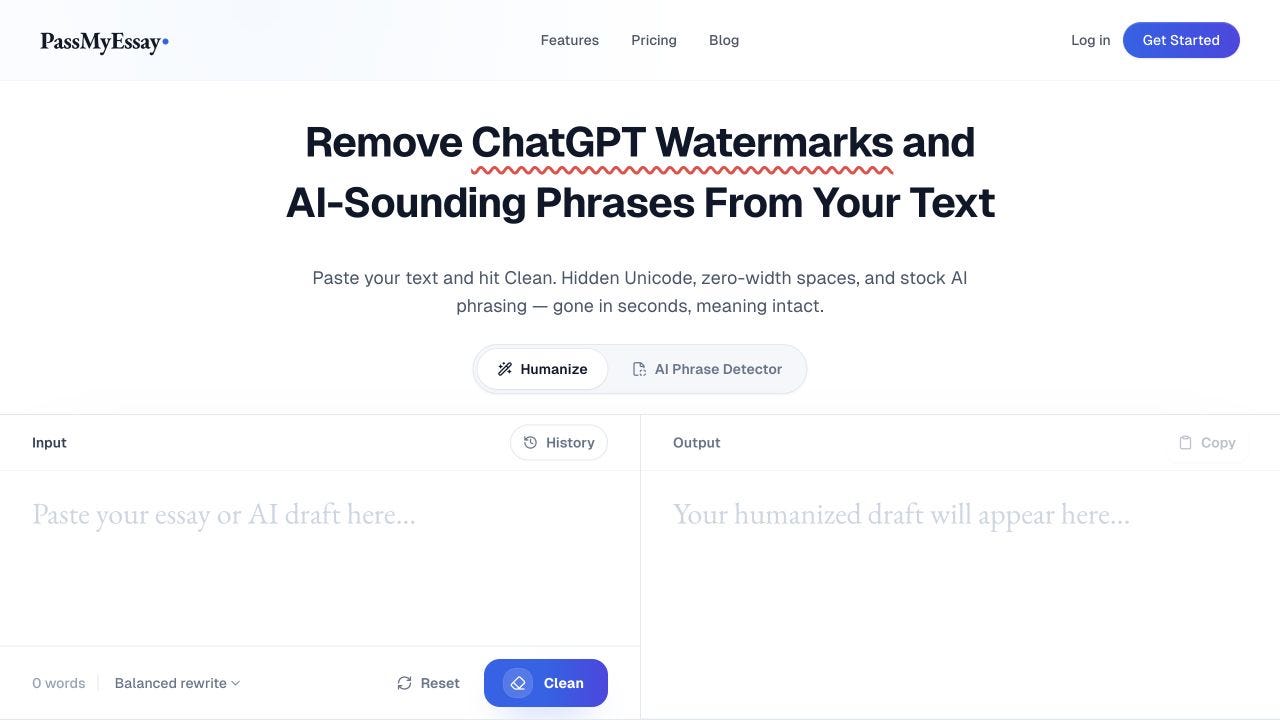
PassMyEssay explicitly uses “watermark remover” language, but its page describes hidden characters, zero-width spaces, and AI-sounding phrasing, not a verified test against Claude’s private detector.
That loop probably moves the numbers on whatever detectors are bundled into the dashboard. It tells us close to nothing about Claude’s private detector.
The aggressive modes come with a cost: odd vocabulary, grammar slips, subtle meaning drift. So verify what matters, not just whether the dashboard turns green. Check that facts, quotations, numbers, and the author’s voice survive the pass. And for client work, ask whether the service stores or trains on submitted drafts. That can be a larger risk than the watermark itself.
Method 2: Cross-model rewriting
This is arguably the biggest threat to model-specific text watermarking.
The move is simple: do not ask Claude to paraphrase its own output. Pass the draft to a different model, ChatGPT, Gemini, DeepSeek, Grok, or a local open-weight model, and have it rebuild the piece from the underlying claims.
Why should this work? The second model generates an entirely new token sequence. It is not stripping invisible characters; it is reconstructing the carrier that may hold the statistical signal.
If privacy is a concern, run the local version through Ollama or LM Studio so the original draft never leaves your machine for another cloud service.
“Likely to disturb” is still not “verified against Claude.” But technically, this beats the naive habit of pasting the same paragraph through Notion, Markdown, or a plain-text editor, which changes nothing about the underlying sequence.
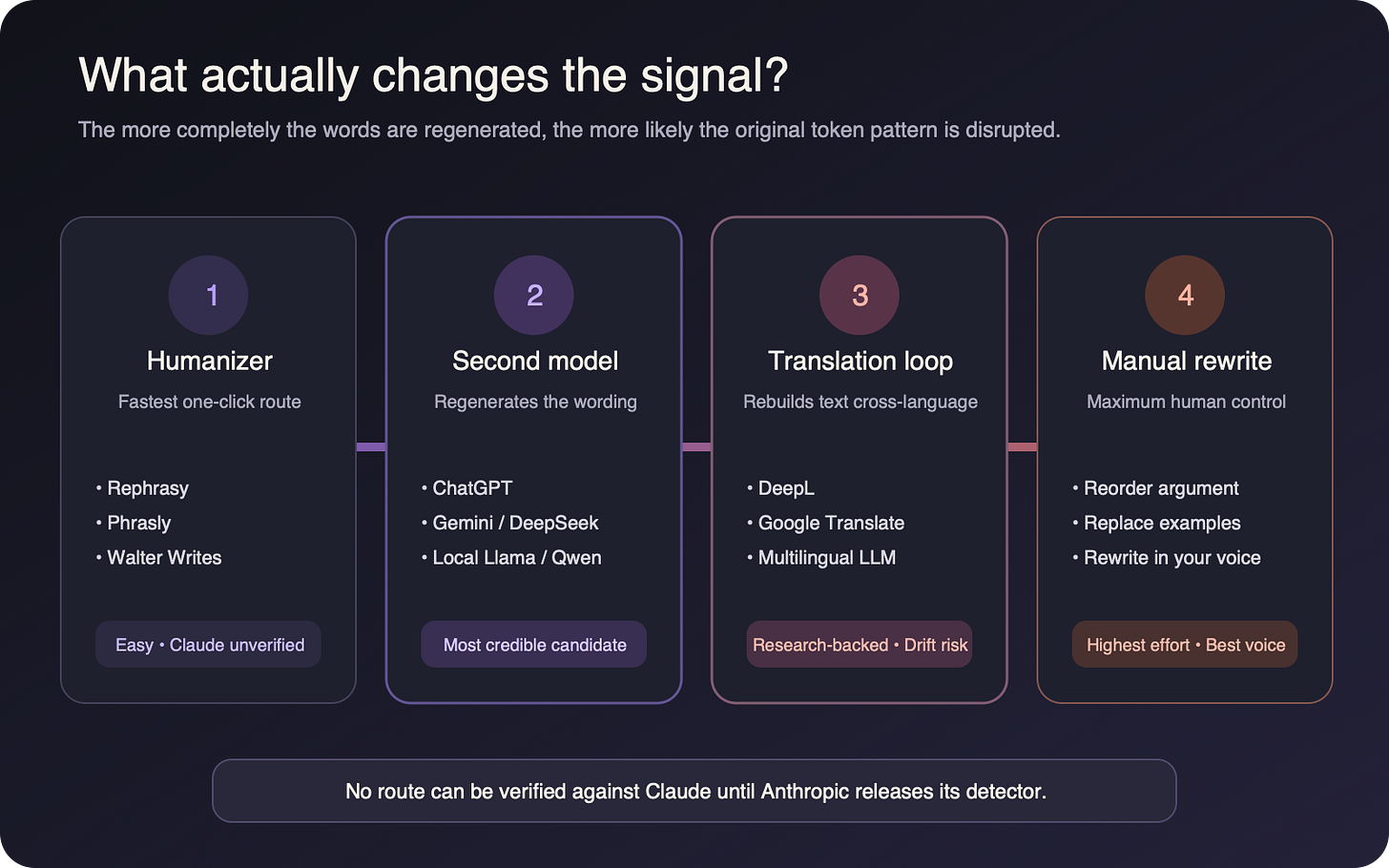
The more completely the wording is regenerated, the more likely the original token pattern is disrupted, but Claude-specific removal is still unverified.
Method 3: Translation round-trips
Translation is not just a creator hack. It is one of the better-documented attacks on published text watermarks.
The standard pattern is a round-trip through a pivot language: move the source away from English, then reconstruct it back. Research has repeatedly shown that current watermarking methods struggle to stay consistent across languages.
Vaporizer, a 2026 watermark-removal paper, evaluates lexical changes, machine translation, and neural paraphrasing while measuring how much meaning and readability survive. Earlier work likewise found that translation can destroy a token-level pattern while preserving most of the message.
In practice, creators will reach for DeepL, Google Translate, or a multilingual model. The tradeoff is predictable: voice flattens, idioms shift, precise claims drift.
Translation looks like a clean bypass until your sharp English sentence comes back sounding like an airport information screen.
Method 4: Multi-stage rewriting workflows
The aggressive version chains several transformations together:
Claude draft → humanizer → cross-model structural rewrite → manual edit → detector sweep.
A multilingual variation inserts a translation round-trip before the final edit.
Every stage further disrupts the original token sequence. Every stage also increases the chance of factual drift.
This is what most “one-click” tools hide. Their real advantage is often not a secret watermark exploit. It is automation: chaining rewrites, generating several variants, scoring them against available detectors, and returning the lowest-scoring option.
Academic research calls the stronger version detector-guided adversarial paraphrasing. The model produces multiple rewrites, receives feedback from the detector, and keeps optimizing until the score drops.
That technique genuinely works against some known detectors. Whether it defeats Claude’s private watermark will stay unknowable until a Claude-specific test endpoint exists.
The File-Metadata Route Is Much Less Mysterious
Claude’s C2PA marks on supported .png, .jpg, and .svg files are easier to reason about because the provenance record sits right there in the file.
Start by inspecting the original with Content Credentials Verify or c2patool. Then inspect the published or exported version and compare.
Plenty of ordinary operations will sever the chain:
- re-exporting through software that does not preserve C2PA;
- uploading to a platform that recompresses images;
- converting between file formats;
- rasterizing an SVG;
- taking a screenshot;
- running the image through an optimization pipeline;
- or generating a visually similar version with an image-to-image model.
Tools like ImageMagick, FFmpeg, Canva, Figma, Preview, and social-media upload pipelines can all produce a fresh file without carrying the original manifest forward.
ExifTool will inevitably show up in tutorials, but here is the nuance that matters: C2PA is not simply EXIF. Depending on the format, the manifest may live in a JUMBF container or some other format-specific structure. A conventional metadata cleaner is not a universal C2PA remover.
A screenshot is cruder but conceptually straightforward: it captures rendered pixels instead of preserving the original signed file.
This is why C2PA reads better as a chain of custody than an indestructible watermark. When the chain breaks, the verifier reports missing provenance. It does not certify that the new file was made by a human.
How to Test Whether a Removal Method Worked
If you own the content, or have explicit permission to test it, run a controlled comparison. A victory screenshot from GPTZero is not evidence. It is a mood.
Keep one untouched Claude output as your baseline. Then build separate variants: one through a single humanizer, one through a different model, one through a translation round-trip, and one through a multi-stage pipeline. Do not mix them yet. That is the whole point of a controlled experiment.
For every version, log the same data:
- the tool and settings used;
- how much of the wording actually changed;
- whether facts, quotes, links, and numbers survived;
- generic detector scores before and after;
- and, once Anthropic releases it, the real Claude-watermark result.
For images, run the same before-and-after check with Content Credentials Verify. That will show you immediately which export or platform step drops the C2PA chain.
You want a matrix, not a binary verdict. A transformation can beat a detector while failing the actual publication because it destroys the writing. That is a failed test even if the score looks clean.
The tool I would actually pay for combines four things: Claude-specific verification, multiple rewrite strategies, semantic-drift checking, and a private or local processing option. Nothing I have found today credibly offers all four. Most offer two, badly.
What Reddit Is Actually Saying
Reddit converged on several plausible workarounds almost immediately. Verification is the part nobody has yet.
Reddit reacted less like a policy forum and more like Anthropic had slipped a tracking device into everyone’s keyboard. As of August 11, the largest r/ClaudeAI announcement thread had passed 3,000 upvotes. A parallel r/claude discussion sat above 1,100, and the broader r/singularity thread was over 1,000 too.
The leading r/ClaudeAI thread passed 3,000 upvotes and 800 comments within its first day.
The numbers will drift, but the initial read is clear: this landed as a trust problem, not a transparency feature.
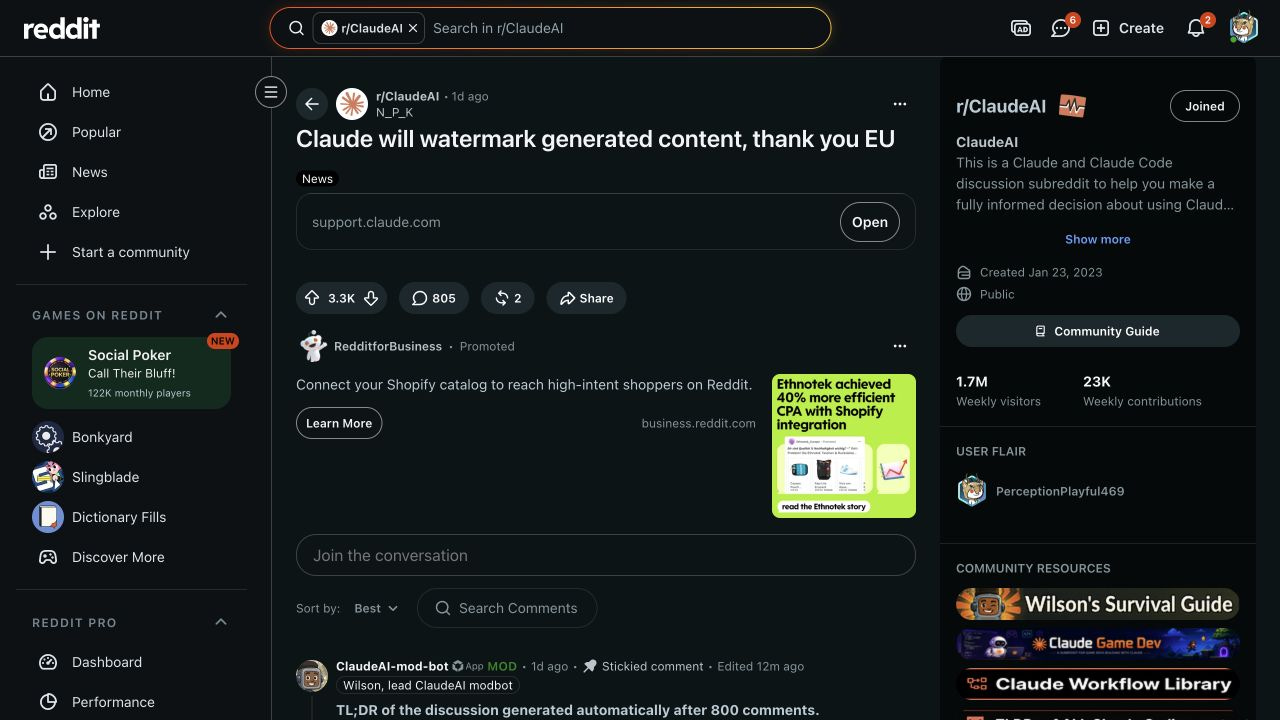
The leading r/ClaudeAI thread passed 3,000 upvotes and 800 comments within its first day.
1. The dominant fear is the “scarlet letter”
Creators are not mainly worried about getting caught publishing untouched AI text. They are worried about being mislabeled after using Claude for legitimate editing.
One widely shared r/ClaudeAI post makes the case that the prompts, decisions, revisions, and final approval belong to the user. Claude should be treated as infrastructure, not as a co-owner stamping its name on the result.
That is the strongest creator angle in the whole conversation: a provenance signal for tool usage will be read as a verdict on authorship. And this is where I share the concern from my own layer. Watermarks help filter slop, sure, but they may quietly damage work in areas we have not even mapped yet. Legitimate editing is the obvious casualty. It will not be the only one.
2. Reddit independently converged on cross-model rewriting
Across several threads, the same workaround appears within hours: take Claude’s output and regenerate it with DeepSeek, ChatGPT, Gemini, or a local model.
The replies range from jokes like “hey DeepSeek, remove this watermark” to serious explanations that a second model should replace the original token pattern. A technical r/ClaudeCode thread specifically proposes using a local Gemma model to rewrite Claude output.
That is technically plausible and consistent with published watermark research. It is still speculation about Claude. No Reddit user can validate the result against a detector Anthropic has not released. They are testing against a ghost.
3. The technical community is assuming Claude works like SynthID or KGW
The better threads explain green and red token lists, biased sampling, secret keys, and detection over long passages. See this mechanism discussion and the r/ClaudeCode explainer.
Reddit’s technical explanations usually borrow from published watermarking methods. They are useful mental models, not confirmation of Claude’s exact implementation.
These are useful mental models, not reverse engineering. Anthropic has not confirmed that Claude uses Google SynthID, KGW, or any specific published scheme. So claims like “rewrite exactly 25%” are Reddit folklore until someone can test the real system. Treat them as such.
4. There is a smaller pro-watermark camp
The counterargument: thoughtful creators already rewrite and refine their work, while the people most threatened by detection are publishing one-shot AI slop.
That view shows up in “the slop is the biggest watermark”, a thread arguing that strong human direction matters more than hidden provenance. Other commenters support marking because it could reduce training-data contamination or make mass-produced content easier to filter.
So the community is not unanimously anti-watermark. It splits between authorship as process and authorship as generated text. That is the real fault line, and neither side is wrong in the abstract. They are arguing about different definitions of the same word.
5. Humanizer Reddit is full of marketing disguised as testing
The humanizer subreddits demand a much higher skepticism level.
There are dozens of near-identical posts titled “I tested every AI humanizer” or “the only one that actually works.” One r/AIToolTesting post reports flawless results for Rephrasy. Another r/humanizeAIwriting story recommends Walter Writes after an assignment supposedly passed Turnitin. A long r/AiHumanizer ranking is posted by an account named rephrasyai and ranks Rephrasy first.
These posts may contain useful product details. They are not independent benchmarks. They test generic classifiers, rarely publish the source text and transformed text side by side, and have zero access to Claude’s watermark detector.
My read: the mainstream Claude communities are useful for discovering proposed workflows. The dedicated humanizer communities are mostly useful for discovering which companies are buying distribution.
My Honest Take
Claude’s watermark is weaker than many headlines suggest, and the methods people are discussing are more technically credible than Anthropic would probably like.
It is weak because it cannot measure originality, effort, or authorship. It can disappear. It can also flag work where Claude made only a minor contribution. That is a false-positive machine aimed at the people doing the most legitimate editing.
Published research already shows the underlying problem: if a watermark lives in a particular sequence of words, another system can rebuild that sequence while preserving much of the meaning. Translation, neural paraphrasing, and cross-model regeneration all attack that gap. None of this is hypothetical.
The removal products are still overselling what they know. Beating GPTZero is not beating Claude. Removing ordinary metadata is not the same as attacking a model-level text watermark. And a missing C2PA manifest proves only that the provenance chain was lost. It does not prove anything about authorship.
But the direction is obvious.
We are about to get an arms race between model providers embedding signals and rewrite systems optimizing them away. The winners will not be basic synonym spinners. They will be multi-model pipelines that regenerate structure, measure semantic drift, test several detectors, and keep sensitive drafts local.
That may make AI provenance useful as a speed bump. It is unlikely to make it durable proof of authorship. And the collateral damage to legitimate assisted work is a cost nobody has priced in yet.
Would you pay for a Claude-specific watermark checker or remover, or is this entire market solving a problem that only exists because clients still confuse AI assistance with AI authorship? Reply in the comments.
This article was first published in the Creators AI newsletter. View the original edition.