Best Tips & Tools for AI Creative Writing 2025
Tips from the pros and everything that could come in handy
Hello friends!
We’ve already talked about how LLMs can help you work with code and massive amounts of data.
But for a while now, we haven’t touched the one thing we can’t live without and interact with every day: text.
AI-written content is a very controversial topic these days, kicking off endless debates about writers being replaced by AI.
But we’re witnessing what is happening instead. LLMs became another layer in an already complex content creation process.
I have been writing for years, and I know one thing for sure. If you respect your audience, you do not hand raw prompts to AI and publish the output without review. Your thoughts matter even when they feel rough or unfinished.
It’s about the craft of writing, not the act of writing. It is about how you build your creative system over time.
In fact, we have already embarked on this journey into creative writing with AI. For more inspiration and practical insights, we encourage you to review our previous works: Write With AI: Guide to Craft Bestsellers with AI Tools, and The Napoleon of API Wrappers & CEO of Jasper AI + What’s Next in AI Text Generation?
People like to say AI will expose who is talented and who never knew how to write in the first place. But if you lack a skill, you just learn it. LLMs can help you learn how to write better by working through different tools and approaches, not by skipping the work:
In this piece, we will:
- Discover how people succeeded in writing with the help of AI
- Focus on the tools that help you move past writer’s block and keep your brand voice consistent.
Keep your mailbox updated with practical knowledge & key news from the AI industry!
How Creators Write with AI
His First Fiction Book with AI Tools
You might hear about him if you’re interested in Crypto.
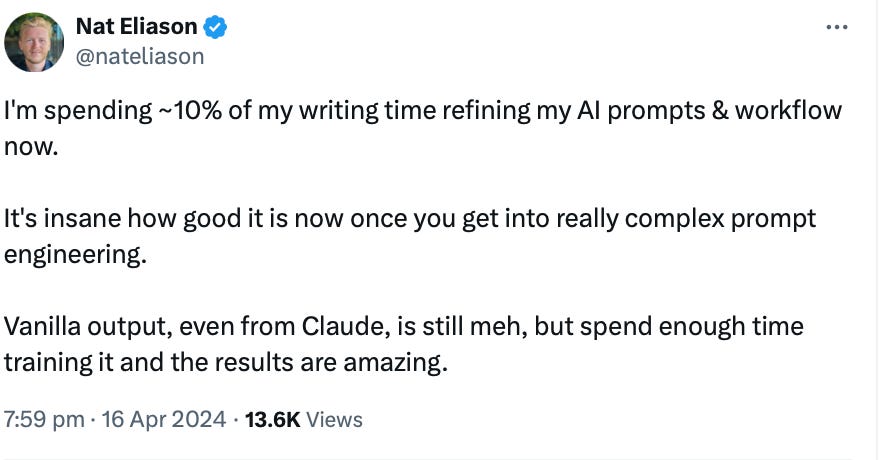
Nat Eliason, the author of Crypto Confidential, a real-life thriller about making and losing millions in crypto, constantly shares how he uses AI to edit his writing.
Somewhere, the author is saying that AI isn’t great at writing from scratch, then elsewhere he’s talking about how he brainstorms with it when he’s stuck. But overall, his primary benefit of using AI is in the editing phase. He just plugs chapters or the whole manuscript straight into AI tools, gets instant analysis, and, by his own words, skips those months-long waits you get with traditional editing cycles.
Here’s what we can learn from his approach:
- Nat built his prompts around a document listing all his own writing weaknesses.
- He asks AI to flag his specific problems, like writing too many “stage directions” (stuff like “he looked at blank” or “I thought I felt I smelled”).
- He runs 10, 20, 30 super-specific prompts against the manuscript at once to get detailed feedback. Turns out asking for everything at once gives you surface-level analysis.
Omg, I mentioned Claude Code earlier as a way to learn new things. And while digging on this case, I ran into another real proof point! Nat uses Anthropic’s Claude Code, because it does a much better job keeping the context of a long manuscript (like a 100,000-word book), compared to expensive web-based AI tools.
- After running all these checks, the AI gives him a “score” for each aspect, so he can zero in on the specific areas that need work for each chapter.
How to Write 40 Books and Not Go Bananas
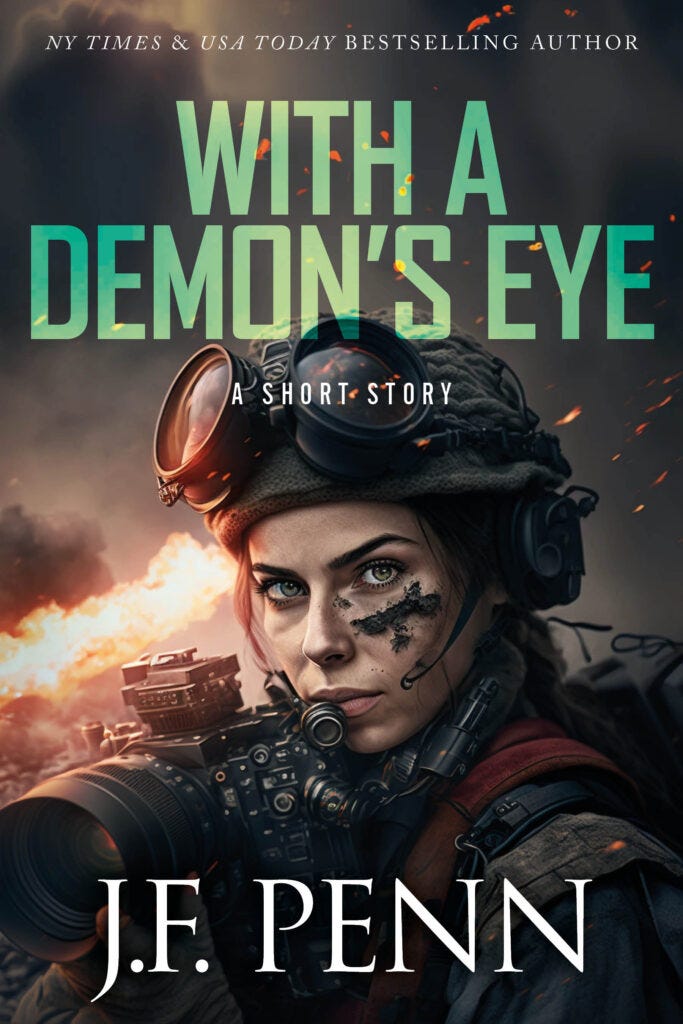
For the second example, I chose an absolute writing machine. Joanna Penn cranked out over 40 books and made a name for herself with thrillers, dark fantasy, and crime novels under the pen name J.F. Penn.
She’s hit the New York Times and USA Today bestseller lists, and she runs this super popular podcast called The Creative Penn, where she shares what she’s learned and gets authors pumped about using tech in their work.
Joanna uses AI to refine specific elements of her fiction:
- To expand descriptions, particularly focusing on sensory details such as sight, smell, sound, and taste, she relies on tools like Sudowrite, which she finds particularly useful for improving her setting and character descriptions.
- She employs ChatGPT to overcome difficult creative hurdles, such as generating book titles for short stories.
- For her fiction, she uses GPT-5’s deep research to generate extensive, referenced reports on complex topics that form the basis of her stories, such as the flora, fauna, and Māori myths of the Poor Knights Islands. Then she uploads this report back into the AI’s project knowledge to use it as context for further brainstorming.
- After her initial hand-editing process, Joanna uses the AI editing software ProWritingAid to fix up the manuscript before it goes to her human editor.
If you want to go deeper in this topic, this video is a great way to start - click
Structure, Speed, and Newsletters

The final writer is Ali Abdaal. This guy is a well-known YouTuber, newsletter author, and entrepreneur who is constantly sharing his workflow.
His blog and videos are about changing habits, managing time and routine, and, of course, how AI eliminates bottlenecks in content production.
I’ve discovered that he shares the AI-powered process he uses to create his newsletters, and likely applies it to his YouTube scripts and website articles as well.
Here is his simplified 3-step workflow for content creation:
- For idea generation, he uses the Voicepal tool during a walk. AI inside this tool converts his spoken ideas into a preliminary transcript.
- Then, he feeds this stream of thoughts into Claude or ChatGPT to generate 4-5 output drafts for critique and refinement.
- He finalizes the draft in Notion. According to him, the release time has been reduced from about 2 hours to ~30 minutes per letter.
Ring a bell? We’ve already covered a similar approach to using AI not to lose track of your best thoughts. If you want to build a system like this for yourself, check out this article:
Looks like this system is working, because Ali is super prolific, to my mind. The creator has got newsletters, a YouTube channel, and he even wrote a Sunday Times and New York Times Bestseller!
What LLMs and Tools Help You Keep Up With Writing
Every week, we’re looking at new models together, so there’s really no point in saying one is much better than another at writing. However, there are still nuanced details that make them different.
Below, I’ll run through and compare different LLMs for working with text. I’ll also give you some useful prompts you can use.
!function(){"use strict";window.addEventListener("message",(function(e){if(void 0!==e.data["datawrapper-height"]){var t=document.querySelectorAll("iframe");for(var a in e.data["datawrapper-height"])for(var r=0;r<t.length;r++){if(t[r].contentWindow===e.source)t[r].style.height=e.data["datawrapper-height"][a]+"px"}}}))}();
These were my observations. Of course, when you use AI all the time, you don’t notice how it adjusts to your tone. Let’s give it a simple prompt to check if the models do without preparation:
Write a short, engaging LinkedIn post (max 150 words) explaining how Deep Learning models work. The explanation must be technically accurate but delivered in a super casual, almost ‘slangy’ tone, like a friend hyping up the tech to you at a coffee shop. Focus on the concept of ‘layers’ and ‘weights’ without using overly academic language. End with a strong, confident closing line.Here, I’ll be testing models without any subscriptions to show how they work for an ordinary user who doesn’t have a tier.
GPT-5.2
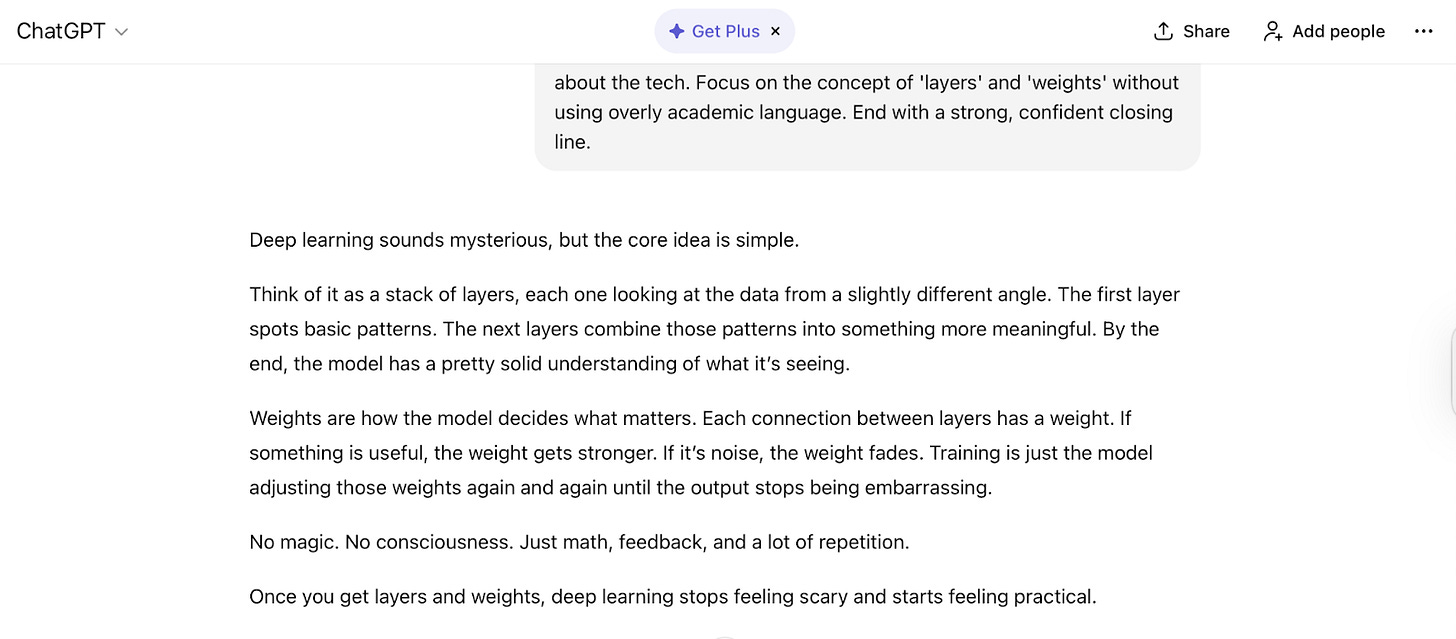
As I mentioned earlier, it handles logical structure. So, for the generation of academic/expert texts, ChatGPT must work exceptionally well. This example, in principle, confirms that assessment.
We observe a very concise introduction, a main body consisting of two paragraphs with supporting arguments, and a conclusion that is not bogged down with unnecessary words (despite my instruction for a casual tone). I’ve written a whole bunch of essays with a similar structure in the university, so the structure is very familiar to me.
Still, there is a noticeable absence of transitional phrases. Also, it exhibits a typical ChatGPT trait, and one common among people who favor ending sentences with a single word.
Claude Sonnet 4.5
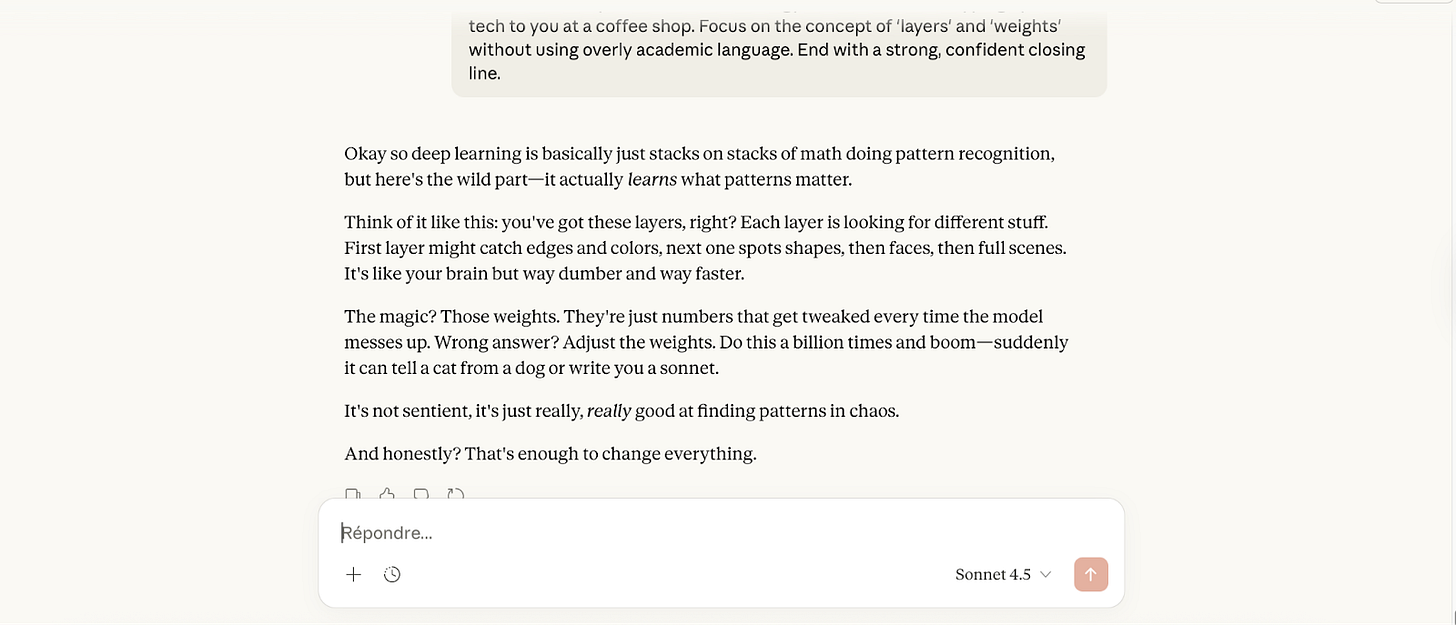
Hm, this is significantly more slangy and, when compared to the ChatGPT output, uses far more filler phrases.
The primary objective, which is explaining what Deep Learning actually is, gets a bit lost behind this, I’d say.
Nevertheless, we definitely observe a much more conversational format, which feels more suitable for LinkedIn. Its tendency to add additional context shows high stylistic adaptability, so you can fine-tune to perfectly match your specific tone of voice.
Gemini 2.5
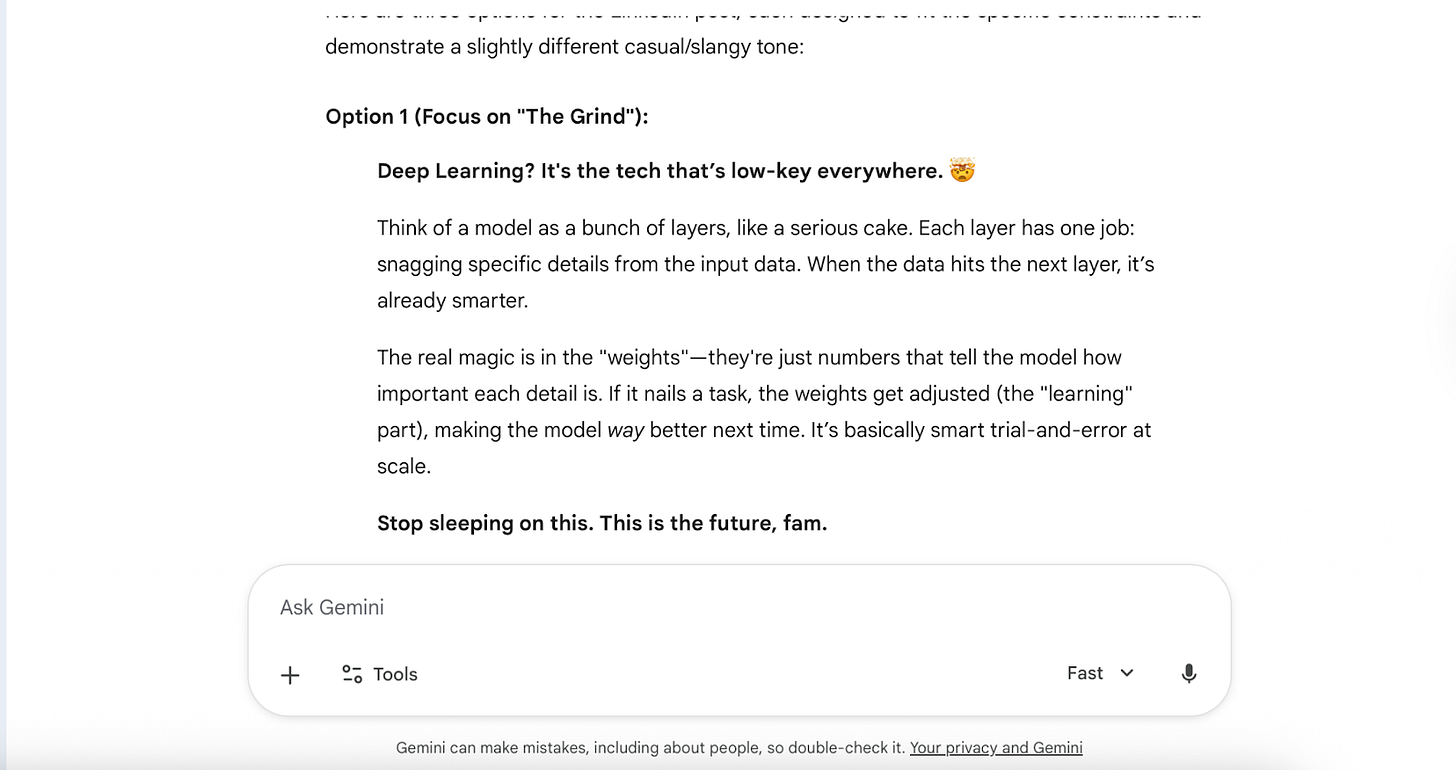
“Magic” again lol (that word has already been added to the list of “dead words” that often distinguish AI-generated text).
But this happens because the models are programmed to do this right from when they were trained. They just grab the words that showed up a ton in their data when people were trying to sound impressive. Undoubtedly, no one forbids using the word, but it has simply become a cliché.
Anyway, the model still provided me with three drafts, though they were significantly shorter than the previous outputs.
Frankly, the content felt far more lost than the response from Claude. Of course, you’ve noticed general phrases like “already smarter” and oversimplified the technical facts. The key requirement, “technical accuracy”, was not really followed.
Grok 4
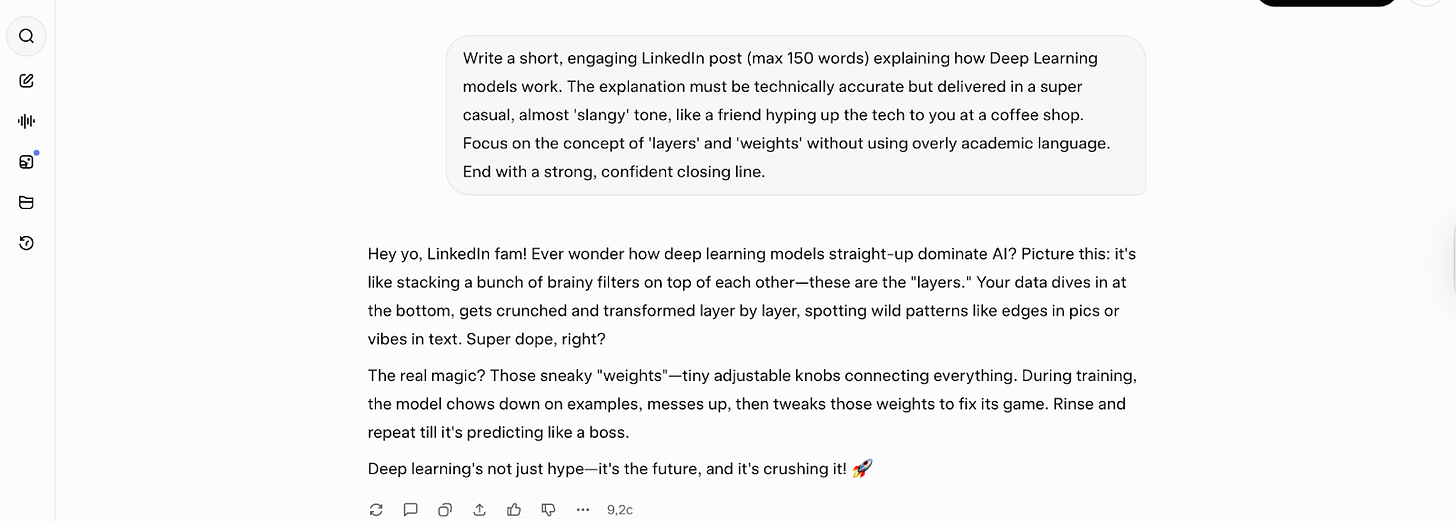
✨Magic✨
Regarding Grok, it seems that whenever I interact with it, I feel like I’m being answered by a teenage boy who has just picked up all the trendy phrases from X. It interprets the word “casually” as a mandate to make it extremely slangy, so be cautious if you need to write with it.
Getting Started: Writing With LLMs
AI is not here to think for you.
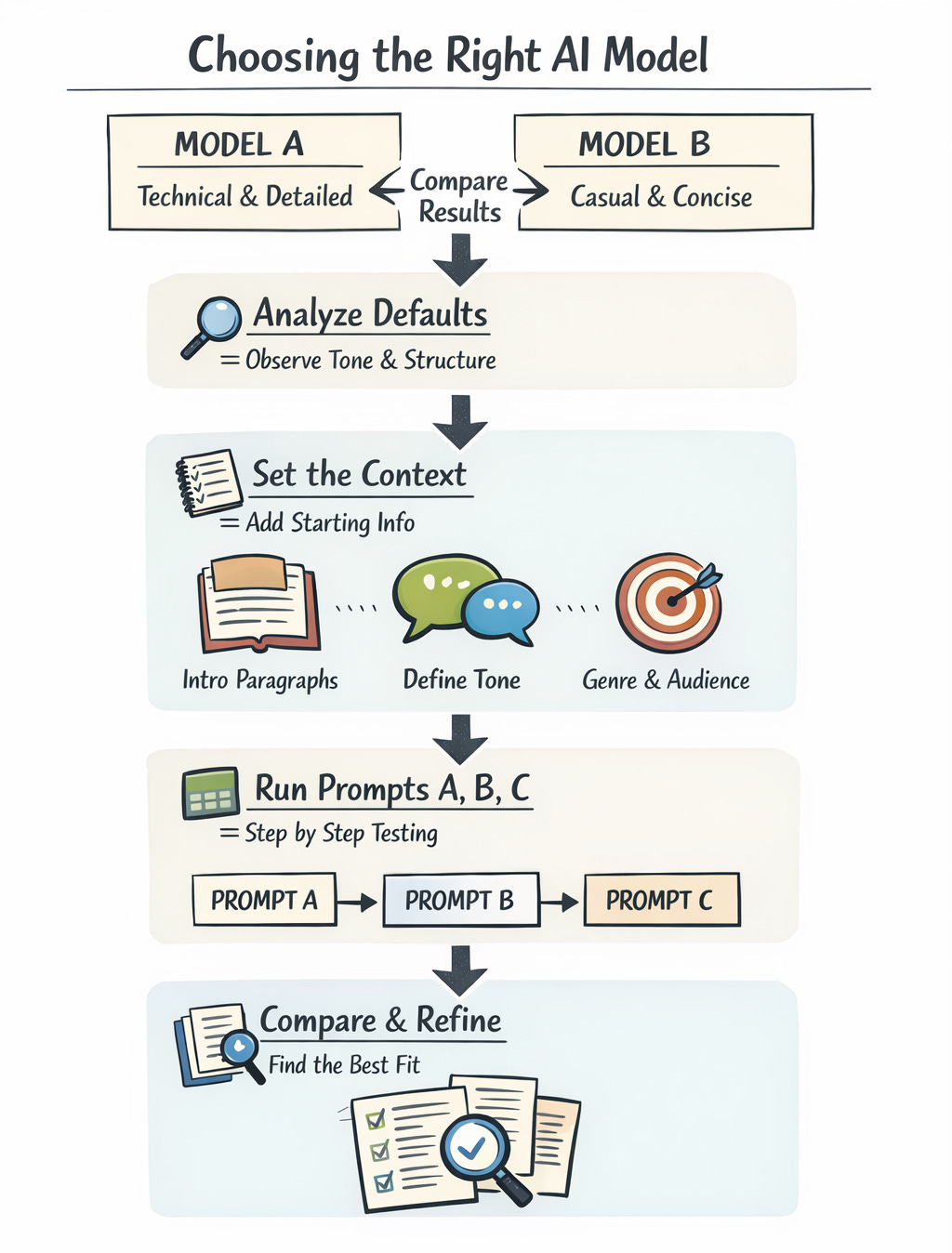
It’s obvious that different models lean into different tones. Once you understand that, you can choose the right tool based on the voice you need, not just the task itself.
Start by picking two different models and running the same prompt through both.
First of all, observe their default tone. You need to see how they structure text, how technical they sound, and how much weird info they add.
Secondly, before you ask AI to write anything meaningful, give it context. This can be:
- 2–3 paragraphs of your own writing
- a short description of your tone
- a genre + audience definition
The clearer your starting point, the less generic the output.
Then work step by step. Run Prompt A, B, and C with small changes (structure, constraints, voice). Finally, compare results across models, as I’ve done above.
This way, finding the model that complements your style will be much easier.
Other Useful Tools to Write with
- Copy.Ai: focused on short-form marketing copy and social media content.
- Jasper: AI-powered marketing copywriter designed for ad copy, blog posts, and sales content.
- Sudowrite: specifically built for fiction writers with features like story brainstorming, character development, and creative rewriting
- ProWritingAid: a comprehensive writing assistant with in-depth grammar and style analysis.
- Grammarly: advanced grammar, spelling, and style checker with AI-powered clarity suggestions.
- HyperWrite: AI that adapts to a user’s writing style and offers contextual suggestions.
Tips & Prompts for Better Writing
Here are the key lessons for writing effective prompts:
- Your prompt needs a mandatory structure: Inputs (Who, What, Why), the actual Task (What to create, how long, what vibe), and Constraints (What the AI can’t do). If you miss a piece, the output will be weak sauce.
- Don’t forget about context engineering. We’ve talked about this more than once, and creators keep confirming it: tools like Claude and Cursor are perfect for building content systems.
By storing your past work, drafts, and notes as context, you create a personal library of yourself (sounds big, but it’s true). It helps the model consistently follow your tone of voice and writing patterns, instead of starting from scratch every time.
> If you’re worried about repetition, you can simply ask it to scan your files and flag overlaps.
- Avoid general requests like “make this better.” Instead, provide detailed guidance. This way, Nicolas Cole advises solving “1 problem for 1 specific person in 1 specific industry in 1 specific way” method.
Nat Eliason takes this a step further by basing his editing prompts on a personal document listing all the ways he tends to write poorly.
- Explicitly define the boundaries. This is critical for maintaining a unique brand voice. For example, Nat Eliason instructed the AI to ignore his long philosophical interludes, which readers enjoyed, even though the AI suggested cutting them for pacing.
Constraints can also govern style, such as “Avoid metaphors”, “Avoid purple prose”, or “Avoid words like streamline” and “game-changer”.
5 Strategic Prompts for Marketing and Founders
These prompts can help you leverage AI for analysis and critique:
- Focused Weakness Editing
Segment: [Insert the chapter or scene text].
Specific Weakness: “Stage Directions” (e.g., phrases like "He looked at", "I felt", "She thought")

TASK
Act as a line editor. Go through the Manuscript Segment and highlight every instance of the Specific Weakness. For each highlighted instance, provide a suggested concise alternative sentence that maintains the meaning without using the weak phrase.- The Blog Angle Injector
[Current Article/Lesson Problem]: [State the specific argument or lesson you are stuck on, or the main belief you are struggling to frame. E.g., “I am writing a productivity post but every lesson feels cliché. I need a counterintuitive take on ‘effort vs. outcome.’] [Desired Creative Flavor]: Casual, Emotional, and Uneven.

TASK
Your goal is to shatter the writer’s inertia by generating three wildly different, unconventional Blog Post Angles (Frameworks) to solve the [Current Article/Lesson Problem]. Each angle must be suitable for a long-form article/blog post and must embody the [Desired Creative Flavor].- AI Slop and Blandness Destroyer
[Insert any section of the text] and [Unique Style Keywords]

TASK
Act as a quality control expert specializing in detecting “AI slop” (homogenized content). Identify the three most generic and predictable phrases in the [Content Draft]. Then, rewrite the surrounding sentences to infuse them with your [My Unique Style Keywords], making the language more subjective and opinionated.- Viral Content Repurposing
Source Post (Viral LinkedIn Post): [Insert the full text of a high-performing post]. My Context: My personal experience regarding this topic is [Insert specific counter-anecdote or specialized insight].

TASK
Act as a rhetorical structure analyst. Break down the Source Post into a sequence of 4-6 structural questions that define its flow (e.g., “What is the initial widely-believed premise I must challenge?”, “What is the counter-intuitive lesson the reader must learn?”). Then, use those questions as a template for a new, unique post based on My Context.- Hook Optimization and Intensification
[Draft Content Body]: [Insert the full text of the article/post body].
[Current Draft Hook]: [The current first 1-2 lines].
[Emotional Target]: [The feeling the hook should evoke: curiosity, fear of missing out, anger, or urgency].

TASK
Act as a viral copywriter. First, critique the [Current Draft Hook] based on its effectiveness in achieving the [Emotional Target]. Second, generate 5 new, high-intensity hooks that maximize the [Emotional Target] and align with the core idea of the [Draft Content Body].
The final words
In an age where speed is common, your ability to build a systematic workflow (Content Engineering) and maintain a perfect brand voice consistency becomes your ultimate competitive advantage.
For all creators, marketers, and writers, you should recognize that AI is not a replacement but a sophisticated layer of creative control needed to scale quality.
In a nutshell:
- Prioritize deep editing over draft generation
- Create “style references”: several of your own texts + descriptions of tone, favorite words, phrase length, and difficulty level.
- Run multiple hyper-specific, targeted queries against your text to receive multidimensional analysis rather than surface-level results.
- Preserve your voice. To stand out against generic output, you must maintain your subjective human style. Regularly audit your writing by asking the AI: “Identify the three most conventional (generic) phrases in this text”.
This article was first published in the Creators AI newsletter. View the original edition.