
Claude MCPs for Finance, Bookkeeping & Taxes: Stripe, Mercury & QuickBooks in Claude
How Claude caught $8k my CPA missed
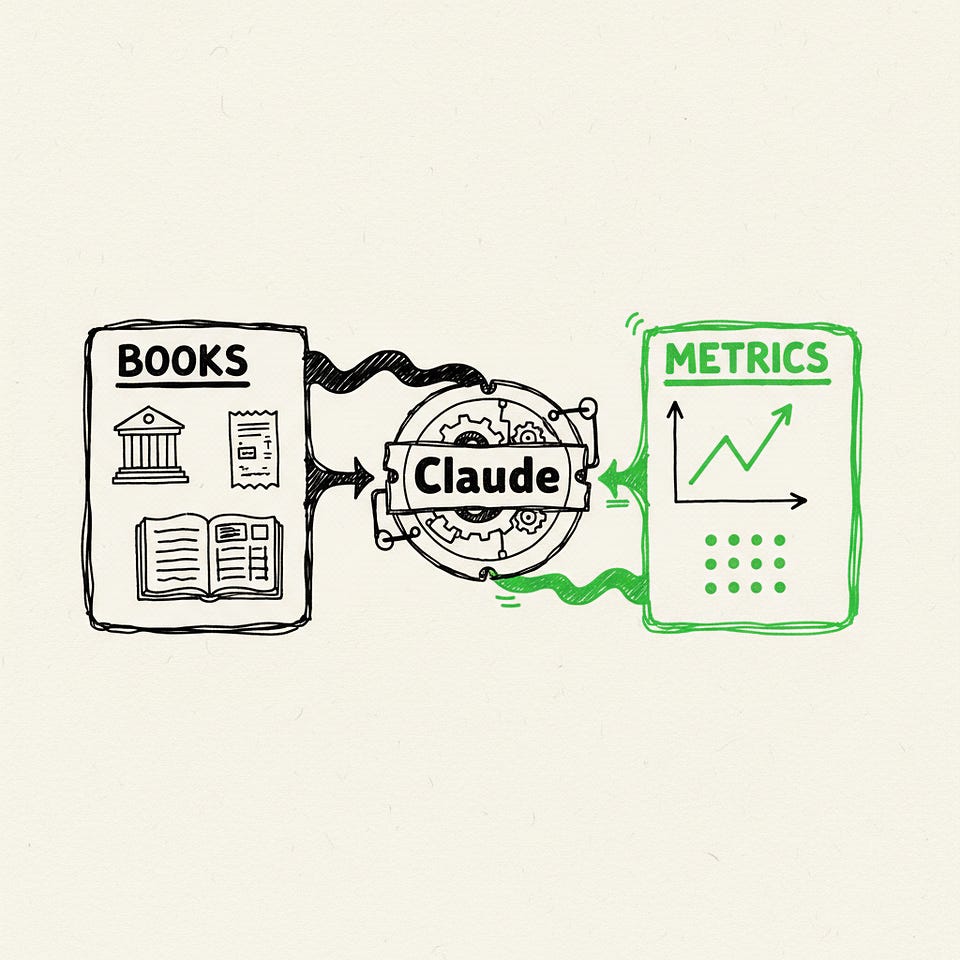
I run two businesses through the AI stack I shared recently, and I lean on Claude a lot. An AI agency with lumpy invoices and contractors, and a creator-platform thesis (newsletter plus paid community) with subscriptions, upgrades, churn and refunds. Last quarter I fed Claude my previous tax return forms and my current P&L and asked one question: what looks off? It surfaced roughly $8,000 my CPA had missed. That is not the headline of this post. It is just the moment I stopped treating this as an experiment.
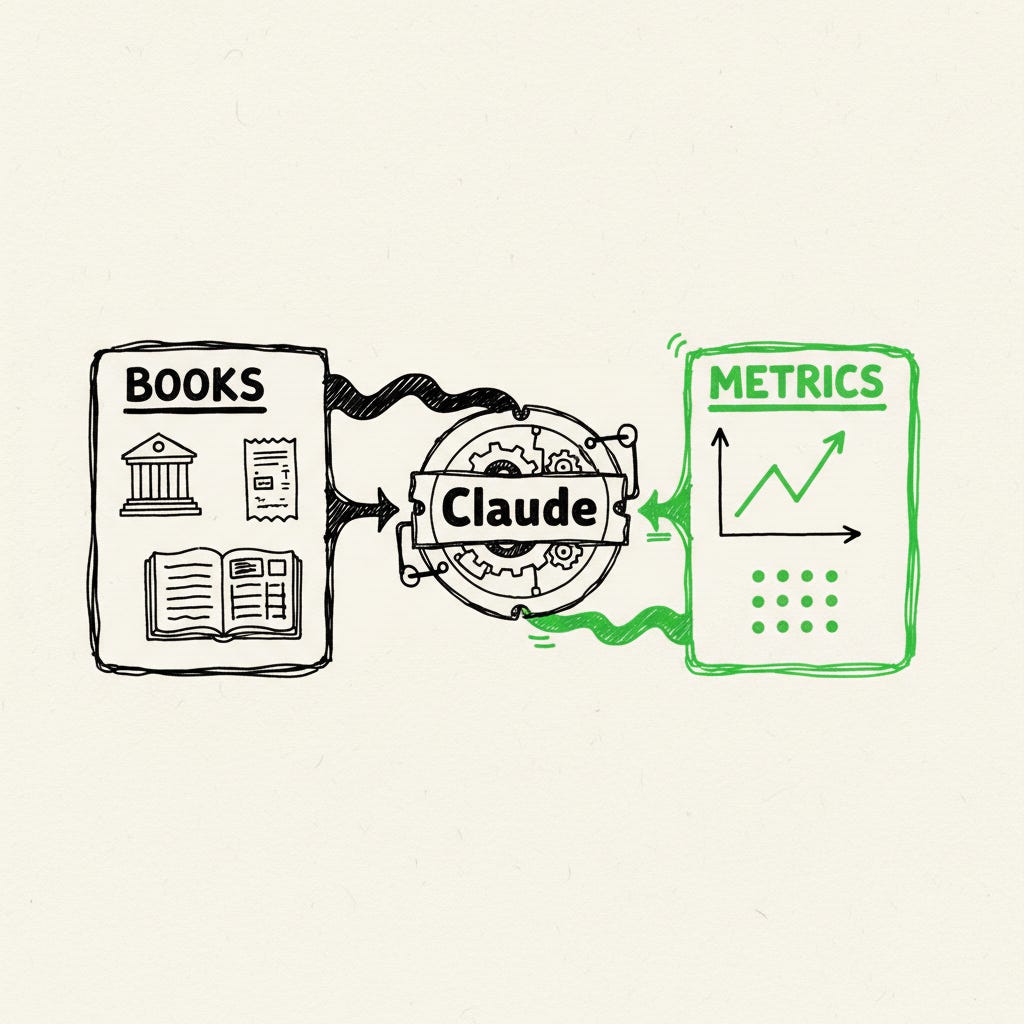
One Claude, two domains: the books and the metrics
Two dozen workflows live, 4 banned, ~$3-6k/mo of tools and hires I didn’t pay for. Put them together and what you have is the closest a solo founder gets to an augmented CFO: the reporting, analysis and alerting half of the role, on call, for the price of the connectors. The judgment half stays yours. That line runs through the whole post.
If you read my piece on the 3-layer agent stack, that was the architecture. This is the first domain it runs end to end. New to connectors? Start with the MCP guide for founders and makers. I will spell out the workflows that earn their keep, give you the prompt for each, and link the rest.
The reframe: operator layer vs. domain
Most “AI for finance” posts conflate two things: the operator (the agent that runs) and the domain (your data).
Mercury writes from the cash side. Stripe writes from the revenue side. Your metrics dashboard writes from the analytics side. QuickBooks writes from the ledger side. All four miss the join, because none of them can see the other three.
The mental model is three rules:
- Source-of-truth tools stay exactly where they are.
- Claude is the read, summarize and draft layer. Never the post-to-ledger layer.
- Claude writes only in Sheets (low stakes) and as QuickBooks drafts I approve.
Here is why the same architecture covers both bookkeeping and product metrics: both are downstream of the same raw events. A single Stripe charge is a revenue event for the books and a retention event for the dashboard. Read once, derive twice.
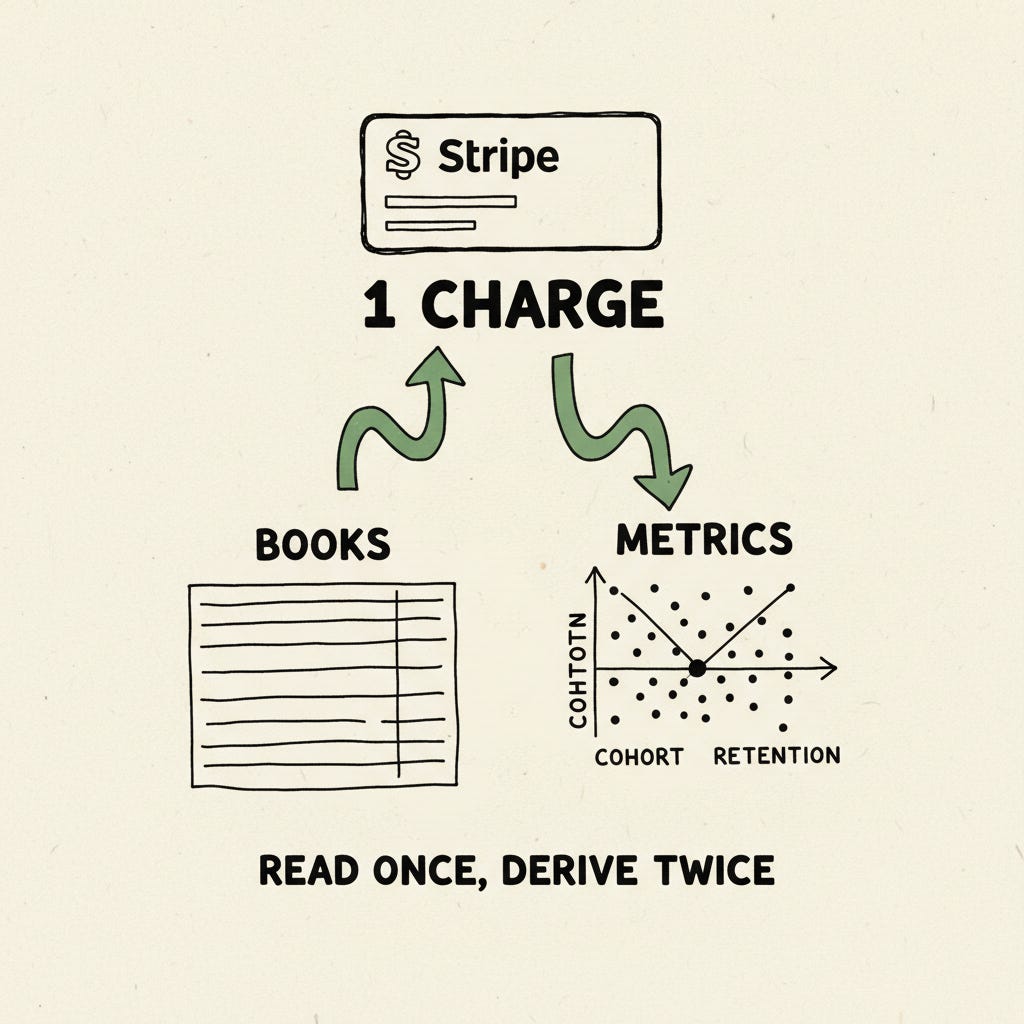
One Stripe charge becomes a ledger row and a cohort dot
That is why I will not pay $200 to $1,500/mo for Bench, Pilot, Pry or a CPA retainer anymore. Not as a flex. As a data-trust call. I would rather have Claude pull from Stripe directly than have a second SaaS interpret Stripe for me and spend an afternoon debugging which one to believe.
Keep subscribed to get the actual Creators & Founders AI stack in your inbox.
The bookkeeping workflows
For the books side: product founders, agencies, creators, solo consultancies, freelancers. The three that matter most, each with the prompt I run, read-only.
Daily cash position (Mercury + Stripe)
Mercury balance plus Stripe pending plus the last 24 hours, condensed into a 5-line brief at 7:30am. The Mercury read is not hypothetical: Mercury shipped its own read-only MCP for Claude in 2026, and the question their team keeps pointing to is “why did our burn increase?” That is the exact monthly follow-up I run off the same connection. Caught one fraudulent charge in week two. Real value: I now actually look daily.
Using Mercury and Stripe (read-only), give me a 5-line morning cash brief: total
Mercury balance, Stripe pending payouts, net change in the last 24 hours, the
largest inflow and outflow, and anything unusual. Then compare this month's
outflows to last month's by category and name the single biggest mover.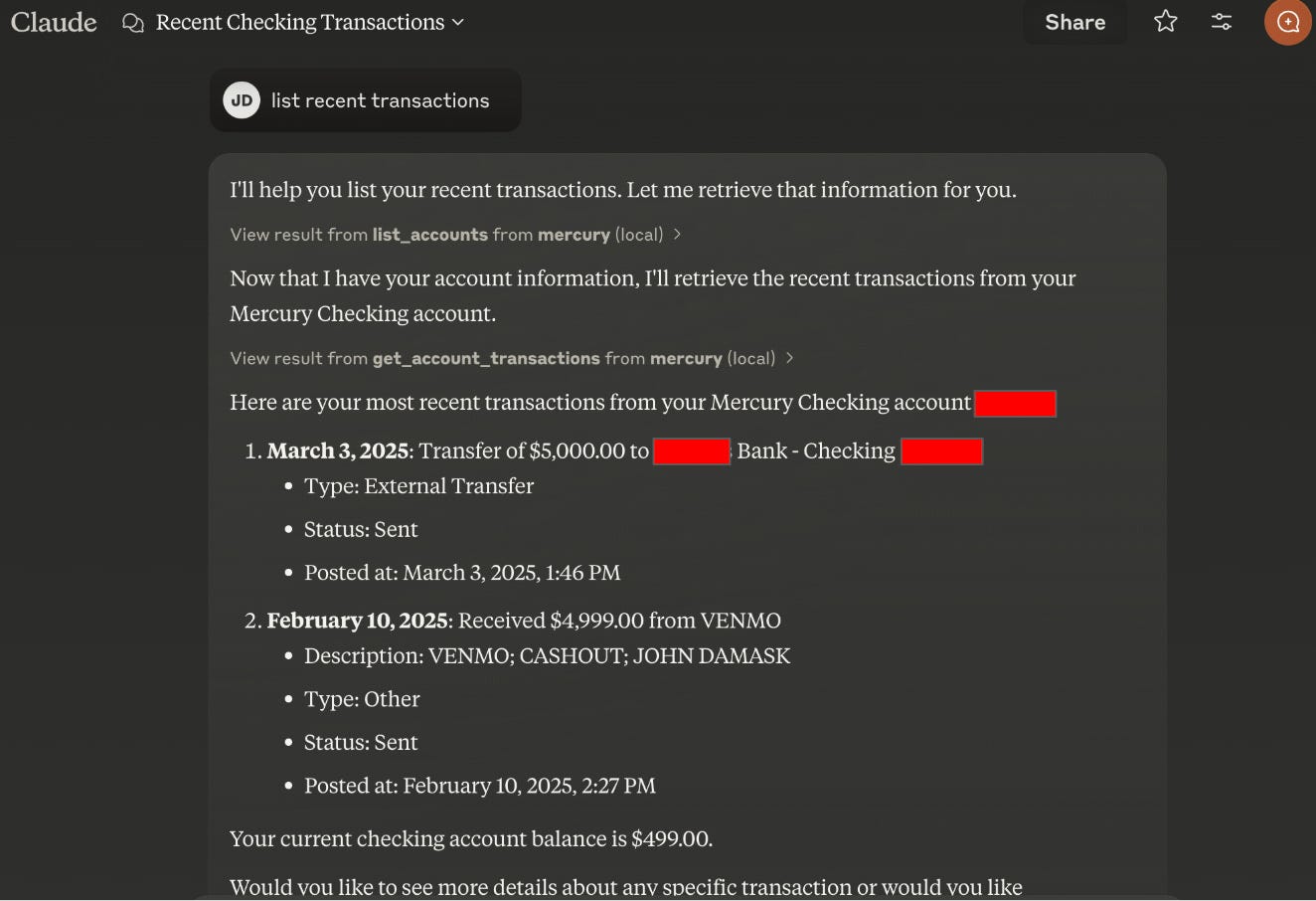
A Mercury MCP pulling live transactions inside Claude. Example shown: John Damask’s open-source Mercury MCP, johndamask.substack.com
Subscription audit (the killer one)
Monthly, Mercury and card charges get scanned for anything recurring. Output is one table: charge, frequency, last-used signal, and a keep / cancel / negotiate call. Found $340/mo of zombie subscriptions on the first run. That single workflow pays for everything else on this list.
Using Mercury and card charges (read-only), scan the last 90 days for anything
recurring. Build one table: vendor, amount, frequency, last-charged date, and a
keep / cancel / negotiate call with a one-line reason each. Total the monthly
dollars sitting in the cancel and negotiate buckets.
Reading old tax returns against the current P&L (the $8,000 one)
This is the workflow that turned me from skeptic to operator, so I will give it the full story.
I dropped my previous tax return forms (PDFs) and my current P&L into Claude and asked it to reconcile the two: what did last year’s return claim that this year’s books are not set up to capture, and what is in this year’s P&L that the return treatment got wrong? It came back with a cluster of contractor payments and software charges sitting under the wrong categories, plus a batch of expenses that had never been marked deductible at all.
My CPA had filed the prior return and missed every one of them. Not out of negligence. He worked from what I handed him, and what I handed him was messy. Claude, reading the actual return next to the actual P&L line by line, caught roughly $8,000 in tax I had overpaid.
I am attaching my last two years of tax return PDFs and my current P&L. Reconcile
them: what did the prior returns claim that this year's books do not capture, what
is miscategorized, and what deductible expense was never marked deductible? List
every discrepancy with its dollar impact. Do not make a tax determination; produce
a memo my CPA can review.
The honest catch: most of that $8k was a one-time correction of a backlog, not a number that repeats every quarter. The recurring value is the discipline it started. Real value: the $8,000, and a tax process I now trust instead of dread.
The point is not “fire your accountant.” I still have one and still need one. The point is that I no longer need a CPA retainer, and I can double-check my CPA before a return ever gets signed.
That $8k was the moment I stopped treating this as a toy. Below is the rest of the system: the routine bookkeeping, the product metrics, the augmented-CFO layer, the Google Sheets workbench, the 4 things I never let Claude touch, the setup, and the full math on what it replaced (~$3-6k/mo). Every workflow comes with its prompt.
This and the rest of the Creators AI deep dives are for our paid subscribers.
The routine rest (books)
Same connectors, same read-only pattern. Full prompts are in the subscriber library.
- Weekly P&L draft per business: Stripe + Mercury + Sheets become a per-entity P&L sketch in Notion, labeled
_draft. ~40 min/week back. - Invoice drafts from client emails: paste the scope, Claude drafts the QuickBooks invoice, I press send. ~90 min/month back.
- Receipt and contractor triage: forwarded receipts get OCR’d and categorized into a Sheets
raw_expensestab for batch approval. ~2 hours/week. - Sales pipeline forecast: CRM tags times close rates become a 30/60/90 cash forecast I can pull up live on a team call.
- Sponsor and recurring revenue tracker: Stripe subs plus Substack payouts plus sponsor income, summarized to Notion monthly.
The product-metric workflows
For SaaS founders, digital-product sellers, paid newsletters and communities. All pull from Stripe alone (the official MCP, read-only). No separate analytics tool.
I wired this in one afternoon, and the first thing I asked was the numbers founders pay a metrics dashboard $149/mo for: MRR, churn and LTV. I never subscribed to one. I just pointed Claude at Stripe.
Daily revenue and churn brief
Same 7:30am channel as the cash brief: MRR, MRR delta, new subscribers, voluntary cancels, involuntary churn (lost to failed payments, not choice), upgrades and downgrades. Two negative days running and Claude flags it as a question, not a verdict. Replaces the metrics-dashboard daily digest, $129 to $249/mo.
Using Stripe (read-only), give me a 6-line daily brief: current MRR, MRR change
vs yesterday, new subscribers, voluntary cancels, involuntary (failed-payment)
churn, and net upgrades/downgrades. If MRR fell two days running, ask whether I
want the breakdown by plan rather than just reporting it.
Weekly cohort retention and LTV
Customers grouped by signup month (a cohort), with month-1, 2 and 3 retention and average LTV per cohort, charted in Sheets. For a newsletter or community this is the only long-term number that matters. Month-3 retention more than 10 points under month-12 is my early-warning line. Replaces the cohort tool I would otherwise buy, $50 to $200/mo.
Using Stripe (read-only), group customers by signup month for the last 12 months.
For each cohort show month-1, month-2 and month-3 retention plus average LTV.
Redraw the cohort chart in my Sheets scratch tab. Flag any cohort whose month-3
retention is more than 10 points below the 12-month cohort.
Failed-payment recovery (the second killer one)
Stripe surfaces a failed payment, Claude pulls the customer context and drafts a per-customer recovery email calibrated by tenure, queued for my approval. I approve. Claude sends nothing. Default dunning recovers 20 to 30% of involuntary churn; personalized nudges push closer to 50%. Replaces Churnkey or Retainly, $99 to $499/mo.
Using Stripe (read-only), list this week's failed payments with each customer's
plan, tenure and last activity. For each, draft a recovery email whose tone
matches tenure: warm for long-time customers, functional for trial-end. Queue
them as drafts for my approval. Send nothing.
Plus plan-mix and expansion revenue: MRR split into base, upgrades, add-ons and annual prepay, with expansion called out as its own line (the number investors ask about). Prompt in the library.
Product-only? These workflows stand alone. You just need Stripe read access. Skip to setup, do Steps 1, 2 (Stripe only) and 4.
Know a founder still paying $149/mo for charts Stripe already feeds? Send them this.
Claude as augmented CFO: unit economics, treasury and runway
The workflows above save minutes. The ones below are the augmented-CFO layer: the analysis a CFO would run, on the same reads, with nothing new to connect. Read-only and recommendation-only: Claude does the analysis, you press the button.
Profit margin per client (agency unit economics)
The number most agencies feel but never see: which clients actually make money once you net out contractor cost and overhead.
Using Stripe or my invoices (revenue, read-only) and Mercury (costs, read-only),
for the last two quarters compute profit margin per client: client revenue minus
directly attributable contractor payments minus a flat overhead allocation I will
give you. Rank clients by margin percent, name the most and least profitable, and
flag any below [target] percent. Use anonymized labels (Client A, B, C).
Real value: turns “this client feels like a pain” into “Client C runs at 9% margin, raise the rate or drop them.”
Idle cash yield gap
How much is sitting in checking at roughly 0% while it could be earning a Treasury yield? Usually the most uncomfortable number in the post.
Using Mercury (read-only), how much cash is sitting in checking or operating
accounts earning roughly 0% versus in Treasury or a yield account? Using the
current Mercury Treasury yield, calculate the annual interest left on the table on
the idle balance. Output the idle amount, the yield used, and the annual dollars
foregone. Recommend only; do not move funds.
Real value: a single “you are leaving $X/yr on the table” number that usually dwarfs the zombie-subscription savings.
Zero-cash date and scenario model
The number every founder should be able to say out loud, plus the two scenarios they actually lose sleep over.
Using Mercury (read-only) for current cash and Stripe (read-only) for revenue
trend, calculate the exact date cash hits zero at current net burn. Then model two
scenarios I will specify (hire 2 contractors at $X/mo; close a $Y raise) and give
the new zero-cash date for each. Output a 3-row table with runway in months and
the date.
Real value: a runway you can defend in a board meeting, recomputed in seconds.
Three more in this layer, prompts in the library: operating buffer vs sweepable surplus (how much cash to keep liquid vs sweep to yield), annual-vs-monthly switch and duplicate tools (the subscription audit’s cousins), and the monthly investor update, auto-drafted from cash, runway, MRR and burn.
The Google Sheets workbench: where the numbers land
Every small business runs on one finance Google Sheet, usually a graveyard of half-finished tabs. This is the one place Claude has write access (rule 3), so it is where analysis becomes a living artifact you open every morning. Claude writes to a claude_scratch workbook or proposes _draft rows into the ledger. It never overwrites a _final tab.
Living finance dashboard
One tab, the numbers that matter, rebuilt on a schedule with live formulas so it does not go stale the day after you make it.
Using Mercury and Stripe (read-only), write a "Dashboard" tab in my claude_scratch
workbook with this month's key numbers: total cash, net burn, runway in months,
MRR, MRR change, top 3 expense movers, and blended margin. Use live formulas
referencing the data tabs so it updates, not static values. Label it _draft and
do not touch any _final tab.
13-week rolling cash-flow forecast
The classic small-business cash tool almost nobody keeps current by hand.
Using Mercury (read-only) for historical inflow/outflow patterns and my list of
known recurring bills, build a 13-week rolling cash-flow forecast in claude_scratch:
opening balance, expected inflows, expected outflows, and projected closing balance
per week, with formulas so each week rolls forward. Flag any week the balance goes
negative.
Plus three more Sheets jobs, prompts in the library: budget vs actual with overspend flagged red, Stripe / Mercury / ledger reconciliation that flags rows that do not tie out, and a data clean-up pass (dedupe, normalize vendor names, fix dates) so your SUMIFS stop lying. Real value: the sheet you already have stops being a graveyard and starts being the dashboard you meant to build two years ago.
The 4 things Claude is BANNED from touching 🥇
Mercury, Stripe and the metrics dashboards will never write this section honestly, because they are selling you the access I am about to decline. An augmented CFO that can move money is not a CFO, it is a liability.
Initiating money movement. Zero authority to move money: not Mercury transfers, not Stripe refunds, not QuickBooks bill-pay, not a Treasury position. Read and draft only. Every outbound payment, I press the button. The failure is asymmetric: the downside is irreversible, the upside is saving 30 seconds.
Final tax decisions. Claude categorizes and surfaces discrepancies (like the $8k). It does not decide what is deductible and it does not file. I make the call, my CPA signs. Tax rules are jurisdiction-specific and audit-loaded; a flag is the start of a decision, not the decision.
Closing the books and the metric period. Claude drafts reconciliations and adjusting entries. I post them. A wrong daily entry I catch tomorrow; a wrong close pollutes every report for the quarter.
Customer-facing actions. Claude drafts the recovery email. It does not send it, change a plan, issue a refund or comp a month. This protects the customer from a bad agent decision, and protects me from a prompt injection buried in a support ticket.

Claude drafts. I press the button.
Bonus rule: anything Claude writes ends in _draft; anything I sign off ends in _final. Claude reads _final, never writes it. That one convention prevents about 90% of the “Claude overwrote my report” failures.
The roadmap
Four on the way: auto-categorization that learns from my corrections (target: misses under 1%), a monthly Net Revenue Retention waterfall, pricing-test analysis that tells me when to stop an A/B test, and a cross-domain alert, the automated push version of the zero-cash workflow, that pings me unprompted if MRR flattens while runway dips under threshold.
Setup in 30 minutes
Pick your operator (a proactive agent layer, or Claude Desktop alone, you just lose the “pings you first” behavior). Then connect the four connectors in this order, with these scopes
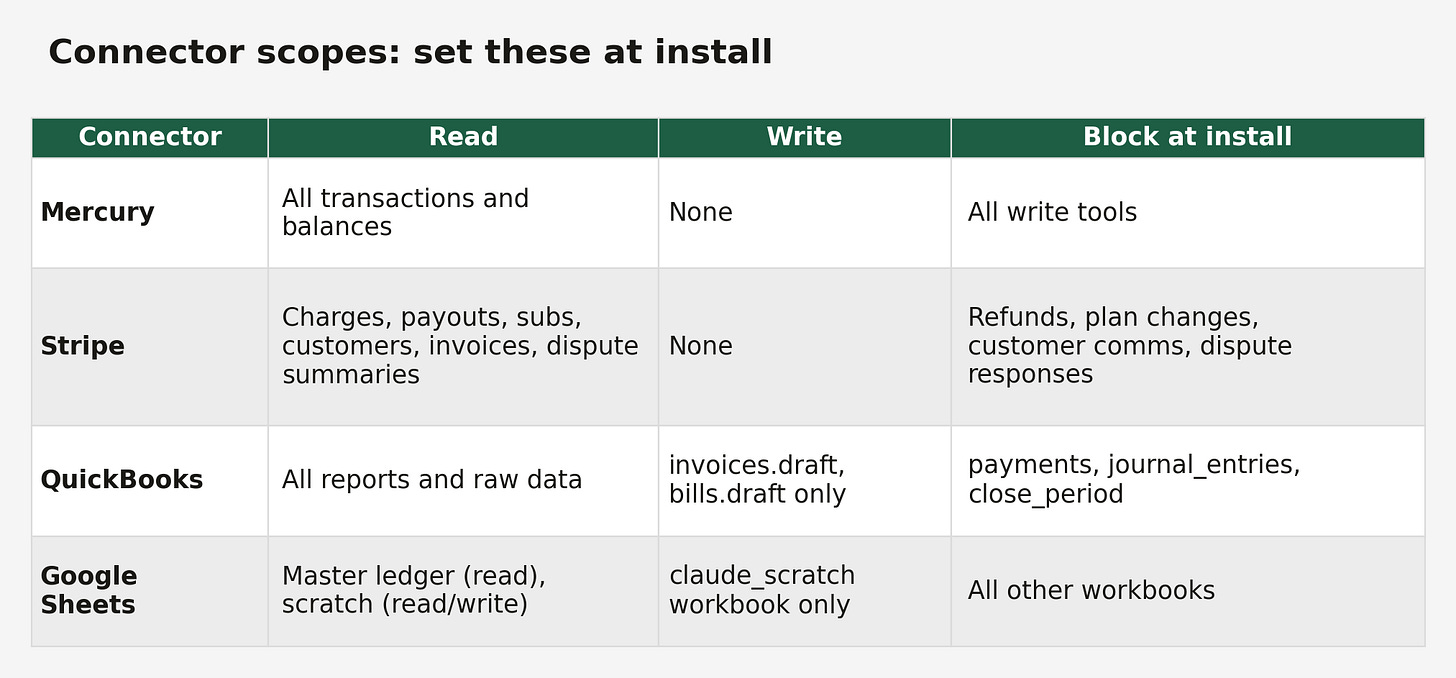
Books-only: install all four. Product-only: Stripe only. None of these is a sketchy hack: Stripe ships an official MCP server, Mercury shipped its own read-only MCP, and Intuit and Anthropic partnered directly to bring QuickBooks into Claude. First-party does not mean unsupervised: set every one to read-only at install and block the write tools by hand.
From there, build in this order: the daily cash brief (cron, 7:30am), the daily revenue brief (7:31am), the expense triage (after ~20 receipts the miss rate drops under 10%), then run the subscription audit once this week (the fastest ROI on the list), and add the weekly cohort chart. The last step is a mindset one: when the agent pings you about money first, you are operating, not running.
The architecture and what it replaces 🥇
Four sources of truth, none of them Claude. Mercury is cash truth, Stripe is revenue and product-metric truth, QuickBooks is ledger truth, Sheets is everything else. Claude is the layer that reads, derives and drafts, and owns none of the truth. Stripe is the highest-leverage connector because it is the only one feeding both domains: one charge becomes a row in the books and a dot in the cohort. Two businesses stay two clean sets of books (QuickBooks classes, separate Stripe accounts, Mercury sub-accounts); the consolidated view lives only inside Claude’s prompts.
This is the practical version of an argument I made earlier: AI agents are quietly eating SaaS. Here is the bill.
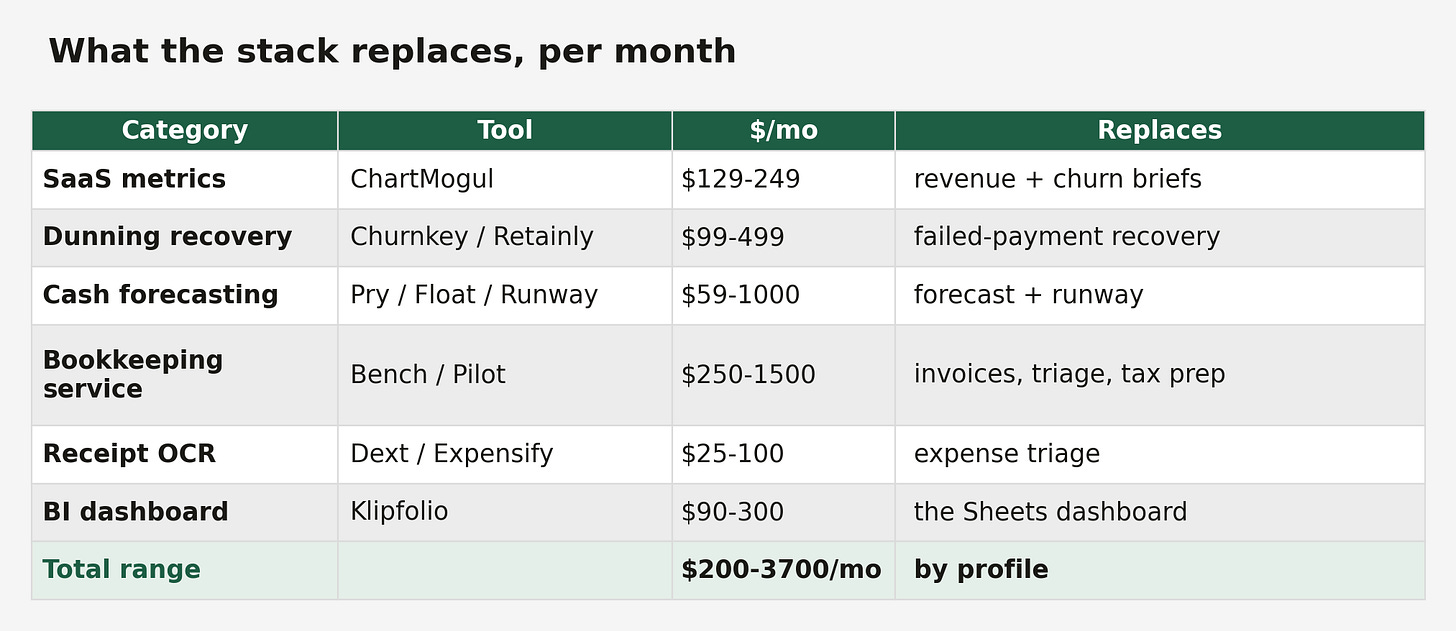
It also defers or shrinks hires: a junior bookkeeper, AP clerk or data-entry VA ($300-1,600/mo) almost fully, and the reporting work of a fractional revenue-ops analyst or CFO (~70-80% of a $2,000-4,000/mo role), though the raise and the strategy stay human. Add the founder time back, roughly 25 hours/month at a $60-120/hr rate, and the all-in value lands around $700-1,500/mo for a solo newsletter, $2,500-4,500/mo for a two-business shape like mine, and $3,500-6,000/mo for a SaaS founder with 200+ customers.
Worth that to a founder you know? Send it over.
What this does NOT replace. A live human bookkeeper for a full month-end close once you have investors or revenue over $500k. A tax CPA for the signature, the filing and the structure; mine missed the $8k and I still keep him, the lesson is to give Claude a second read before you sign. And a strategic CFO for raise prep, M&A and equity design: this is the line that matters, the stack is an augmented CFO, not a replacement one. It does the reporting, analysis and scenarios on call. The human does the positioning, the negotiation and the judgment.
The bottom line
AI for finance plus product metrics is the unsexy compound of the agent trend. Less viral than coding, less obvious than image generation, and worth more per hour saved than either. Think of it as hiring the reporting half of a CFO, on call, for the price of four connectors.
That December Hacker News take, “accounting is the real low-hanging target,” was right. It only missed that product metrics are the second target on the same tree, reachable from the same Stripe connection, and the cash sitting idle in your operating account is the third.
What I deliberately did not automate: tax decisions, money movement, the close, customer-facing actions, plan changes. Same line as in my agent-stack piece: Claude is the operator, not the founder.
Pick a single brief. Daily cash if you are book-side, daily MRR if you are product-side, the idle-cash prompt if you are sitting on a balance. Build it this week. If your phone pings you tomorrow at 7:30 with a number you trust, you will know whether the rest of this stack belongs in your business.
Related reading from Creators AI
- Your AI Agent Stack Is Spaghetti, It Should Be Lasagna: the 3-layer architecture this finance stack runs on.
- MCP: The Full Guide for Founders and Makers: how connectors actually work.
- AI Agents Are Better Than SaaS: the bigger argument behind the replacement math.
- 4 Ways to Monetize AI Agents in 2026: for the paid-community readers of the product section.
This article was first published in the Creators AI newsletter. View the original edition.