Hire Nano Banana 2 and Fire Your Agency
4 Workflows That Allow Anyone Get Agencygrade Designs
By Sergei Lomakin
A founder sent me landing page visuals, product shots, UGC concepts, 40 ad variations. He made it in one afternoon. One URL -One photo. That was it. The uncomfortable question hit immediately: how many teams are still paying premium creative budgets for work that just became same-day?
Case 1. Animated product sites built from keyframes
This is still the cleanest “wow” case in the set. It ends as a live site that a DTC brand would buy for $20k. Hero motion, scroll reveals, product deconstruction, dynamic copy, and mobile responsiveness. Just look at this:
This animation is displayed on the site’s main page. It was built from a single image — specifically with Nano Banana 2
Ed Hill made a site that a DTC brand would pay $15–20k for. Hero motion, scroll reveals, product deconstruction, mobile responsive. Built in a day.
How to replicate that:
- Generate two consistent product frames in Nano Banana 2: one “closed” hero frame and one “exploded” or transformed end frame.
- Animate the two stills in Kling 3 to create a short transition clip.
- Feed that clip into Claude Code, often with a site-building skill or a prebuilt markdown spec.
- Let Claude generate the site structure around the motion asset: hero, benefit blocks, proof sections, CTA, responsive layout, and scroll logic.
- Export and host the result, often on Vercel or a similar front-end stack.
You can read more about this case here.
If you are still piecing together how Claude Code skills fit into these workflows, Creators AI’s Skills, Plugins, Swarm Mode: Practical Tips with Claude is a useful background read.
Prompt to copy
Use one prompt for each stage rather than one giant all-purpose instruction blob.
For the start frame:
Create a premium studio hero frame for [product]. Black background, sharp rim light, reflective materials, product centered, luxury-tech campaign lookFor the end frame:
Create a matching end frame for the same product, but with components separated in a clean exploded layout. Keep materials, proportions, and camera angle consistentFor Claude Code:
Build a premium landing page around this motion asset. Use scroll-driven transitions, restrained copy, dark UI, large type, one hero section, three benefit blocks, one proof strip, one CTA section, and full mobile responsivenessWhy this one belongs in the piece
Because it is one of the first Nano Banana workflows that clearly crosses the line from spectacle to service. The client-facing angle is “premium motion microsite in 48 hours.”
Business angle
This is easy to package as a service: launch microsites, product pages, SaaS homepages, luxury e-commerce campaigns, or founder-led launch pages. The value is speed with polish, not novelty for its own sake.
Recommended videos & posts:
- Nick Saraev — “Claude Code + Nano Banana 2 + Kling = $15K Animated Sites”
- Nate Herkelman — “Build AI Websites with Claude Code and Nano Banana 2”
If you want more breakdowns of AI workflows that already map to real services — subscribe!
And if a motion microsite already feels billable, the next workflow is even easier to explain to a client: one input, dozens of ready-to-test creatives.
Case 2. Static Ads factories that turn one brand URL into 30-40 ad creatives
This is where Nano Banana stops being a creative tool and starts behaving like a production engine.
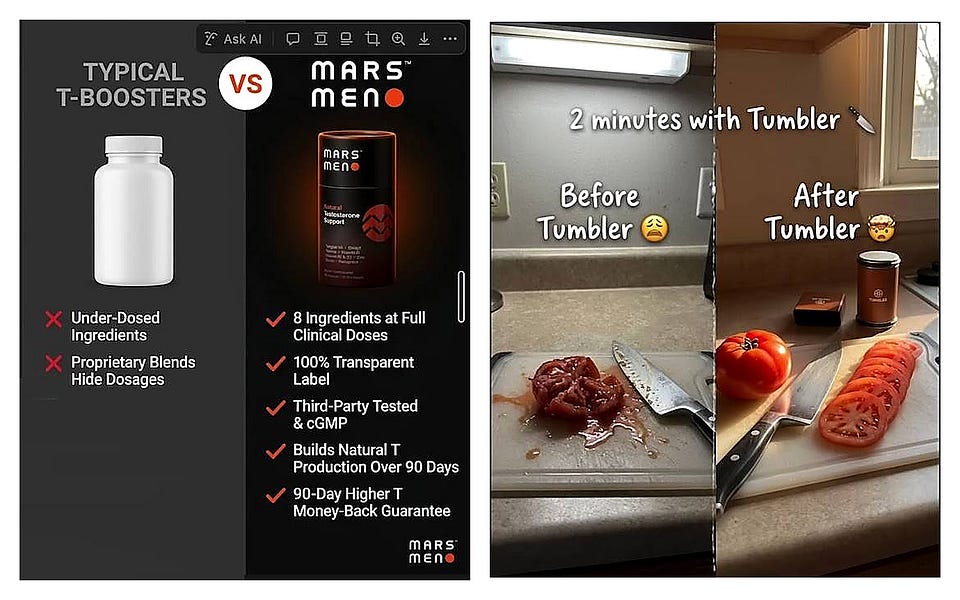
One URL — and we got a dozens, hundreds of ad creatives:
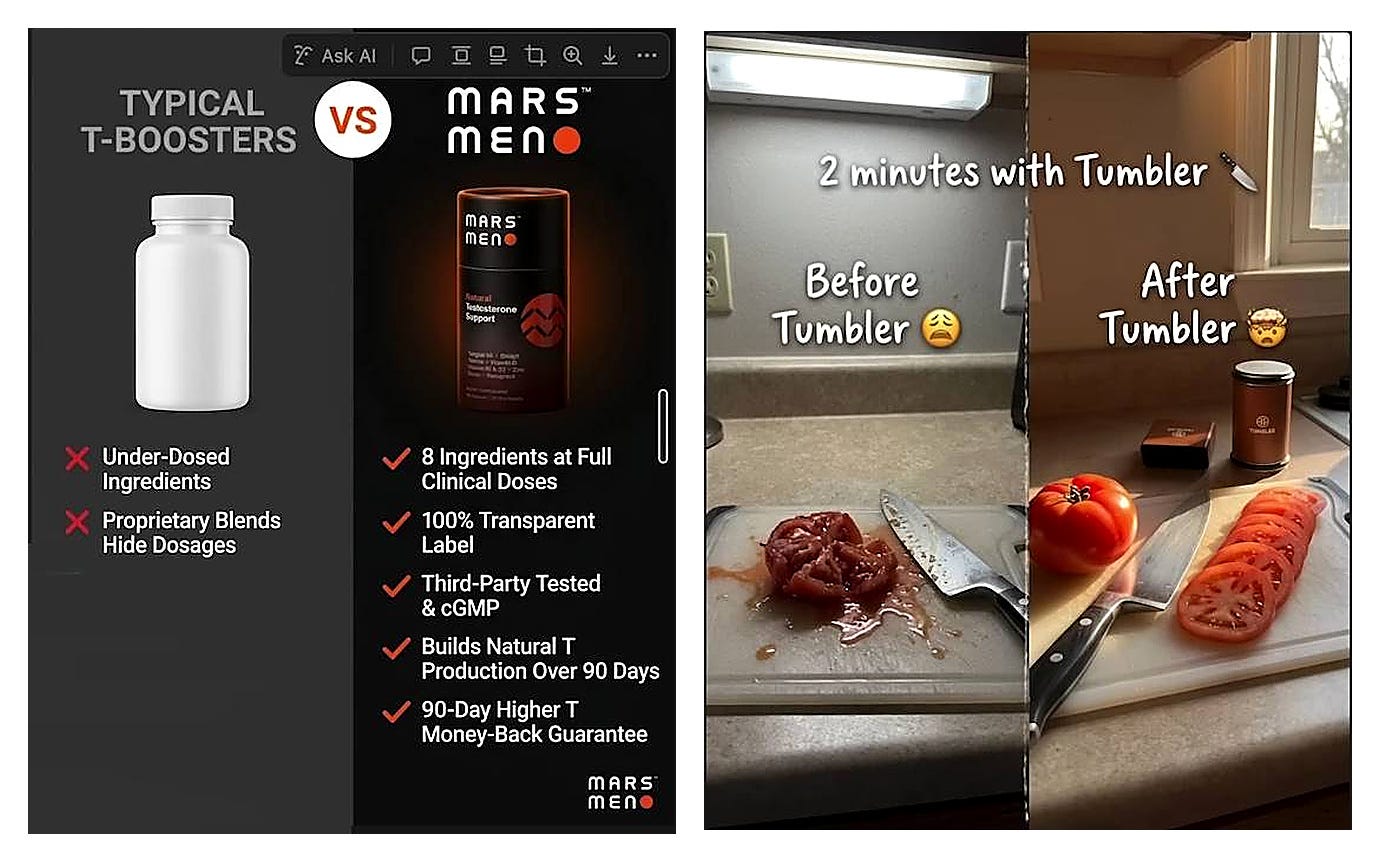
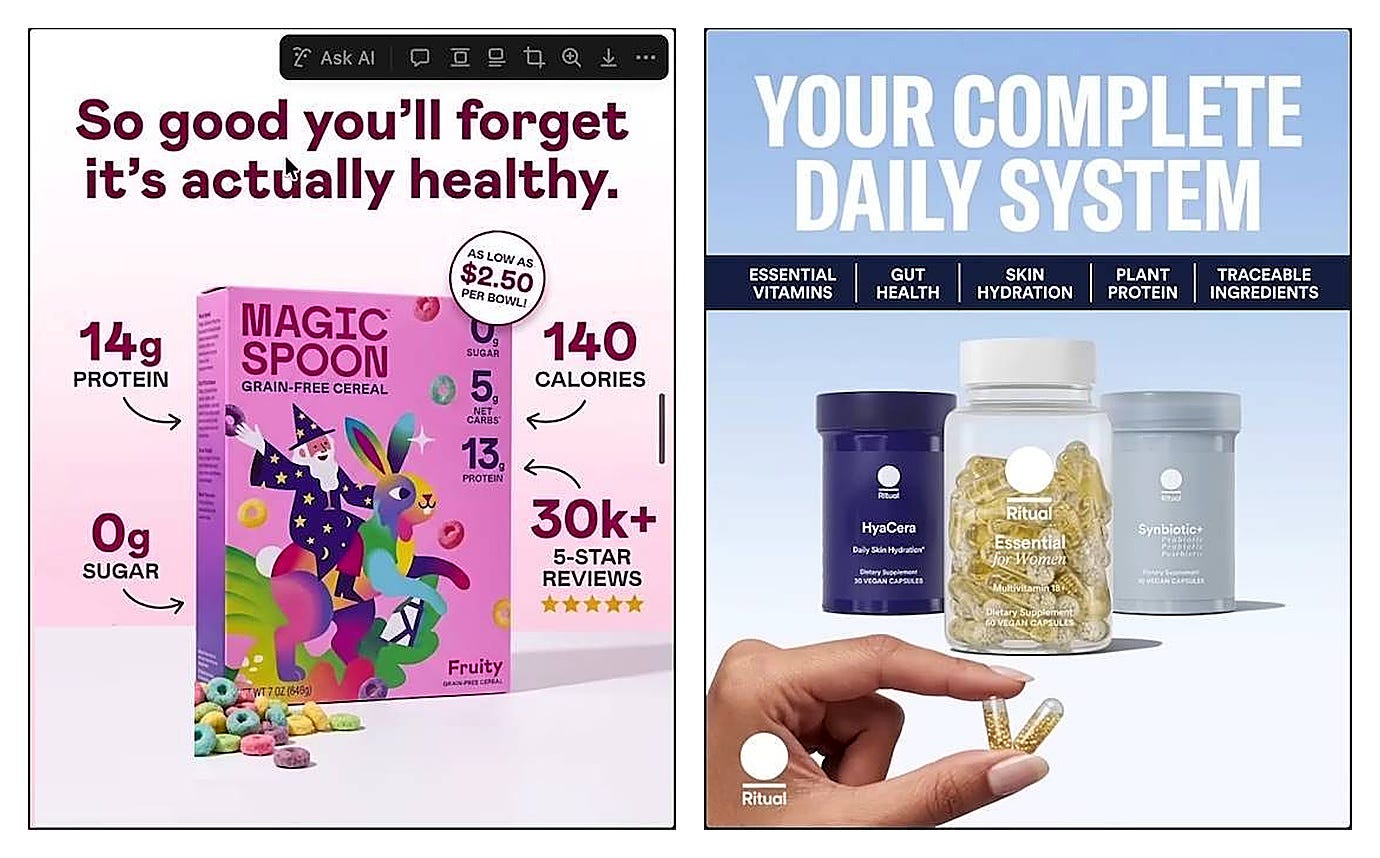
Examples of ads we got just from one URL
This is the most commercially legible case in the set. The promise is immediate and concrete: instead of making one ad, the system makes a batch. That is why this case is so important. It behaves similar to a repeatable production pipeline.
What the result actually is
A grid of static ad creatives built from the same brand system while testing different hooks, layouts, visual framings, and offers. The outputs are usually already in platform-native aspect ratios and can go straight into Meta or TikTok testing.
Know friends, co-founders, or media buyers who need this in their workflow stack. Share this post.
How they actually build it
- Paste the brand URL into Claude Code.
- Claude analyzes the site: product type, audience, offer style, palette, tone, and positioning.
- Claude turns the request into structured prompts, often JSON-shaped, with composition, lighting, camera, and style constraints.
- Claude sends those prompts to Nano Banana 2 in bulk.
- The output is a 30-40 image test set grouped by hook, angle, or concept.
In this video you will find more details about this case. And here is a similar case that will definitely not leave you indifferent.
Prompt to copy
The best version is a two-layer system: first research, then generation.
Research prompt:
Analyze this brand URL. Extract the product category, emotional triggers, target customer, offer style, proof style, and visual language. Return 10 ad anglesGeneration prompt:
Create 4:5 static ad creatives for [brand]. Use [angle]. Show the product clearly. Use native paid-social composition, bold first-line hook, clean hierarchy, and direct-response visual logicVariation prompt:
Generate five variations of the same concept by changing headline framing, crop, scene energy, and visual emphasis while keeping brand colors and product identity consistentWhy this one belongs in the piece
Because this is the first Nano Banana case that clearly behaves close to a creative operations system. It has repeatability, batch economics, and an obvious test-and-iterate loop.
Business angle
This can be sold as a creative subscription, an internal media-buying tool, or a white-label service for agencies. It also expands naturally into competitor ad cloning, variation engines, and always-on creative refresh systems.
Recommended reads & posts:
- Mike Futia — “I built a system inside Claude Code that researches any brand, writes 40 ad prompts from scratch, and fires them all to Nano Banana 2.”
- Mike Futia — LinkedIn post on one brand name + one URL = 40 production-ready static ads
- Alex Cooper — “How to Create UNLIMITED Image Ads with AI (Nano Banana 2)”
- Reddit / n8n — competitor ad cloning system using scraping + Gemini + Nano Banana
But batch volume is still only half the story. The next step up is subtler and more valuable: a tighter visual system that still looks like one brand.
Case 3. Brand-system boards — one prompt, nine on-brand assets
This is the strongest Nano Banana Pro case from a design-system perspective. It matters because the model is generating a coherent visual language across multiple asset types inside one board.
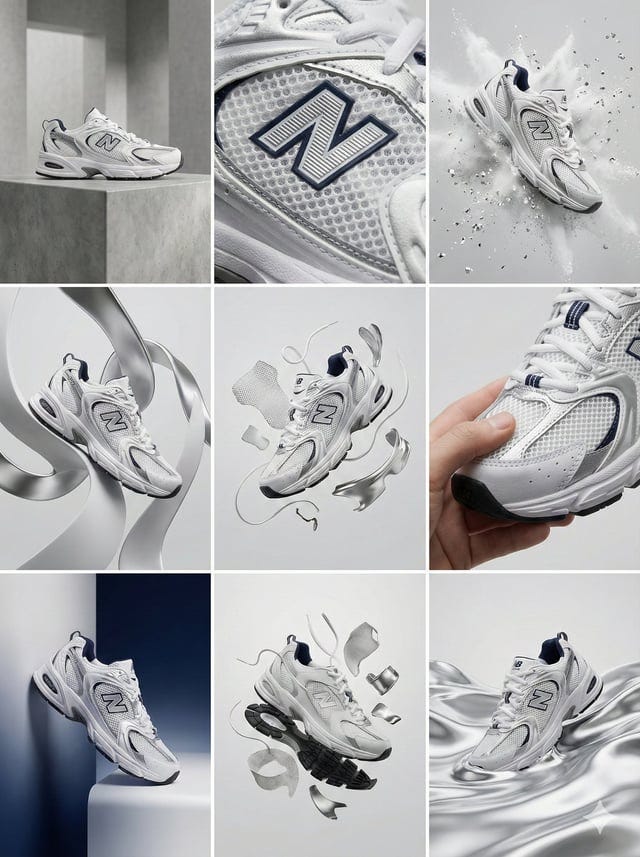
Prompt to copy
Start with:
Create a 3×3 grid in 3:4 aspect ratio for a high-end commercial marketing campaign using the uploaded product as the central subject. Each frame must present a distinct visual concept while maintaining perfect product consistency across all nine images.Now — examples of grid Concepts (one per cell).
- Iconic hero still life with bold composition.
- Extreme macro detail highlighting material, surface, or texture.
- Dynamic liquid or particle interaction surrounding the product.
- Minimal sculptural arrangement with abstract forms.
- Floating elements composition suggesting lightness and innovation.
- Sensory close-up emphasizing tactility and realism.
- Color-driven conceptual scene inspired by the product palette.
- Ingredient or component abstraction (non-literal, symbolic).
- Surreal yet elegant fusion scene combining realism and imagination.
Visual Rules: Product must remain 100% accurate in shape, proportions, label, typography, color, and branding No distortion, deformation, or redesign of the product Clean separation between product and backgroundLighting & Style: Soft, controlled studio lighting Subtle highlights, realistic shadows High dynamic range, ultra-sharp focus Editorial luxury advertising aesthetic Premium sensory marketing lookOverall Feel: Modern, refined, visually cohesive High-end commercial campaign Designed for brand websites, social grids, and digital billboards Hyperreal, cinematic, polished, and aspirationalWhat the result actually is
Usually the output is a single 3×3 board. Each tile presents a different asset — product hero, detail crop, packaging view, poster, mockup, lifestyle scene, social tile — but the materials, palette, lighting, and art direction stay consistent.
How they actually build it
- Start with one fixed product or packaging reference.
- Lock the palette, material cues, surface finish, and visual mood.
- Ask for one final board, not nine separate generations, so the system has to preserve consistency.
- Structure the request as a named storyboard grid: hero shot, macro detail, packaging front, packaging side, poster, social tile, shelf scene, lifestyle shot, and mockup.
- Run a second pass only for refinement: typography, edge cleanup, label readability, and material realism.
If you need more details, read this post.
Why this one belongs in the piece
Because it pushes beyond “generate a product render” into something commercially serious: a fast prototype of a brand system. That makes it useful for founders, agencies, and design teams that want direction before they commit money to a full shoot or brand build.
Business angle
This can become a paid “brand sprint” offer for early-stage startups, CPG founders, agencies, and studios. If you are thinking about how to package workflows similar to this into an actual offer, 4 Ways Monetize AI Agents in 2026 is a useful follow-up because the logic is similar: you are no longer selling content. You are selling execution.
Recommended reads & posts:
- Dari Designs — X prompt for a 3×3 brand visual storyboard
- Reddit / aicuriosity — prompt to create a 3×3 high-end campaign grid
If you like helping others — share this post.
And if nine on-brand assets already feel substantial, the final case pushes the same logic into motion. This is the one with the cleanest before-and-after story in the entire set.
Case 4. One product photo in, ad video out. The one-click product-to-UGC pipeline
One product photo — goes in, a usable ad-style video — comes out. That clarity is why this workflow is so commercially strong!
What the result actually is
This is an n8n automation that takes a single product photo from Telegram and returns a ready-to-use UGC-style video ad. The output is production-ready enough for paid ads or social posts, with a per-video generation cost of $0.39 in Veo 3.1 Fast mode or $1.34 in Veo 3.1 Quality mode.
How they actually build it
The workflow starts with a Telegram upload node in n8n, which triggers the full generation pipeline through the Kie.ai API. First, the system runs AI image analysis on the uploaded product photo to extract the visual context needed for generation. Then Nano Banana Pro generates a UGC-style actor based on that input, at a cost of $0.09 per image. Next, Veo 3.1 renders the final ad video, with Fast mode priced at $0.30 and Quality mode at $1.25 per video. Once rendering is complete, n8n automatically sends the finished video back to the user in Telegram. For more details— check this post.
For a broader companion read on Nano Banana’s image-to-video direction, Nano Banana Use Cases & Tutorial | Part 2 is worth opening alongside this case.
Prompt to copy
For the still-image stage:
Use this product image as the identity anchor. Build a believable creator-style environment around it. Keep the product geometry exact. Make the setup feel native to paid socialFor the reveal frame:
Keep the scene identical, but make the product emerge physically toward the camera, sharp in focus, with the background softened and subtle backlightWhy this one belongs in the piece
It is a clear production pipeline with defined inputs, defined outputs. And, of course, with obvious buyers.
Business angle
This can be sold as a creator-replacement system, a low-cost content engine for small brands, or a multilingual ad-production layer. It is also the cleanest case for agencies that want to collapse production time without collapsing volume.
Original publications
- Reddit / n8n — “Make Infinite AI UGC Ads with 1 Click (using Nano Banana Pro + Veo 3.1)”
- n8n workflow page — product video creator with Nano Banana and Veo 3.1 via Telegram
- Gowtham SB — “How I Created a Viral-Style AI Product Video for Garmin Watch (Without Spending a Dime)”
- George Stock — X post on Nano Banana 2 + Veo 3.1 + MakeUGC at scale
Across all four cases, the real pattern is simple: Nano Banana becomes most valuable when it sits inside a workflow. The people who win with it will be the ones who package these flows into retainers, offers, and repeatable systems.
That’s not a flex post. That’s a workflow. And four of those workflows are worth breaking down right now.
If you missed our previous post, don’t worry, here it is.
Which of these four would you actually test first for a client or your own brand? Comment.
This article was first published in the Creators AI newsletter. View the original edition.