How To Hire & Manage AI Agents: GSTACK and Paperclip
Frameworks For Zerohuman & Agentic Teams
Hey, it’s Daniil. This is a subscriber deep dive on the two agent-management tools everyone is arguing about right now, and which one, if any, you actually need.
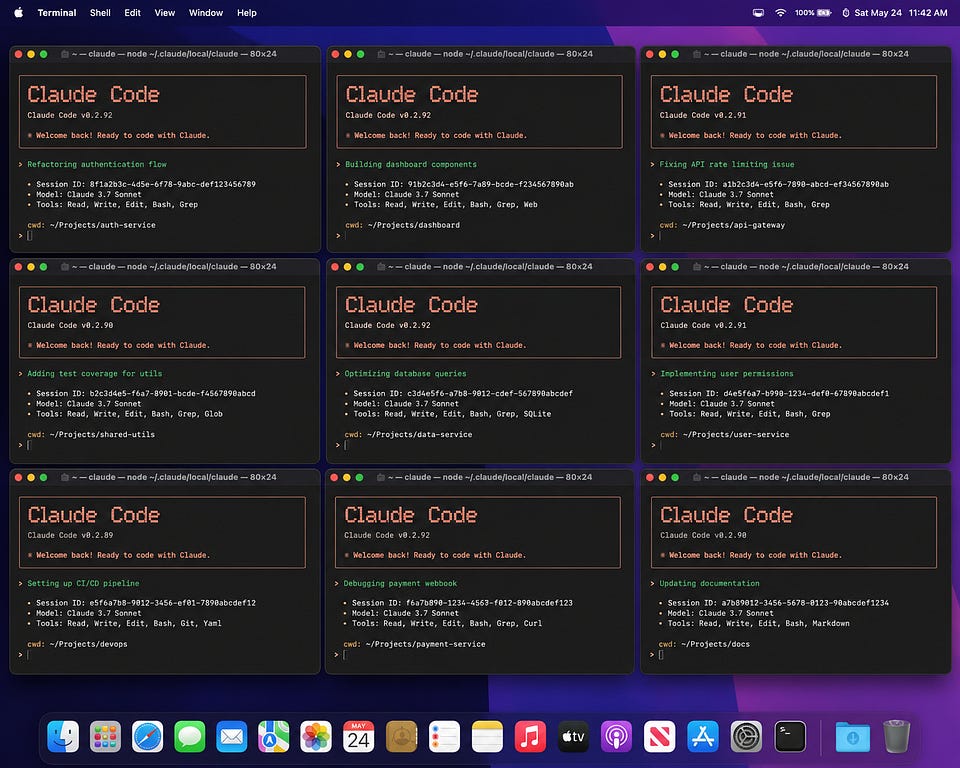
Last week I counted nine Claude Code tabs open across two monitors. I could not tell you what three of them were doing.
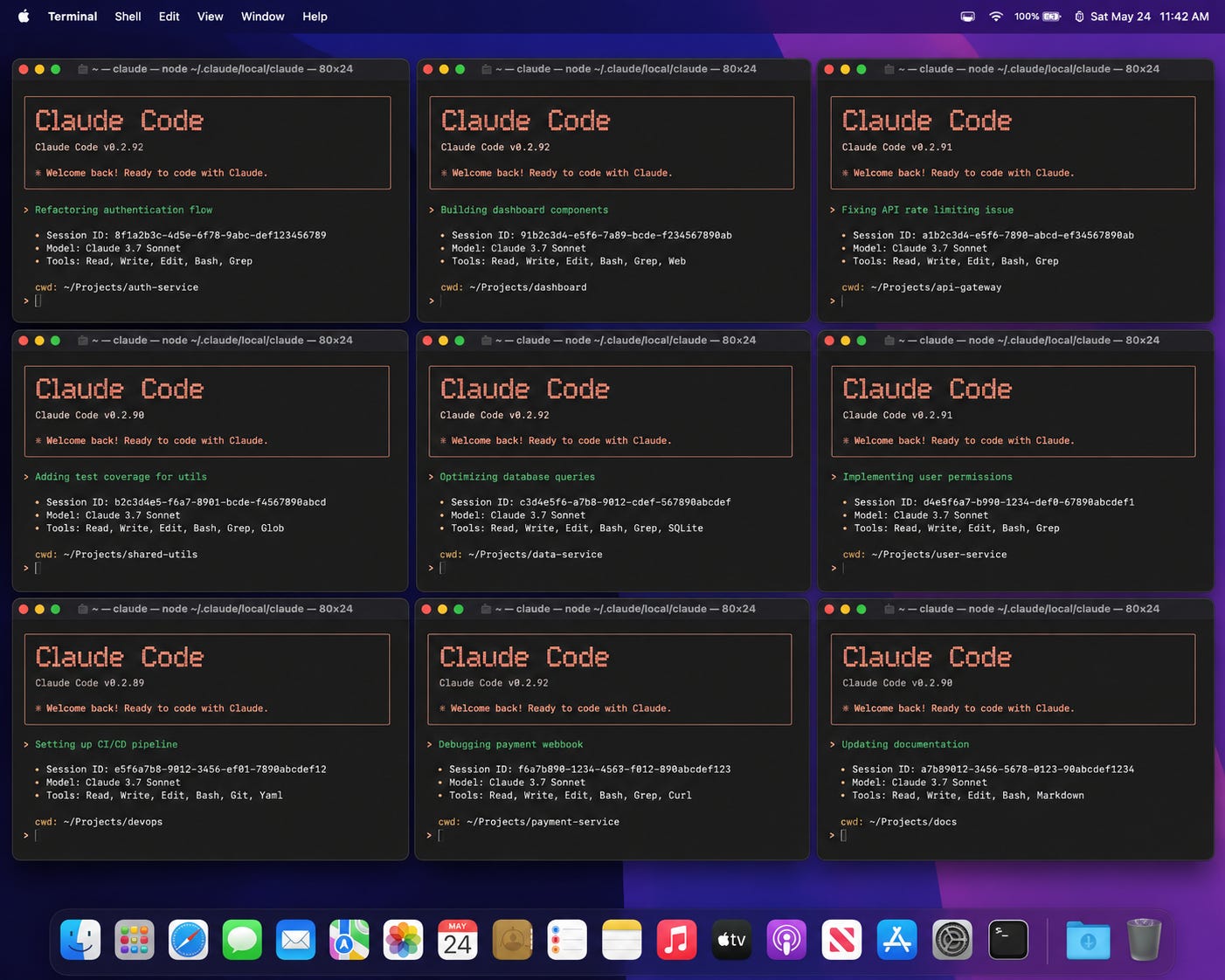
One had been looping on the same failing test for forty minutes while I answered Slack. That mess is the entire reason this post exists.
For two years the question with AI coding was whether the agent could do the work. In my stack, running an agency, media and launching AI products, that question is basically dead.
Claude Code, Codex and Hermes write real code, open real browsers, file real pull requests. The bottleneck moved. It is not the LLM anymore. It is me, trying to remember which agent is doing what, what each one is burning in tokens, and whether anyone reviewed the output before it hit main.
That gap turned into a whole category this year, and it arrived loud. Two open source projects went viral recently, answering the same question from opposite ends.
GSTACK, from Y Combinator president Garry Tan, is sitting near 97,000 GitHub stars. Paperclip, from a developer who goes by dotta, is above 67,000.
Neither is a new agent. Both are the org chart around the agents you already run.
At a glance
In this piece, you will learn:
- What GSTACK and Paperclip actually are, in plain language, and how they differ
- Which one fixes your real bottleneck: judgment, throughput, or management
- How to install and test each one on day one, step by step
- Real cases from operators on Reddit and X, and two setups worth stealing
- The honest catch nobody selling you a “zero-human company” mentions
Stop reading this as “more AI tools.” Start reading it as layers stacked on the agent.
One layer adds judgment. One adds throughput. One adds management. You want the cheapest layer that fixes your actual bottleneck, not the one with the best launch video.
This whole post assumes your stack is already split into layers. If yours still is not, start here: Your AI Agent Stack Is Spaghetti, It Should Be Lasagna.
Never miss practical AI knowledge: Tools, Agents, Frameworks, and Use Cases - stay subscribed!
GSTACK: judgment for one agent
I will start with the smaller and, to its credit, more honest of the two.
GSTACK is a free, MIT licensed pack of opinionated skills you drop into Claude Code. The install is one line and takes about thirty seconds. Nothing runs in the background, nothing touches your PATH.
What you get is 23 core skills plus 8 power tools. Each is a slash command that loads a specialist persona with its own priorities and constraints.
The personas are the whole i
dea. A CEO that challenges your scope before you write a line. An engineering manager that locks architecture. A designer that hunts AI slop. A reviewer that looks for production bugs. A QA lead that opens a real browser. A security officer that runs OWASP audits. A release engineer that ships the PR.
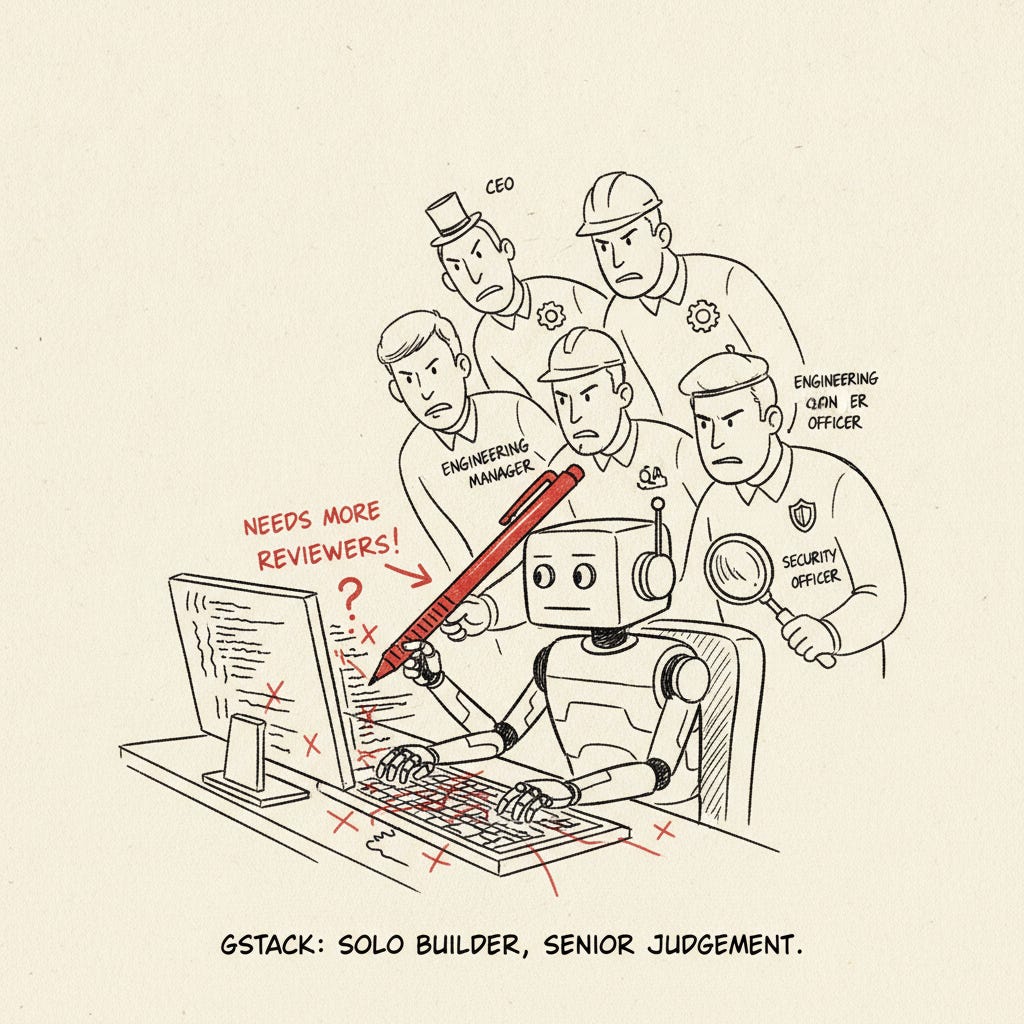
The work moves through a fixed loop: Think, Plan, Build, Review, Test, Ship, Reflect.
This is the tweet that kicked it all off, and it is still the cleanest one line summary of the pitch.
What it solves is real, and I feel it every week. A solo developer has no senior reviewer in the room. Not because they are careless, but because that person does not exist on a team of one.
Under deadline, the review step is the first thing to go. GSTACK fills the empty chairs and makes review the default instead of the thing you meant to do.
Why this skill pack out of the thousands floating around? Because of who shipped it. Garry Tan runs the engine that funded more than 4,000 startups. When that person publishes the exact setup he ships his own code with, I pay attention.
Newer to Claude Code itself? Start with our walkthrough on how Claude Code can be your AI teammate, then come back here.
Now the honest part, which is also the most interesting thing about GSTACK.
Tan’s launch claim was enormous: 600,000 lines of production code in 60 days, part time, while running YC. My first reaction was the same as yours. Sure, buddy.
Then Tan walked it back himself. On the repo today he notes that raw line counts inflate with AI and switches to a “logical code change” metric instead. His own line: “AI wrote most of it. The point isn’t who typed it, it’s what shipped.”
The creator of the viral tool retired his own viral number. That made me trust the tool more, not less.
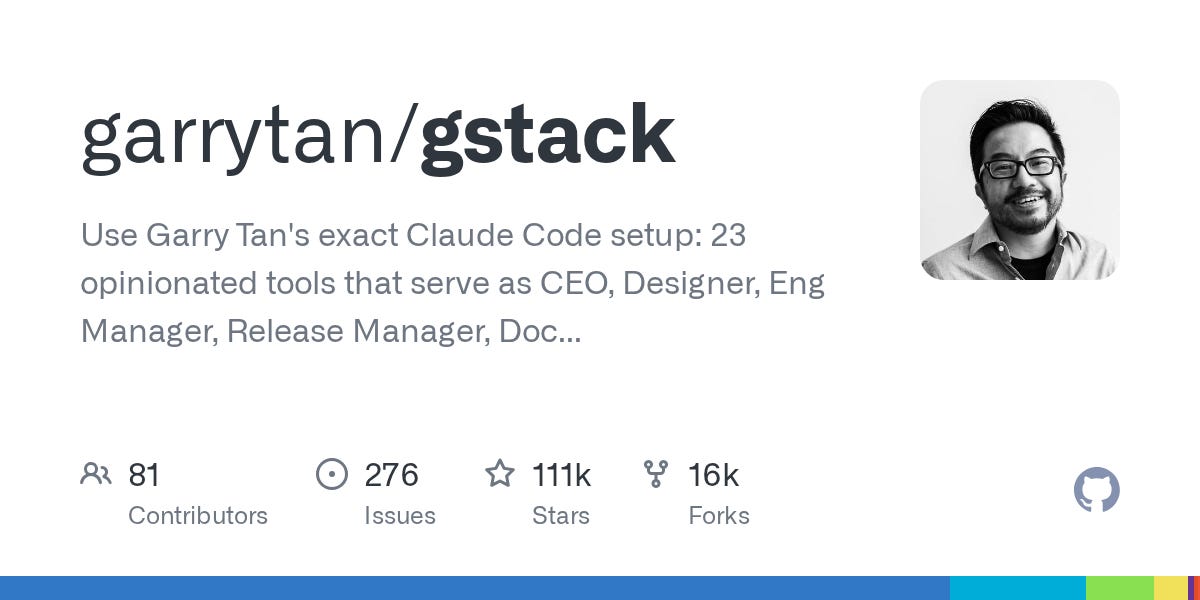
github.com/garrytan/gstack. It crossed 10,000 stars inside 48 hours and sits near 97,000 by June.
What is actually inside it. The install drops markdown skill files into ~/.claude/skills/gstack/, plus a roughly 58MB browser binary. Everything is a slash command grouped under the seven stage loop.
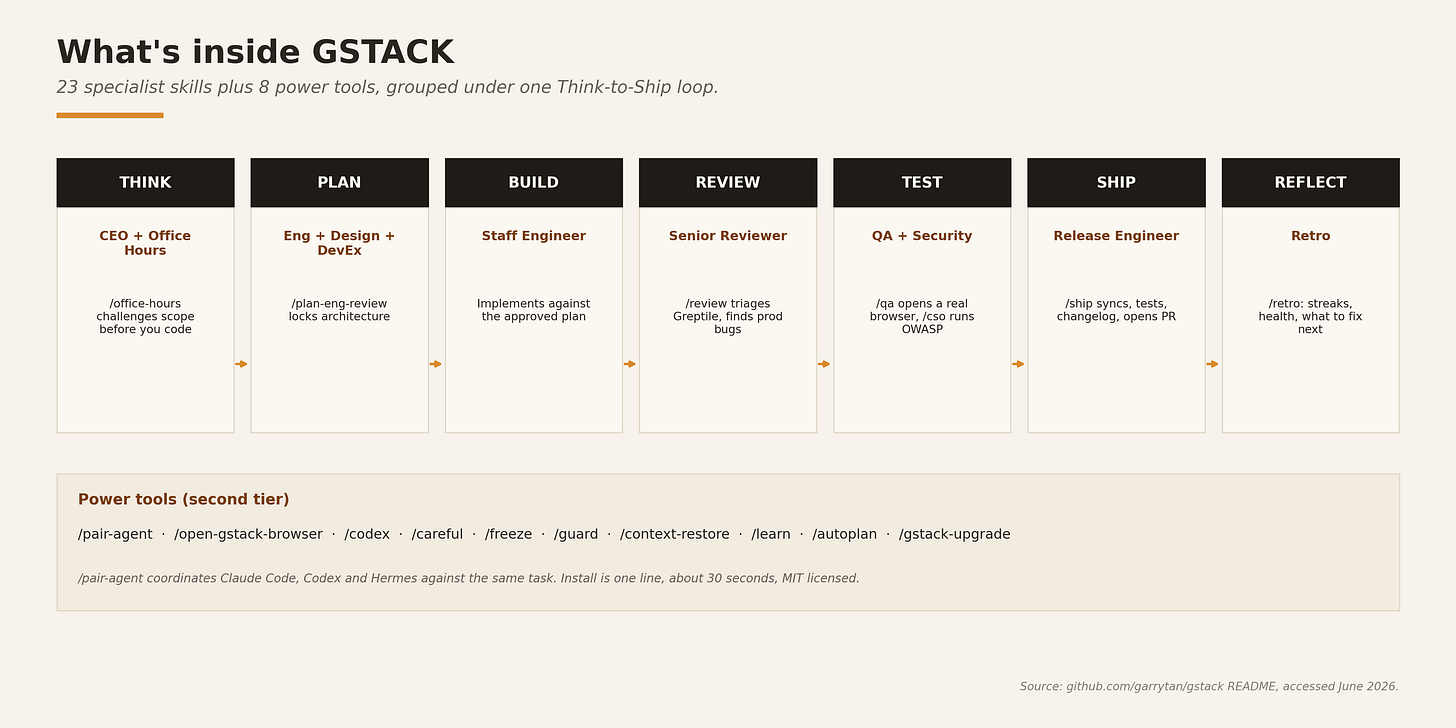
The three skills I lean on hardest:
/qa launches a real browser and clicks through your app. Full pass runs 5 to 15 minutes, a 30 second smoke test, or a regression mode.
/ship runs the whole release in one command: sync main, run the suite, update the changelog, push, open the PR.
/review triages comments from a PR reviewer like Greptile into valid, already fixed, or false positive, so a second pair of eyes never gets quietly ignored.
gstack runs entirely inside Claude Code, so the “interface” is just your terminal with these slash commands. The full command list and real output examples are in the repo README.
Real cases
Garry Tan, in production. The most cited case is the creator’s own. Tan reports running 10 to 15 gstack sprints in parallel, roughly 30 minutes per feature sprint, on real services he ships while running YC. It is self reported, and he has since walked back the raw line count, but his public GitHub graph is the receipt. Treat it as the ceiling, not your Tuesday.
The security skill caught a real bug. Tan’s launch included a story of a CTO friend whose gstack security pass flagged a genuine flaw on the first run, and the repo documents catching live issues like cross-site scripting. That is the most repeatable value in the whole pack: not raw speed, but a reviewer that catches the thing you would have shipped.
fagemx ported it to game development. A developer took the Think-to-Ship methodology and rebuilt it as gstack-game, swapping the engineering roles for an economy designer, a UX researcher, and a game-feel diagnostician. People are not just using gstack, they are forking its structure into new domains. Link
Want the wider map of Claude Code skills, plugins and swarm mode? We broke it down here: Skills, Plugins and Swarm Mode. GSTACK is the opinionated, batteries-included version of that idea.
Paperclip: management for many agents
Paperclip starts where GSTACK stops. I will admit I rolled my eyes at its pitch first.
“Open source orchestration for zero-human companies.” I run a company with humans in it and would like to keep it that way.
But strip the manifesto and what is left is the control plane I had already half built for myself with spreadsheets and cron jobs. The launch post nailed the framing in one line.
It is a Node.js server with a React dashboard and an embedded Postgres database, MIT licensed and self hosted. You bring your own agents, give them goals, and watch their work and their costs from one screen.
Under the friendly task manager surface sits the machinery you would otherwise build by hand. Org charts with reporting lines. Monthly budgets per agent with hard stops. Board style approval gates. An immutable audit log of every tool call. A heartbeat scheduler that wakes each agent on a cadence.
Their rule for what counts as an employee: “if it can receive a heartbeat, it’s hired.” As of June that covers Claude Code, Codex, Gemini, Cursor, Hermes, OpenClaw, Pi and OpenCode, plus plain bash and HTTP bots.
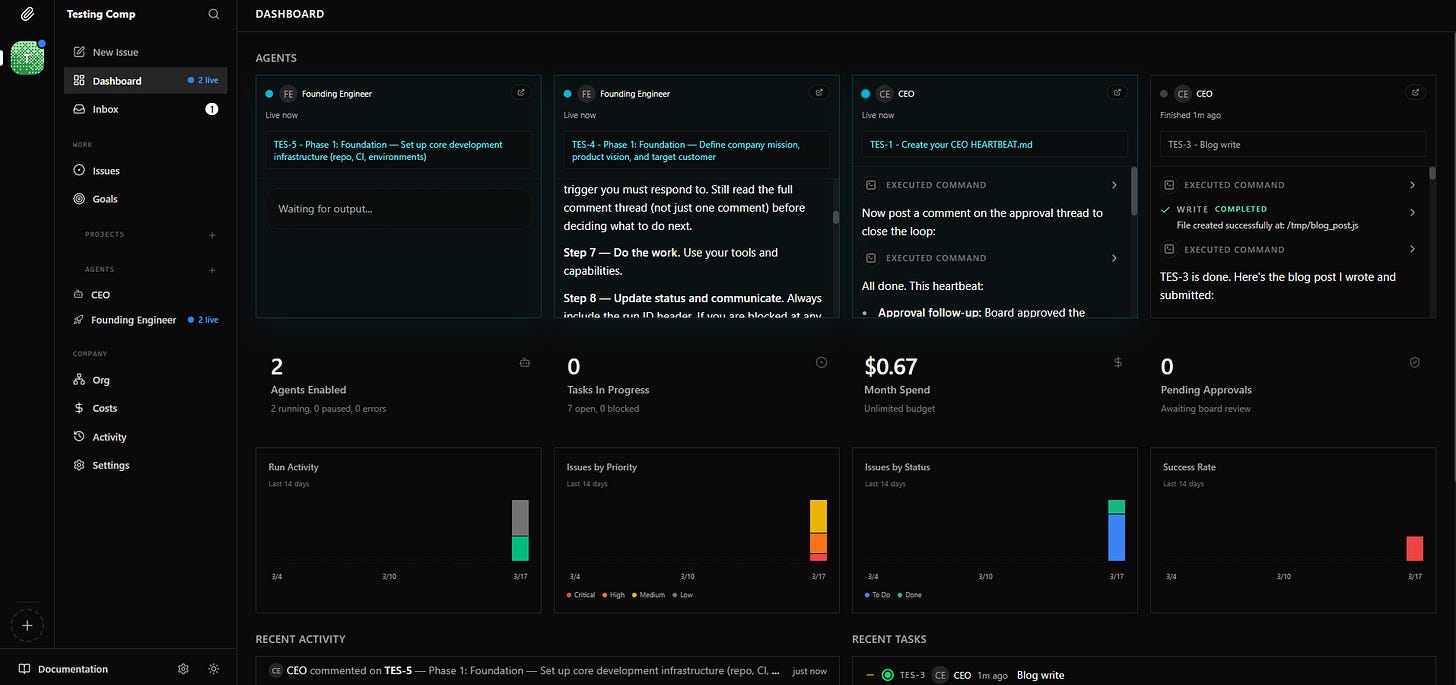
And here is the interface itself. It looks like a task manager, but every ticket traces up to a company goal, every agent has a budget that hard stops at the cap, and every action lands in an audit log.
The problem it targets that actually sold me is budgets. A runaway loop that burns hundreds in tokens before you notice is not a hypothetical for me. It has happened.
Paperclip pauses an agent the moment it crosses a line you set. Add persistent task context across reboots, cron style routines, and a gate where nothing ships without your sign off, and it stops being a manifesto and starts being infrastructure.
What is actually inside it. Paperclip is a full control plane, not a wrapper. The README breaks it into a dozen systems you would otherwise rebuild yourself.
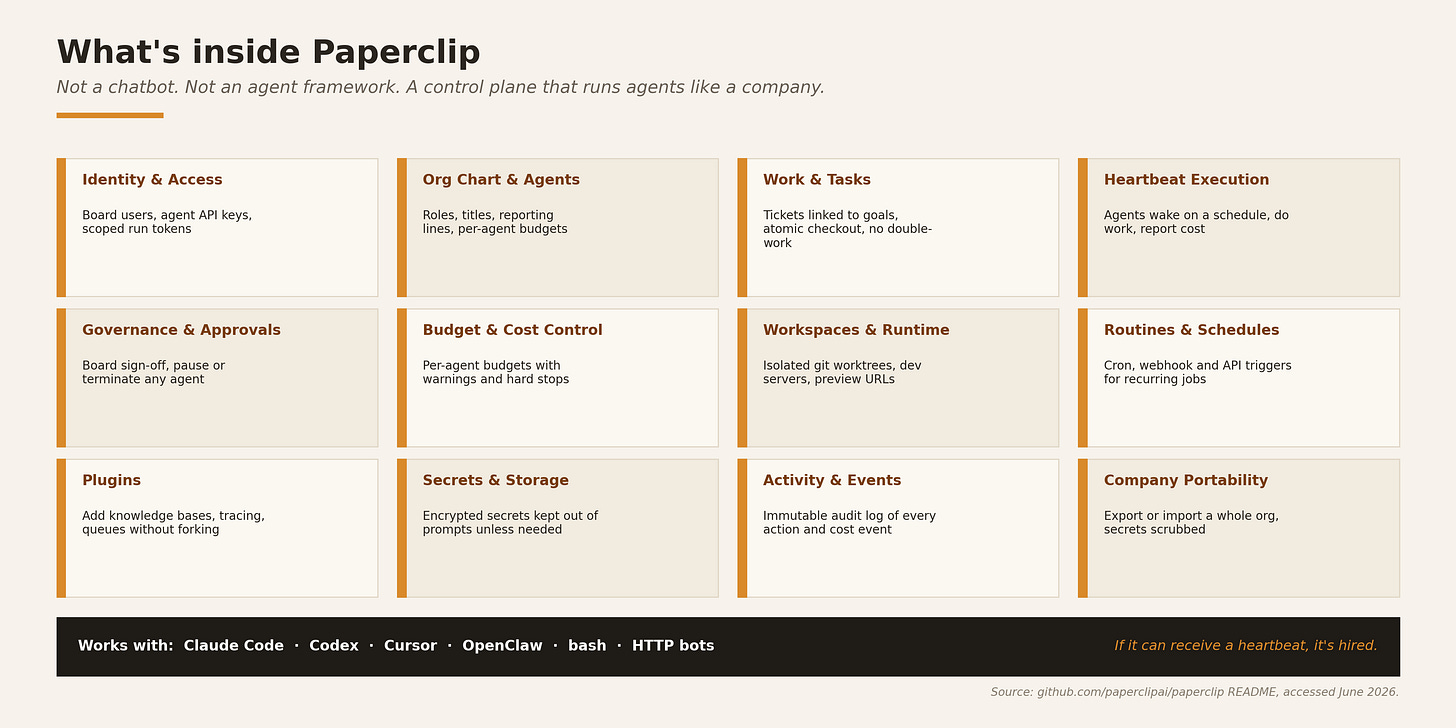
Want to see the real thing in motion rather than a still? The clearest demo is dotta walking the full dashboard live.
Watch the real demo: Paperclip: Hire AI Agents Like Employees, live demo with dotta and Greg Isenberg. Or click through the interactive tour at paperclip.ing, read the docs, or run your own at localhost:3100 with npx paperclipai onboard --yes.
My honest verdict: this is the heaviest tool here, and the weight is the point. With one agent it is pure overhead. With twenty it is the only thing between you and chaos.
Real cases
dotta built it for his own hedge fund. Paperclip exists because its creator was running an automated hedge fund and drowning in 20-plus Claude Code terminals, with no shared context, no cost tracking, and no way to recover state after a reboot. The tool is the fix he built for his own operation, which is about the most honest origin a tool can have. The name is a wink at Bostrom’s paperclip maximizer, and the governance controls are the joke’s punchline.
A nine-agent team shipped a SaaS in three days. A user on r/claude reported building a working website in three days with a nine-agent Paperclip company: the CEO agent split the spec into tickets, engineers wrote the code, QA reviewed it. Not a vendor demo, a real build posted to the community.
A local services business used it for lead gen. A roofing operator ran a Paperclip company to process satellite imagery and surface qualified leads, one of the more serious non-developer uses documented on Reddit and X. The same threads show solo founders running 8 to 14 agent companies that split engineering and growth. On his own live demo, dotta said Paperclip has pulled in users from security firms to dentists to roofing companies, while admitting in the same breath that the project has made zero revenue so far.
The rest of the field
GSTACK and Paperclip are the two that went viral, but they sit in a crowded tier. Seeing the rest helps you place yourself.
At the bottom, free and built in, is Anthropic’s own answer. Claude Agent Teams coordinate subagents inside one session. The newer Dynamic Workflows, in research preview as of June, let Claude split a task into parallel subtasks and check the results before answering.
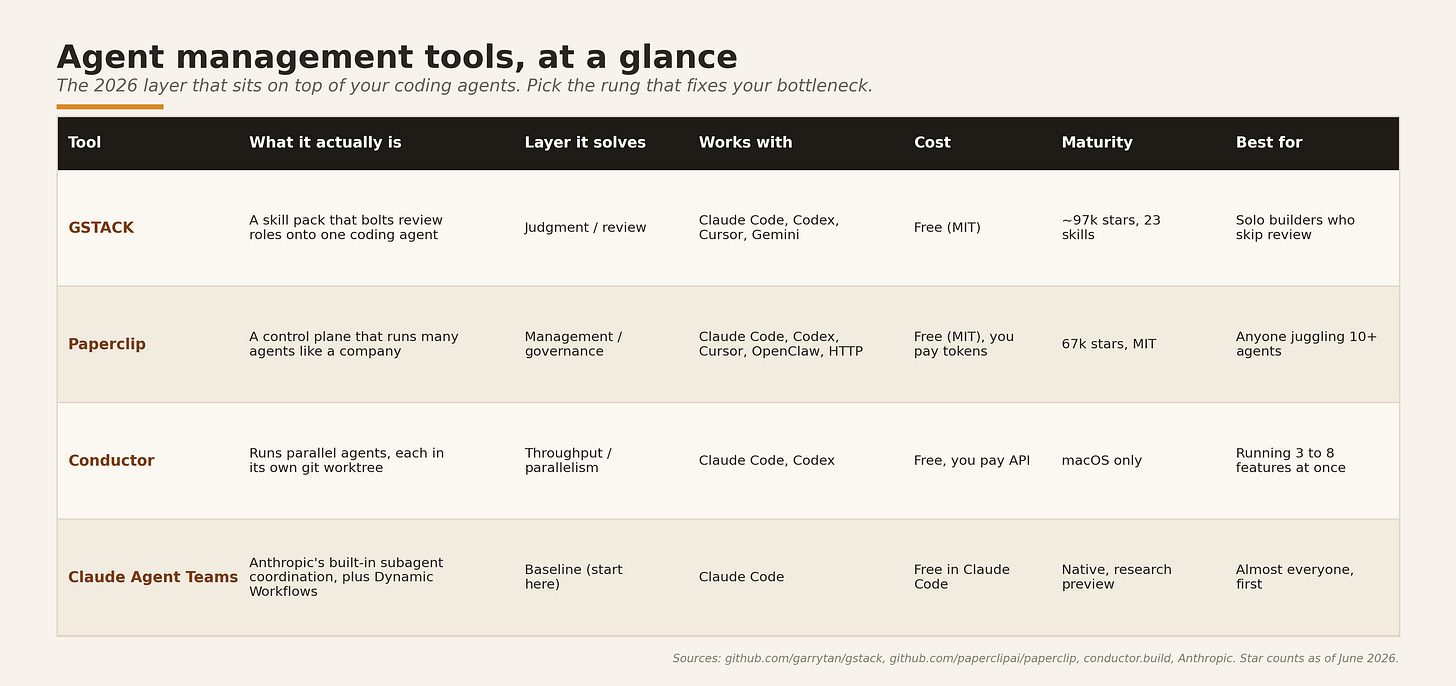
For most people this baseline is enough, and it costs nothing extra. I say that as someone who reached for heavier tools before I had earned the need.
One rung up is the throughput tier: tools that run several agents in parallel without you babysitting terminals. Conductor is the cleanest entry, free, macOS only, running Claude Code and Codex side by side in isolated git worktrees.
Steve Yegge’s Gas Town is the maximalist take, which he openly calls “Kubernetes for AI agents.” Microsoft even shipped its own Conductor for deterministic workflows.
The point is not to recommend all of them. It is to show that GSTACK, judgment, and Paperclip, management, answer a different question than the throughput tools, parallelism.
Day one: the simplest way to start, and how to check it worked
No theory here. This is the shortest path to having each tool running, plus how to know it actually did something.
GSTACK, in about two minutes
You need Claude Code already installed. That is the only prerequisite.
- Install. Paste this one line in your terminal and wait for it to finish:
git clone --single-branch --depth 1 https://github.com/garrytan/gstack.git ~/.claude/skills/gstack && cd ~/.claude/skills/gstack && ./setup- Confirm it installed. Open Claude Code in any project and type
/. If you see commands like/review,/qaand/shipin the list, you are done. - Test it works. Open a small project, make a tiny change, then type
/review. It should read your change and hand back a short list of issues.
If you get a review back, it works. That is the entire loop in one command, and it is the fastest way to feel what gstack does.
Paperclip, in about ten minutes
You need Node.js version 20 or newer, and pnpm. This one is heavier on purpose.
- Install and open. Run
npx paperclipai onboard --yes. It sets up a local database and opens a dashboard in your browser. - Create a company. Give it a name and a one line goal in the dashboard.
- Hire one agent. Connect a single agent you already use, like Claude Code, and give it one small task.
- Test it works. Trigger the agent, then watch the activity log. If you see it pick up the task, do something, and record a cost, the wiring is good.
- Test the safety net. Set a tiny budget on that agent and confirm it stops when it hits the cap.
That last step matters more than any other. The budget hard stop is the one feature you must verify before you trust Paperclip with anything real. If it stops on cue, you are safe to grow from there.
Share with someone who is into agents but not using Paperclip or Gstack
Two setups worth stealing
The basics are easy. The harder question is what to actually point these at. Here are the two setups I would build, each one already proven by real operators rather than by a launch demo.
Setup 1: a reviewer that catches what you would have shipped (GSTACK)
Forget the 10x line count claims. The part of gstack worth keeping is the review gate, and the loop is simple to run on anything that ships to users.
/office-hoursfirst. Let the CEO skill kill the scope you do not actually need before any code exists.- Build. Normal Claude Code from here.
/review. It reads the diff like a senior dev who has been burned before, and triages a PR reviewer’s comments into valid, already fixed, or false positive./qa. It opens a real browser and clicks the actual flow, not a mock./cso. An OWASP and STRIDE pass on anything touching payments or user data./ship. Opens the PR with the changelog already written.
Why I would run exactly this: the value is not speed, it is the catch. In the case that made gstack famous, its security pass flagged a real flaw on the first run, the kind of thing you ship at 11pm and find in production on Thursday. I would skip the loop for a one line copy tweak, and run all of it on anything that touches money or data.
Setup 2: a lead-gen and ops company that runs while you sleep (Paperclip)
This is the non-content use I find most convincing, because real operators are already running it. A local services business wired Paperclip to process satellite imagery and surface qualified leads. Solo founders are running 8 to 14 agent companies that split engineering and growth. Here is how that setup goes together.
- Onboard and set a goal.
npx paperclipai onboard --yes, then a company with one concrete goal, for example “surface 20 qualified leads a day.” - Hire a CEO, let it propose the org. In dotta’s own live walkthrough with Greg Isenberg, the CEO created a founding engineer and broke the roadmap into tickets within minutes. You approve the hires.
- Budgets before anything runs. Per-agent monthly caps with hard stops. This is not theoretical: one operator’s engineer agent hit $612 on a $600 cap, and Paperclip paused before the next model call.
- Routines on a heartbeat. A daily lead sweep, a nightly regression, a weekly digest. Each fires on a schedule, no manual kickoff.
- You sit at the gate. Approve hires and strategy, review deliverables, pause or terminate any agent. The audit log shows what each one did and spent.
Why I would build this and not a content farm: ops and lead-gen jobs are repetitive, measurable, and safe to run unattended behind a budget cap and an approval gate. Anything that goes out under my name still gets read by a human first.
If you are in a different seat
The same two layers map onto most AI native roles.
Product managers, the sleeper GSTACK use is /office-hours as a spec interrogator. It challenges scope before any code exists, which is cheaper than a sprint spent building the wrong thing.
Sales and growth, Paperclip heartbeat agents suit repetitive outbound: enrich, draft, schedule, log. This is exactly where the audit trail and hard budget stops matter most, because an unattended outbound loop is the last thing you want running unbounded.
Thinking about turning agent work into an actual offer? We covered the business side here: 4 Ways to Monetize AI Agents in 2026.
The honest catch
These are not multi agent breakthroughs. GSTACK is a disciplined pack of prompts, and its own creator says so by reframing his headline metric. Paperclip is plumbing and governance, not intelligence.
Half of X called GSTACK god mode and the other half called it a folder of prompts. Both are right, which is the point.
Multi agent setups do not help most work. By the count of people actually running them, parallel workflows make no sense for roughly 95 percent of agent assisted tasks. They are expensive and still experimental.
Token burn is not a footnote, it is the main operating cost. The reason Paperclip ships hard budget stops at all is that runaway loops genuinely torch quotas overnight. Mine did once. Not a story I am proud of.
The founder is the most honest critic here. On his live demo with Greg Isenberg, dotta admitted Paperclip has generated zero revenue, and that third-party agent skills still run with full filesystem and network access with no sandbox, a gap he said nobody has solved yet. If you wire one up, audit every skill before you trust it with anything real.
Bottom line
GSTACK is worth the thirty second install the week you ship something without review and regret it. Paperclip earns its keep the day you genuinely cannot track your agents or your spend, and not a day before.
Until then, the best agent management tool is still the one already built into Claude Code, plus the discipline to actually look at what your agents shipped.
I do not run a twenty agent company. I run a handful of agents with a human at the gate, and that is the setup I would bet on for most of you too.
Figure out which one rung you are standing on, and buy only that.
This article was first published in the Creators AI newsletter. View the original edition.