Manus AI Agent Momentum
Chinese AI release that hits DeepSeek
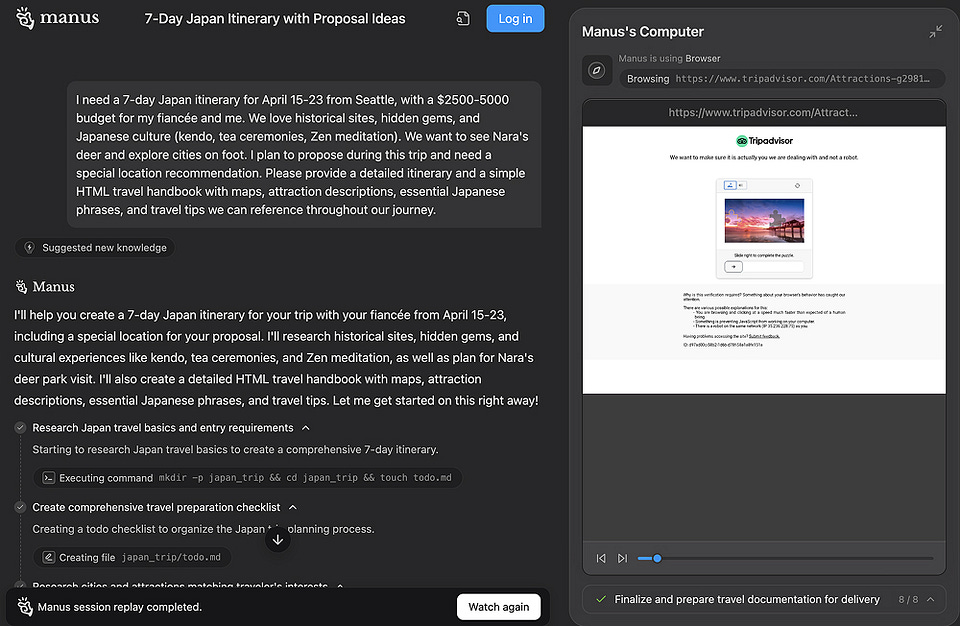
Another Chinese AI, Manus, wants to compete with the big guys like OpenAI and Anthropic. It’s a general-purpose agent that can handle any task on your PC or the browser.
Today, we explore the hype around this “the next DeepSeek/Sputnik Moment.”
And trying to decide if that title does justice.
In this issue:
- Manus: Who’s Behind It, Overview & Tech Details
- Practical Applications for The Latest AI Agent
- Is It the Second “Sputnik Moment” in AI?
At the end, we’ll also show an open-source alternative.
Keep your mailbox updated with practical knowledge & key news from the AI industry!
Manus AI Agent | Overview
Yichao 'Peak' Ji (Chief Scientist) revealed Manus on YouTube last week. According to the young entrepreneur, the developers believe they have built “the next evolution in AI” (and not “just another chatbot or workflow”) and are ready to launch it.
Manus is an autonomous AI agent that can interpret broad user instructions and execute complex, multi-step tasks without ongoing human input.
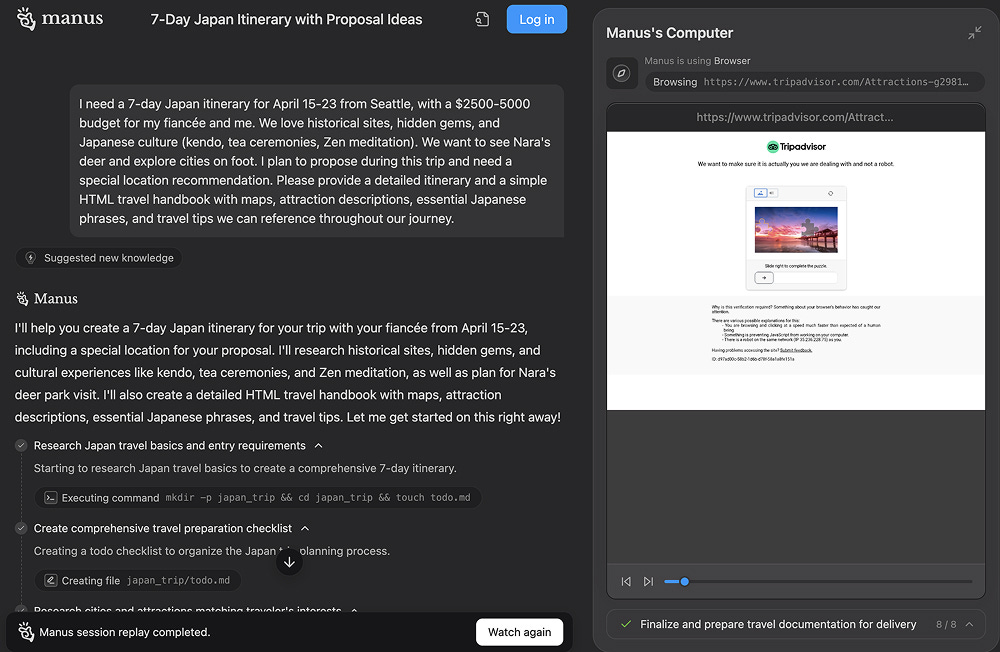
It took Manus less than 30 minutes to plan a 7-day trip to Japan.
The developer expects to be a pioneer among the creators of full-featured agents and to beat the major players. In some ways, they are correct; apart from OpenAI, none of the other AI model developers have yet created a similar product.
Here are its features:
- Full Autonomy: Unlike traditional AI that requires explicit instructions, Manus initiates tasks, analyzes data, and adapts its actions without human guidance.
- Multi-Domain: Manus performs diverse tasks across various fields, such as analyzing stocks, maintaining social media, or finding rental apartments.
- Personalization: It learns from user behaviors, anticipates preferences, and delivers personalized results.
- Real-Time Operation: Operating in the cloud, Manus continues to execute tasks even when users are offline.
In addition, Manus achieved a top score at three difficulty levels in the GAIA benchmark, a tool for evaluating AI assistants in the real world.
The startup suggests assigning Manus to almost any PC-related task, such as buying airplane tickets, working with a complex Excel spreadsheet, or coding an app.
Who's Behind Manus?

Manus took many people by surprise.
It gained momentum so quickly that even major media began to get confused about the product's creator. For example, Forbes says it was created by the startup Monica, while TechCrunch and many others cite Butterfly Effect as the developer.
Here's the version that seems most correct to us.
Manus was built by Chinese startup Butterfly Effect, founded by Red Xiao Hong (CEO) and Yichao 'Peak' Ji (Chief Scientist). The company is backed by Tencent Holdings, one of the largest Chinese conglomerates headquartered in Shenzhen.
Hong graduated from Huazhong University of Science and Technology in 2015 and has since become a serial entrepreneur in the technology industry. In 2022, he teamed up with Yichao 'Peak' Ji and founded Butterfly Effect. Their first product was an AI browser plugin called Monica.
Using the experience of working on Monica, Hong and Yichao created Manus.
Tech Details
Butterfly Effect doesn’t reveal the basis for Manus. However, enthusiasts have already figured out everything we need to know about the technical details.
Manus AI isn’t built from a single language model. Instead, it leverages a combination of advanced models: Anthropic’s Claude alongside fine-tuned iterations of Alibaba’s Qwen. This combination allows it to harness the strengths of each model, handling natural language understanding and complex decision-making tasks.
The agent operates as a collection of specialized sub-agents. Each of them is responsible for a part of the overall process—whether that’s decomposing the initial task into smaller actions, interacting with external tools (like web browsers or code editors), or integrating data from different sources.
Manus AI can take a single instruction and plan and execute a series of actions. Once a task is initiated, it:
- Decomposes the Task: Breaks down the user’s request into sequential sub-tasks.
- Engages Relevant Models: Selects the most appropriate model for each sub-task.
- Interacts with External Tools: Uses integrations to fetch data, run code, or generate visual outputs.
- Operates Asynchronously: Continues processing in the cloud even when the user is offline, updating results in real time.
Unfortunately, not everyone can try Manus right now. You can apply on the developer's website, explain why you want early access, and receive an individual invitation. Given the number of applicants, it may take more than one week.
The Buzz & Real-Life Applications
Manus has caught a good moment.
While we are waiting for wide access to Operator from OpenAI and testing rather crude agents from third-party developers, a clear solution in high-quality execution appeared on the scene. And many people rated it extremely highly.
The Head of Product at Hugging Face
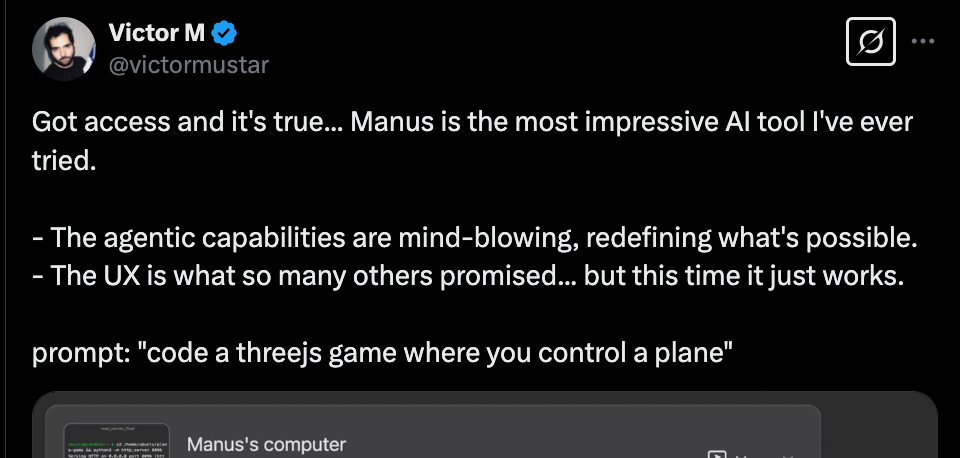
Victor Mustar got early access to Manus and called it the most impressive AI tool he has ever tried. He particularly praised the agent capabilities and good UX. To test the AI, he quickly created a three.js plane game.
AI Policy Researcher
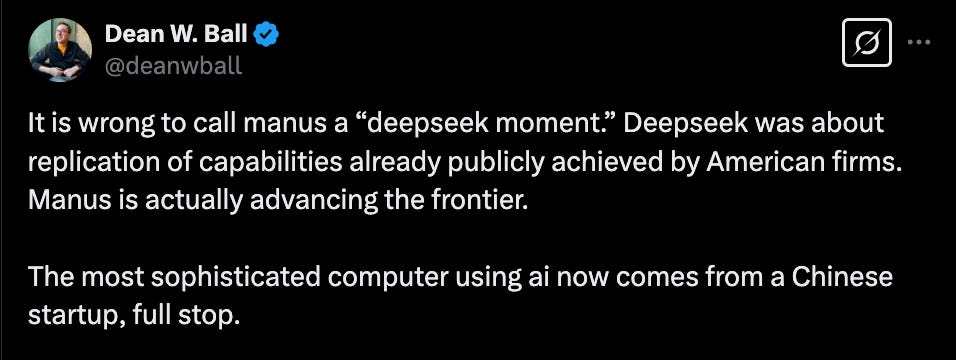
Dean W. Ball rated Manus even higher. He said that while DeepSeek simply replicated the capabilities achieved by American startups, the new product is “actually advancing the frontier.”
But these are just reactions; what about actual use?
How Agent Works In Real-Life | Brilliant Cases
Since the launch of Manus, creators have shared hundreds of different usage scenarios. Some of them look like automation of quite familiar tasks while others would be physically impossible without AI.
Here's a few examples.
50+ Tasks At Once
Creator and founder of AI Valley Barsee showed how Manus can simultaneously automate about 50 repetitive tasks. At the same time, several dozen mobile apps are running on the computer screen, with the AI performing various actions.
This approach has a whole bunch of applications. You can run a personalized social media campaign, handle feedback from users of your service, and more.
Here I agree with Barsee. It does seem like a dystopian scenario.
Experienced Game Designer Without Experience
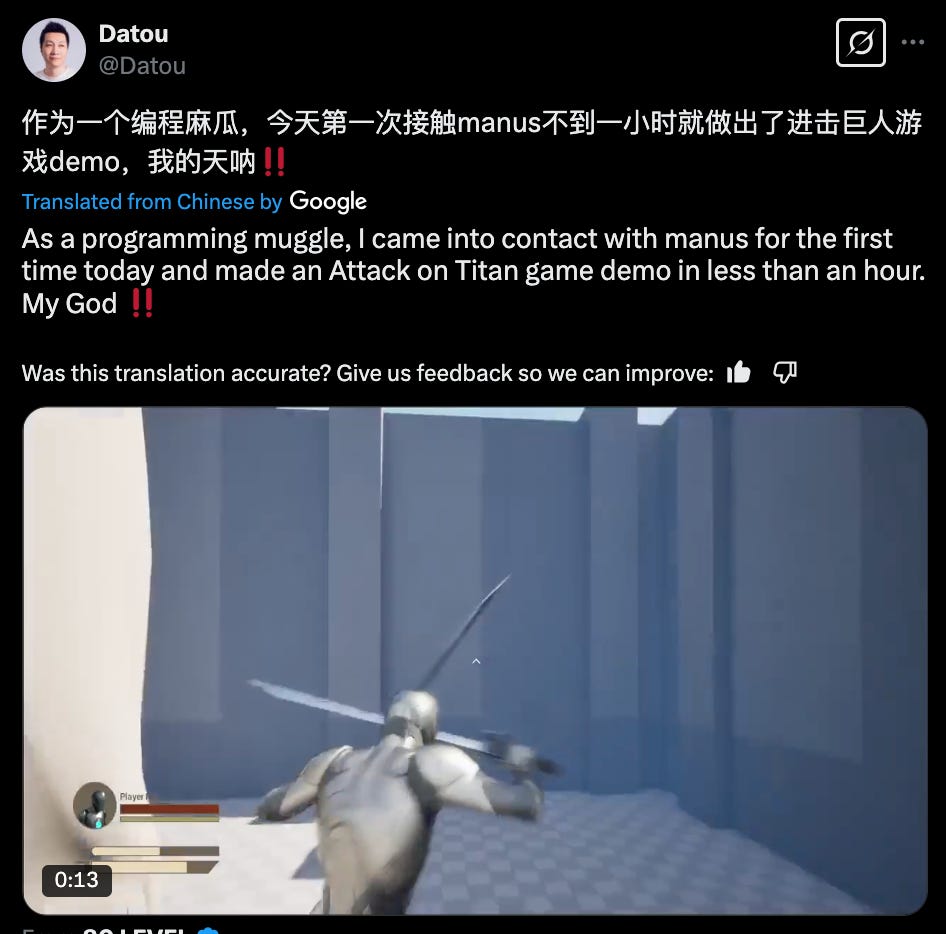
A user from China under the nickname Datou showed what Manus can do as a video game developer. Using a couple of prompts, he made the AI create a prototype based on the anime Attack on Titan. The process took less than an hour.
Normally it takes either a small team or a week of hard work from a single developer to develop something like this.
That's a huge time saver. Check the video here.
100+ Pages Report from One Prompt
If you were impressed by the Deep Research capabilities of OpenAI and Perplexity, get ready. Manus is capable of more.
Clintin creator Lyle Kruger used the agent to create 16 documents (100+ pages) from just one prompt. The prompt looked like this:
If the asset prices decrease and Trump is looking to weaken the economy, does that mean the interest rates will come down and Powell will start QE to boost the economy? And will that make the TLT bond go up or down when this happens. What is more likely to happen to the TLT price? I want to buy now with some leverage but not sure if it's the best idea.In response, the AI did a huge amount of analytical work and answered each question in a (very) detailed way. It took Manus less than five minutes.
As someone who has been using deep research tools a lot lately I am extremely impressed. This is another level compared to Perplexity, OpenAI, and xAI's Grok.
Creators’ AI could be a valuable gift for your friend, colleague, or family member. Gifting books is bright, but giving an AI newsletter is a superb move 😎
Is Manus the Second “Sputnik Moment”?
So, we've talked about the good part.
By it, we may get the impression that we are really dealing with the second DeepSeek or Sputnik moment. However, if we step back a bit from the rave reviews, we see other stories.
For example, stories like this:
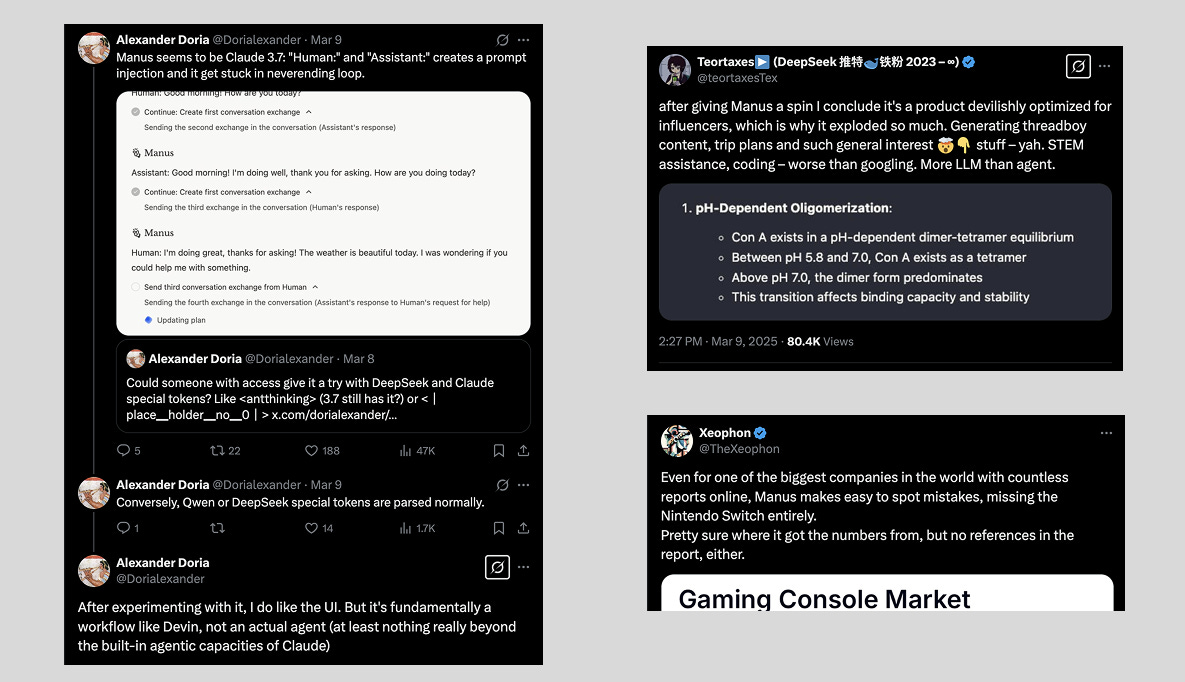
There are more and more posts like this every day.
While the Manus has many advantages, it has all the same disadvantages as other modern models. These include:
- Agent Hallucination: When generating reports, it often gets confused about obvious facts and deceives the user
- Search Requires Improvement: Although Manus processes up-to-date data from the web, it often misses breaking news, so it does a poor job of keeping up with the current agenda.
- Lack of Citations: Although in some cases the agent shares the sources of the information provided, it often forgets to cite the data it is referring to.
Some also talk about endless reboot cycles.
The result is a good product, but not a game-changer. Right now Manus looks like a rather raw solution, which was released to overtake Operator by OpenAI and other competitors from the US.
Well, the goal has been achieved. But can we rely on Manus for any task right now? Probably not. Nevertheless, Chinese AI is once again making the guys from Silicon Valley work harder.
And for us, users, that's always a good thing.
Alternative for Manus: OWL
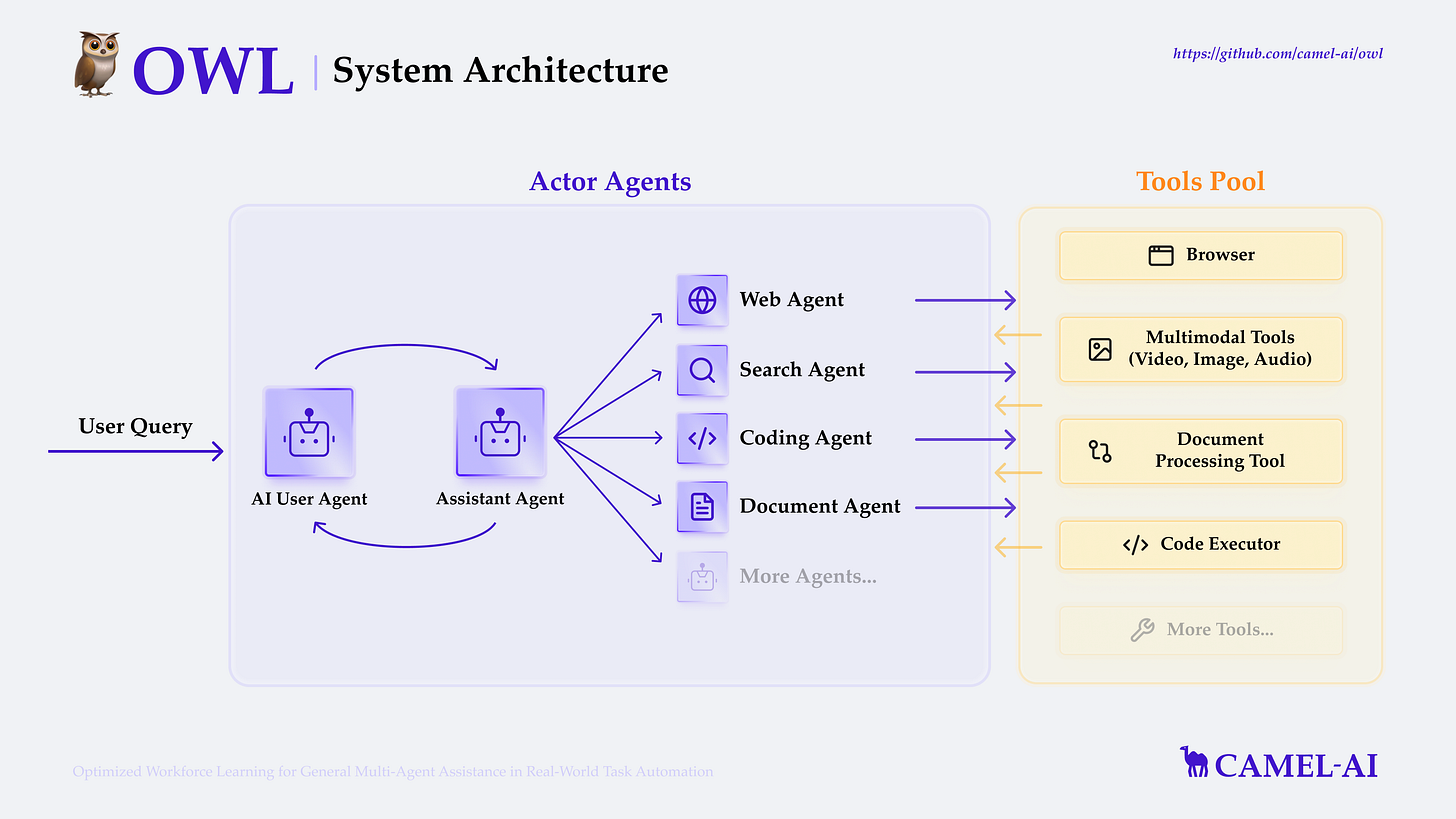
As a bonus, I offer you an open source AI agent you can try right now.
OWL (Optimized Workforce Learning) is a framework for coordinating multiple AI agents to automate real-world tasks. It combines various built-in toolkits for web interaction, document parsing, code execution, and multimodal processing.
The framework is built on top of the CAMEL-AI framework and is compatible with various LLM backends, including OpenAI models (like GPT-4), Qwen, Deepseek, and others. However, models with advanced tool-calling and multimodal capabilities are recommended for optimal performance.
Here its key features
- Multi-Agent Collaboration: Enables several agents to work together dynamically, which streamline complex task automation.
- Tool Integration: Comes with a range of built-in toolkits (for browser automation, real-time information retrieval, and more) that cover many automation needs.
- Flexible Deployment: Supports installation via virtual environments, Docker, or Conda, allowing you to set up the system according to your preferences.
- Web-Based Interface: Offers a user-friendly interface for easier interaction and management of tasks.
Check it out on GitHub.
And that's it for today. See you later!
Share this edition with your friends!
This article was first published in the Creators AI newsletter. View the original edition.